





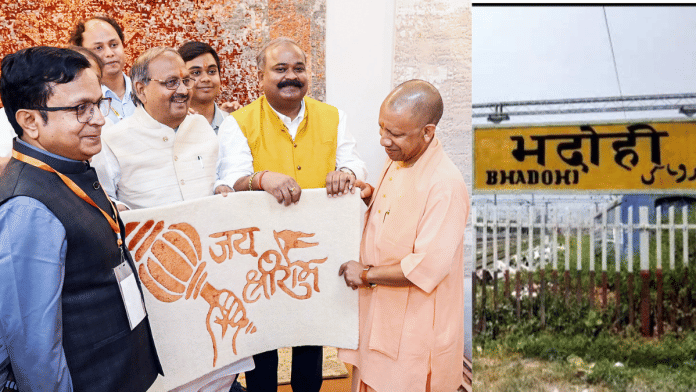


Lucknow: Uttar Pradesh’s Bhadohi district is set to be renamed again—the fourth name change for the district since it was carved out of Varanasi in 1994. Chief Minister Yogi Adityanath has announced that Bhadohi will once again be called Sant Ravidas Nagar.
The announcement has already triggered a political debate in Uttar Pradesh. While BSP chief Mayawati has thanked the Yogi Adityanath government for restoring the name associated with Sant Ravidas, the Samajwadi Party has accused the BJP of focusing on changing names instead of addressing development issues.
The move also comes ahead of the 2027 Uttar Pradesh Assembly elections, giving the renaming a political dimension. The BJP expects to woo Dalit voters by restoring the name after Sant Ravidas, a revered figure among large sections of the Dalit community.
Sant Ravidas, the 15th-century poet and saint, was born in Varanasi. His association with the region gives the name particular cultural and political significance in eastern UP.
From Bhadohi to Sant Ravidas Nagar and back
Bhadohi was carved out of Varanasi district in 1994 by the then Mulayam Singh Yadav government, fulfilling a long-standing demand for a separate district in the region.
The demand for a separate district had been raised for years, with former Union minister Pandit Shyamdhar Mishra and Jana Sangh leader Murlidhar Pandey among those who led a prolonged movement during the late 1980s and early 1990s.
The creation of the district was initially welcomed by residents. But within a few years, the district itself became embroiled in a political and administrative controversy over its name.
On 4 December 1997, the then Mayawati government removed the name Bhadohi and renamed the district Sant Ravidas Nagar. At the same time, Barasathi tehsil, which had been transferred from Jaunpur to Bhadohi, was returned to Jaunpur.
1. जैसाकि मीडिया की ख़बरों से सर्वविदित है कि यूपी की वर्तमान सरकार ने, बी.एस.पी. सरकार द्वारा भदोही को राज्य मुख्यालय का दर्जा देते हुये संत रविदास नगर के नाम से नया ज़िला बनाया था और जिसे समाजवादी पार्टी (सपा) की सरकार ने अपनी संकीर्ण जातिवादी मानसिकता के तहत् बदल दिया था, इसे…
— Mayawati (@Mayawati) July 31, 2026
The change triggered another agitation in the district, with sections of residents demanding the restoration of the name Bhadohi. Many localites claimed that during the medieval period, the region was ruled by the Bhar dynasty. It is believed that the area was called Bhardohi in honour of the Bhar rulers, which later evolved into Bhadohi.
When the BJP returned to power in Uttar Pradesh, then Chief Minister Ram Prakash Gupta issued an order on 12 November 1999 adding Bhadohi to the official name, resulting in Sant Ravidas Nagar-Bhadohi.
The name changed again under the Akhilesh Yadav government. On 6 December 2014, the district was officially changed back to Bhadohi.
The latest change was announced on 29 July 2026, when the Yogi Adityanath government said the district would again be known as Sant Ravidas Nagar. This will make it the fourth major change in the district’s name since its creation.
Adityanath announced the renaming while addressing a programme in Varanasi, where he attacked the Samajwadi Party over its 2014 decision to restore the name Bhadohi.
The chief minister said the SP government had committed a sin by removing Sant Ravidas’s name from the district and announced that his government would restore its identity as Sant Ravidas Nagar.
BJP’s Dalit outreach
Political observers believe that Sant Ravidas is revered among Dalit communities, particularly the Jatav and Ravidas communities in parts of northern India. His religious and social legacy has also made his name an important symbol in Dalit politics.
The BJP is continuously trying to expand its outreach among Dalit voters in UP, particularly ahead of the 2027 Assembly elections. Now, restoring the name to Sant Ravidas Nagar could allow the party to project itself as a party that respects the legacy of one of the most influential figures associated with Dalit social and religious history.
The move fits into a broader pattern under the Yogi Adityanath government of renaming the places associated with the Mughal or colonial period, or restoring names carrying religious and historical significance.
In 2018, the state government changed the name of Faizabad district to Ayodhya and Allahabad district to Prayagraj
However, there is no consolidated publicly available figure from the Uttar Pradesh government on how much has been spent on changing names of districts and other administrative units, including alterations to government records, signboards, stationery and digital databases.
How does a district’s name get changed
A senior Uttar Pradesh government official told ThePrint the process begins with a proposal from the district administration, which is sent to the state government.
Once the proposal receives approval at the government level, the Revenue Department issues a formal notification. Copies of the notification are then circulated among departments concerned with the district so that official records can be modified.
The changes have to be reflected across government documentation, from district-level records to documents maintained by panchayats and urban local bodies.
The official said that the renaming of a district does not automatically change the names of other institutions located within it.
For instance, a district-name notification by itself does not change the name of a railway station, university or other independent institution. Those entities have their own naming procedures.
The official said that information regarding changes in administrative areas is also communicated to the Union government.
Under Section 6(2) of the Uttar Pradesh Revenue Code, 2006, the state government has the power, by notification, to name or alter the name of a revenue area, which includes a district.
The process is, therefore, primarily an exercise under the state’s revenue and administrative framework, although changes in official records and the names of institutions or entities under the Union government require separate action.
Bhadohi District Magistrate Shailesh Kumar said the administrative paperwork for implementing the new name would be completed soon.
He said there should not be any major difficulty because Sant Ravidas Nagar had previously been the district’s official name. With government records increasingly digitised, the process of updating documents and databases is also easier than it was when the name was changed in the late 1990s and again in 2014, he said.
Mayawati welcomes the move
BSP chief Mayawati welcomed the decision, but used the occasion to remind voters that it was her government that had originally named the district after Sant Ravidas.
In a post on X, Mayawati said the BSP government had created Bhadohi as a new district and named it Sant Ravidas Nagar. She alleged that the subsequent Samajwadi Party government changed the name because of its “narrow casteist mindset”.
Mayawati said the BSP was grateful to the present state government for restoring Sant Ravidas Nagar as the district’s name.
She also highlighted the BSP’s record of creating new districts, tehsils, development blocks, police zones and ranges during its four terms in government, saying several of these administrative units were named after prominent saints, gurus and social figures from Dalit and OBC communities.
On the other hand, SP spokesperson Manoj Kaka criticised the BJP government by saying that this government is always more interested in changing names than improving the lives of people.
”The BJP government’s focus is only on names, not work,” he said, arguing that the government should explain what it had done for Bhadohi’s development instead of repeatedly highlighting name changes.
(Edited by Ajeet Tiwari)
Also Read: Upper cut: What’s behind Yogi govt’s decision to rename UP’s Jalalabad as Parshuram Puri