





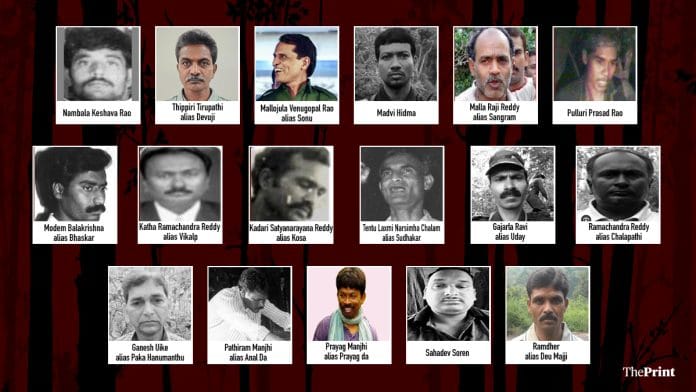



New Delhi: More than 20 senior Maoist leaders were active when Union Home Minister Amit Shah set a March 2026 deadline to eradicate Left Wing Extremism (LWE) from the country. That number has been whittled down to just one now: Jharkhand-based Misir Besra.
Under the carrot-and-stick policy adopted by the police and security forces across all Naxalism-affected states, all others have surrendered arms or been killed. The other remaining member of the top decision-making Maoist body, the central committee and Politburo, Muppala Lakshman Rao, or Ganapathy, has fallen off the radar of both intelligence agencies and his comrades. “Considering his health and age, he is surely in some urban areas where his medical necessities have been taken care of. He is definitely not in the jungle, which is his status for so many years,” an intelligence source told ThePrint.
On the other hand, another senior officer operating in the LWE sector said: “Ganapathy has fallen off the radar since September 2024. There were a few intelligence inputs about him moving to Nepal and subsequently to the Philippines.” Another conceded: “There is no confirmed information, though.”
As the 31 March 2026 deadline arrives, ThePrint takes a look at the state of the Communist Party of India (Maoist), its senior leadership, and its cadres, especially after Home Minister Shah’s deadline.
Nambala Keshava Rao (67)
Known by his alias Basavaraju, Nambala Keshava Rao was the general secretary of the Maoist outfit when he was killed in an encounter with security forces in Abujmarh by the Chhattisgarh Police and the District Reserve Guard. After his killing in May last year, the organisation of the outfit went into a downward spiral, with assembly line surrenders and killings of other senior leaders.
Born in the Srikakulam district of Andhra Pradesh, Rao served as head of the Central Military Commission before his elevation to the Politburo. He was also credited with strengthening the People’s Liberation Guerrilla Army (PLGA), the armed wing of the CPI (Maoist), formed in 2000 after the merger of several splinter groups. He was a member of both the Central Committee and the Politburo.
Thippiri Tirupathi alias Devuji (62)
Having developed an affinity for Communism during his college days, Tirupathi, who became famous by the name, joined the precursor to the Maoist outfit, the People’s War Group (PWG), in 1982. He was appointed commander of the first battalion by the PWG after the formation of the Dandakaranya Special Zonal Committee (DKSZC) in 1995. He was appointed secretary of the Central Military Commission, the top military wing of the Maoist outfit, a post previously held by Basavaraju before his elevation to general secretary. Devuji, surrendered before the Telangana Police last month.
Mallojula Venugopal Rao alias Sonu (60)
Venugopal Rao, the younger brother of former central committee member Kishenji who was killed in an encounter in 2011, came a long way from being appointed spokesperson of the outfit in 2010 to politburo member now. He surrendered to the Maharashtra Police in Gadchiroli last October. A resident of Karimnagar district, Rao was the head of the political wing of the banned outfit who had given a clarion call of surrender to all Maoist cadres across the country. He was a member of the Politburo.
Madvi Hidma (51)
Born in the village of Puvarti in Chhattisgarh’s Sukma district, Madvi Hidma was the most dreaded and infamous commander of the PLGA’s first battalion. Having joined the Maoists in the 1990s, Hidma first rose to prominence for laying an ambush for CRPF troops in the Tadmetla area of Bijapur which resulted in the deaths of 76 paramilitary personnel.
Hidma was widely regarded as the commander-in-chief of the CPI (Maoist), having allegedly planned all major attacks on security forces. He is also seen as the most potent threat to law enforcement agencies. Hidma was killed in an encounter by the Andhra Pradesh Greyhounds in November last year.
Malla Raji Reddy alias Sangram
Known to be one of the longest-surviving members of the banned outfit, Sangram was sent to the Dandkaranya region in April 1984 on the orders of Muppala Laxman Rao alias Ganapathy. He was instrumental in forming the guerrilla army under the banner of the PLGA and in establishing the DSKZC as the Maoists’ base. He surrendered before the Telangana Police last month along with Devuji.
Pulluri Prasad Rao
Weeks after Sonu’s surrender, Rao, also known as Chandranna, surrendered in October last year. He was considered a key man in logistics for the Maoist outfit, and central committee members spread across different regions.
Modem Balakrishna alias Bhaskar
Originally from Telangana’s Warangal district, Bala Krishna joined the banned outfit in 1983 and rose through the ranks to become secretary of the Odisha state committee. He also served as secretary of the Andhra Odisha Border Special Zonal Committee (AOBSZC), a position previously held by another central committee member, Chalapathi. He was killed by the Chhattisgarh Police in the Gariaband district in September last year.
Katha Ramachandra Reddy, alias Vikalp
Vikalp was the secretary and spokesperson of the Maoists’ strongest formation, the Dandakaranya special zonal committee (DKSZC). The other member killed, Kosa, is believed to have been in charge of the north sub-zonal bureau in the same special zone, known as a Maoist fortress for decades. He was killed by the Chhattisgarh Police in an encounter in Narayanpur in the same month of September last year.
Kadari Satyanarayana Reddy, alias Kosa
Kosa was one of the senior leaders active in the Dandkaranya region, having been drawn to Maoist ideology from an early age. He had got involved in a brawl at an institute in Peddapalli district and left the mainstream to avoid police action. He was killed in the same encounter along with Vikap in Narayanpur in September last year.
Tentu Laxmi Narsimha Chalam, alias Sudhakar
On 11 October 2004, Sudhakar emerged from the Nallamala forest with two other leaders of the banned Communist Party of India (Maoist) and two cadres of CPI (Marxist-Leninist)-Janashakti, and addressed a public meeting at Guttikonda Bilam in then-undivided Andhra Pradesh. He joined the People’s War Group in 1995. Between 2001 and 2003, he worked extensively for the outfit as secretary of the Andhra-Odisha Border Special Zonal Committee. In the same capacity, he attended the peace talks with the Andhra Pradesh government.
He was killed in an encounter with Chhattisgarh Police in Bijapur in June last year.
Gajarla Ravi alias Uday
Belonging to the Karimnagar district of Telangana, Uday was deemed the seniormost Maoist leader in the Andhra Pradesh-Odisha border areas. He was also accused of hatching an assassination plot against Chief Minister N. Chandrababu Naidu in 2003. He was killed in an encounter in Andhra Pradesh’s Alluri Sitharama Raju district in June last year.
Ramachandra Reddy alias Chalapathi
Marked with a bounty of Rs 1 crore, Chalapathi was a member of the Central Committee, the top decision-making body of the Maoists, heading the Odisha state committee of the banned outfit. Known for carrying out meticulously planned attacks, he came into the reckoning by blowing up a police station in Visakhapatnam as well as the police headquarters at Odisha’s Koraput district in 2003.
He was the first senior Maoist leader killed since 2025 after the declaration of the March 2026 deadline by Amit Shah.
Ganesh Uike alias Paka Hanumanthu
He joined the People’s War Group in 1995. Between 2001 and 2003, he worked extensively for the outfit as secretary of the Andhra-Odisha Border Special Zonal Committee. In the same capacity, he attended the peace talks with the Andhra Pradesh government. He was killed in an encounter with Odisha Police in December last year.
Pathiram Manjhi alias Anal Da
From a poor tribal family from Jharha village in Jharkhand’s Giridih, Manjhi had a slow and steady rise to the central committee in 2017. Along the way, he carried out over 100 attacks, including some of the worst attacks on the state’s security and administrative apparatus.
He first entered police records in 2005, when he organised a loot of weapons, including 183 rifles and 2,000 live cartridges from the Home Guards’ armoury in his home district of Giridih. He was killed in an encounter with Jharkhand Police in West Singhbhum.
Prayag Majhi alias Prayag da
Jharkhand Police recall that Prayag da was the “biggest” Maoist commander in the state and “successor” to Communist Party of India (Maoist) politburo member Prashant Bose alias Kishan da, arrested in November 2021.
It was in the Lugu hills of the Lalpania area in Bokaro district that Prayag da, also known as Vivek, along with two other top Maoist leaders and five others, died in an exchange of fire with a joint team of the CRPF Commando Battalion for Resolute Action (CoBRA) and the Jharkhand Jaguars in April last year.
Sahadev Soren
Although there are conflicting accounts of his rank among the senior Moaist leaders, the Jharkhand Police maintain that Soren was a recently inducted member of the central committee. He was freed from the grips of the Police in Giridih in November 2012, after a group of Maoist cadres laid an ambush for a prison van carrying a dozen of their own returning after a court hearing. He was killed in an encounter in September last year.
Ramdher alias Deu Majji
A member of the central committee, in charge of the Maharashtra-Madhya Pradesh-Chhattisgarh zone of the outfit, Ramdher surrendered before the Chhattisgarh Police in Khairagarh last December. Randher had to seek refuge in Chhattisgarh because Madhya Pradesh’s Hawk Force started unprecedented operations towards the end of the last year, in the wake of an inspector losing his life in the encounter.
(Edited by Nardeep Singh Dahiya)
Also Read: On eve of deadline to Maoists, Amit Shah says Maoism led to poverty & injustice, not other way round