





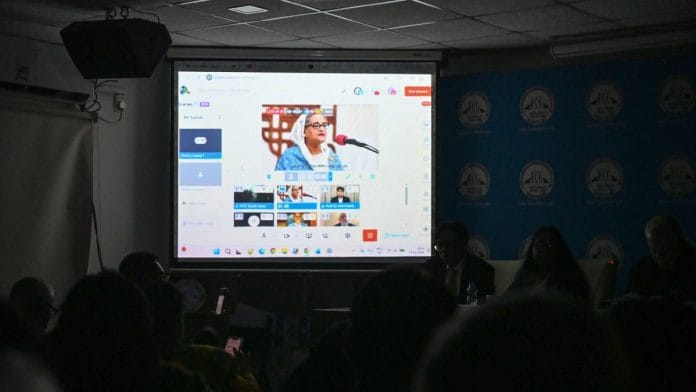


New Delhi: Hours after former prime minister Sheikh Hasina’s maiden virtual press interaction from New Delhi Wednesday, Bangladesh’s government sharply criticised India for allowing her to do so, calling it “deeply hurtful to people’s sentiment and detrimental to the development of harmonious bilateral relations between Bangladesh and India”.
In a statement issued on the second anniversary of what Dhaka calls the July Revolution, the nation’s Ministry of Foreign Affairs said it was “outraged” that Hasina, whom the government described as an “absconding convicted genocider”, had been permitted to address the media from Indian soil.
“Bangladesh is outraged that the absconding convicted genocider Sheikh Hasina was allowed this evening to engage in live interaction with the media in New Delhi where she and her henchmen launched venomous vitriol against the State of Bangladesh and her people,” the statement read.
The government said it had previously conveyed its concerns to New Delhi about the event and warned it could jeopardise efforts to reset relations between the two countries.
“Dhaka deeply regrets that in spite of concerns conveyed a priori to the Government of India about the likely ramifications of this event on the reset of our bilateral relations, this public event was permitted to be held,” the statement said.
It also renewed Bangladesh’s call for India to extradite Hasina under the bilateral extradition treaty signed in 2013.
“Regrettably, Bangladesh’s repeated requests to the Government of India for returning convicted criminal Hasina to Bangladesh under the Extradition Treaty signed between Bangladesh and India in 2013, has not yet elicited a response,” the statement said.
“On the contrary, allowing her the opportunity to openly interact with the media under any pretext is deeply hurtful to our people’s sentiment and detrimental to the development of harmonious bilateral relations between Bangladesh and India.”
The Indian Ministry of External Affairs had Tuesday clarified that Hasina’s press interaction in the national capital had “no involvement of the Indian government”.
“The interaction is being organised by a private media entity. The government has no involvement whatsoever in it. Neither does it endorse any views that may be expressed at the forum,” the ministry said at a regular press briefing.
Earlier on 23 January, a week before Bangladesh went to the polls, Hasina had given a virtual speech in Delhi calling then interim leader Muhammad Yunus “a murderous fascist” and asking Bangladeshis to boycott the election. She had, however, not interacted with the press then.
‘Hasina will never have place in Bangladesh polity’
The government stated that “on a day when the people of Bangladesh are observing the second anniversary of the July Revolution, this interaction by Sheikh Hasina on Indian soil stands as an affront to the sovereignty of Bangladesh and a grievous insult to the martyrs of the July Revolution”.
The Bangladesh government also rejected remarks made by the former PM during the event, accusing her of denying internationally documented abuses committed during the unrest of July and August 2024.
“The denial of facts established by the United Nations, including gruesome killing of innocent civilians including minor children during July-August 2024 by the fascist regime, stands as a futile attempt by the absconding convicted mass murderer Hasina and her criminal cohort to reverse the tide of history,” the statement said, adding that “the people of Bangladesh had already rejected such heinous attempts in the past and continue to do so now”.
Reaffirming the political changes that followed the uprising, the Bangladesh government said the country had turned decisively away from authoritarianism.
“Upholding the spirit of the July Revolution, our people have firmly resolved that our nation will never again go back to the dark days of fascism and that Bangladesh will never be a client State,” the statement said. “Convicted mass murderer Hasina and her mafia enterprise will never have a place in the polity of Bangladesh.”
Despite its criticism, Dhaka said it remained committed to maintaining stable ties with India, emphasising that future relations should be based on “sovereign equality, mutual respect, non-interference in each other’s internal affairs, and national dignity”.
Hasina Wednesday made her first public address at a press conference since she was ousted from power on 5 August, 2024, after a student-led protest. In her maiden press conference, she declared that she intends to return to Bangladesh despite the risk of imprisonment or death.
Speaking by audio link to journalists gathered at the Foreign Correspondents’ Club of South Asia in New Delhi, Hasina also accused Bangladesh’s BNP-led leadership of dismantling democratic institutions, suppressing political opponents and reversing the country’s economic progress.
“I want to return because the people deserve security, development, prosperity, and peace. They deserve a state that protects them, an economy that gives them opportunities, and a democracy that gives them rights,” she said.
“My return… is not about power,” she added. “It is about putting Bangladesh back on the right track.”
(Edited by Nida Fatima Siddiqui)