





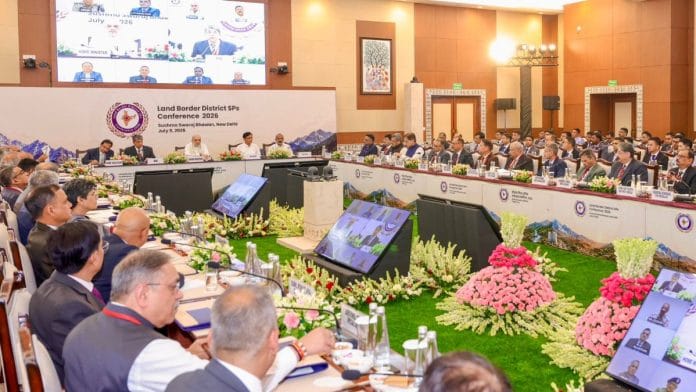


New Delhi: Cyber crime, arms smuggling, narcotics and comprehensive border security were among the key issues discussed at a conference of border district police chiefs as the government steps up efforts to tighten border security amid concerns about rising cross-border crime.
Addressing the Land Border Districts’ Superintendents of Police Conference 2026, Home Minister Amit Shah said that the conference had given “institutional shape to the comprehensive approach towards border security” and India would soon move forward “holistically to ensure coastal border security”.
Union Ministers of State for Home Affairs, Nityanand Rai and Bandi Sanjay Kumar, Union Home Secretary, Director of the Intelligence Bureau (IB), Directors General of Police of the border states, and several senior officials addressed several key border district security issues.
Key border issues
A senior police officer, whose jurisdiction covers the border areas of Rajasthan, said that security in that region is centred around the India-Pakistan border.
“The meeting addressed the need and enforcement of a comprehensive border security throughout the periphery. Illegal encroachment around the Indo-Pak periphery is being looked at,” he said. “Heavy police deployment is specifically made along those routes.”
An Uttar Pradesh Police officer, whose jurisdiction covers the India-Nepal border, told ThePrint cyber crime was a key concern in the region.
“In the conference, there was mention of cyber crime, and for our district and those that are neighbouring, including Bihar, the focus will be on cracking down on cyber crime syndicates,” the officer said.
“Our goal is to look at illegal money transfers, what the channel is, the active syndicates, and have a thorough background check of those involved in these activities. Smuggling of arms is another concern, which is being looked at. Enforcement will increase,” the officer added.
The officer also said that local police and the SSB coordinate for security on the India-Nepal border.
The officer from Punjab, who also oversees the India-Pakistan border region, said the key focus was on narcotics trafficking.
“Our district is working on land border management and cracking down on narcotics and arms smuggling. Raids are ongoing, and so is the police investigation. There have been multiple cases registered as to how this smuggling happens.”
Also Read: FBI indictment of Punjab Police SHO: A murder probe, an extortion bid & a US-based gangster
Security grid
Amit Shah said that India’s border security system, based on the vision of a Smart Border, would become the most modern in the world in the coming years.
He said that the Narendra Modi government, “along with the associated border guarding forces, state and district administrations, relevant stakeholders of the Government of India, and local citizens, through their mutual integration, is constructing a strong quadrangular security grid”.
“The country has been freed from Naxalism and terrorism in Jammu & Kashmir and the North-East, which is an indicator of our collective success,” the home minister said in a statement.
He said that in the next three years, “we will inflict serious damage on the narcotics menace and achieve victory over it as well”.
He added that a strong system is being built to make the country completely infiltration-free.
Shah added that the Modi government had increased investment in border infrastructure by “400 percent” and had adopted a scientific approach to strengthening border security.
Shah cited schemes like the Vibrant Villages Programme and the Demography Mission as part of the government’s strategy to guard border areas.
“The Modi government is committed to curbing abnormal demographic growth caused by unnatural factors through a ruthless approach. The primary cause of demographic changes in border areas is illegal infiltration,” he said.
Shah also said that the Modi government was fencing the 1,610-km-long India-Myanmar border at Rs 31,000 crore.
“The government’s objectives are to prevent proxy war, illegal infiltration, the spread of radicalisation, narcotics trafficking, smuggling, drone-related threats, cybercrime, organised crime, and demographic changes; to make border areas more livable; to prevent migration from these regions; and to ensure their security.”
(Edited by Sugita Katyal)
Also Read: The great Bengal border fencing project: In border villages, white flag means a new battle