



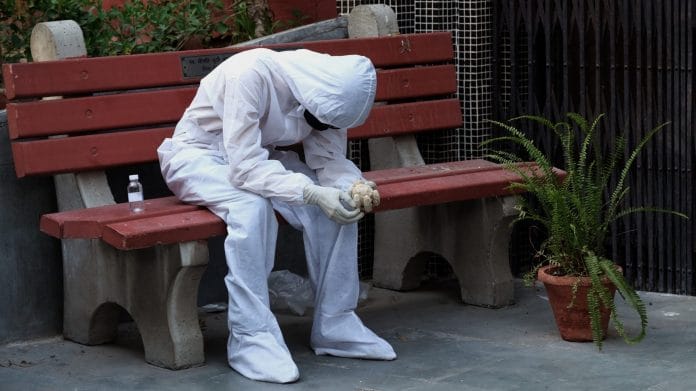
New Delhi: From haunting memories of crematoriums to anxiety about shortage of medical supplies, distress calls at the helpline run by the National Institute of Mental Health and Neuro Sciences (NIMHANS) in Bengaluru have spiked by 40 per cent in the last few weeks.
Furthermore, of the total calls fielded by the 24×7 helpline volunteers, those requiring critical consultancy — where people are consulted on probable mental health and psycho-social issues — have almost doubled.
“People are in distress. The calls for quality consultancy have gone up from 1,085 calls in March to 2,078 calls in April,” K. Sekar, head of the Department of Psychosocial Care and Disaster Management at NIMHANS, told ThePrint.
He added: “Some people are in distress because they have gone through so much, such as a death or deaths in their family. Our consultants ask them to keep talking. They discuss how the imagery of the unfortunate events such as hospitals, ICUs or crematoriums keep coming back to them.”
“Some people are in distress because they are feeling guilty of not being able to cremate, get the one final glance or bid a goodbye to their dear ones,” Sekar further noted.
The NIMHANS helpline (080-4611 0007) was set up on 25 March 2020 when the nationwide lockdown was announced by Prime Minister Narendra Modi.
Since then, the institute has received over 4.48 lakh calls, mostly by people with no history of clinical mental illness.
Later, various mental health institutes, such as The Indian Psychiatric Society, merged their helpline numbers with the one set up by NIMHANS.
Also read: This toll-free helpline is helping people in Maharashtra cope with Covid fatigue, anger, panic
More than 40% hike in daily calls
According to Sekar, the helpline saw a surge in the number of calls this April with the devastating second wave of the pandemic and the critical shortage of medical supplies across the country.
“Of late, the numbers of calls were plateauing. However, they started rising in April. We were receiving around 400 calls per day, which increased to 700 calls per day in April,” he told ThePrint.
A majority of the calls fielded by the mental health professionals were to do with the anxiety over vaccines, the opening up of schools, and the credibility of Covaxin and Covishield. However, they also received several calls by migrant workers who were anxious about a probable lockdown.
“The age group of these callers, according to voice tone, is generally around 45-55 years. However, in April, we have received calls from adolescents and young adults as well,” said Sekar.
The institute is now working on a plan to communicate scientific and positive messages to the public.
“The group at the (health) ministry called Rapid Response Team is working on several communication materials such as video bytes that will be circulated soon through social media handles on mental health,” he said.
The crux of the information that NIMHANS is planning to communicate is based on “there is no need to feel guilt (of losing someone or seeing someone in bad condition). All these things are beyond your control. Whatever is happening around us is a natural phenomenon due to the abnormal situation around you,” Sekar said.
(Edited by Rachel John)
Also read: 1,799 oxygen cylinders, 1.36 lakh remdesivir vials — India receives Covid aid from 14 nations