



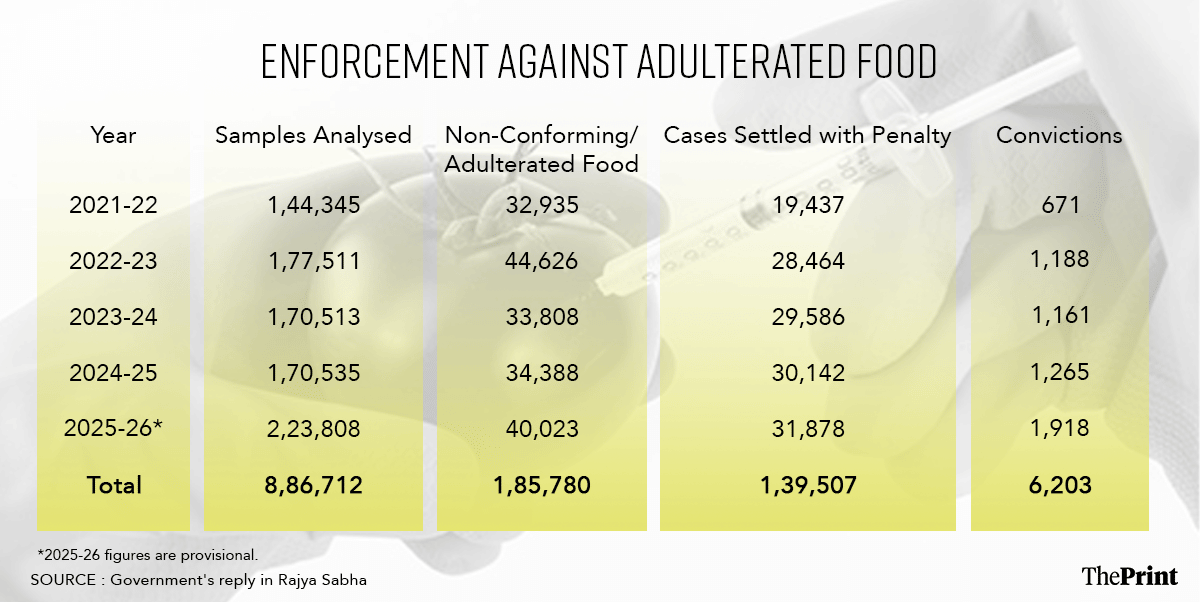
New Delhi: Food safety authorities in India analysed 8.86 lakh food samples across the country over the last five years. Of these, 20 percent were found to be adulterated. And in 75 percent of the 1.85 lakh cases where adulteration was established, the violation was punished with a monetary penalty, according to data tabled Tuesday in the Rajya Sabha.
The data also shows that the conviction rate against the number of samples found to be adulterated was a meagre 3.3 percent during this period.
The figures, shared by the Ministry of Health & Family Welfare in a written reply by Minister of State for Health Prataprao Jadhav, provide an overview of food safety enforcement between 2021-22 and 2025-26.
Of the 1,85,780 non-conforming or adulterated samples of food products analysed over the last five years, 1,39,507 (75 percent) cases were settled with a penalty, and only 6,203 (3.3 percent) resulted in conviction.
Under the Food Safety and Standards (FSS) Act 2006, non-conforming samples are food items that fail to meet legal quality or safety parameters, categorised primarily as unsafe, sub-standard, or misbranded.
“Relatively minor violations may attract improvement notices, while cases involving substandard food, misleading claims, or food that poses a health hazard can lead to monetary penalties,” an FSSAI official told ThePrint on condition of anonymity.
The official added that in more serious cases, where the Food Safety and Standards Act provides for prosecution, criminal proceedings and convictions are sought.
“The categorisation of a case is based primarily on the laboratory report, which determines the nature of the violation. Based on these findings, the Food Safety Commissioner takes a decision on the appropriate course of action under the provisions of the Act,” the official said.
Violations remain high, conviction gap persists
The number of food samples that failed food safety standards has remained consistently high over the past five years. There were 32,935 non-conforming samples in 2021-22. The number rose to 44,626 in 2022-23 before falling to 33,808 in 2023-24 and 34,388 in 2024-25. In 2025-26, it increased again to 40,023.
Convictions have increased gradually over the past five years, but they still account for only a small fraction of cases in which food safety violations were confirmed.
In 2021-22, for instance, 671 of 32,935 cases of non-conforming food samples ended in convictions and 19,437 resulted in penalties. The conviction rate remains around 2 percent.
The rate increased to 2.7 percent in 2022-23, when 1,188 of 44,626 non-conforming samples resulted in convictions and 28,464 cases were settled with penalties.
In 2024-25, 1,265 of 34,388 cases of non-conforming samples ended in conviction, or 3.7 percent, and 30,142 cases were settled with penalties. The figure improved further in 2025-26, with 1,918 convictions out of 40,023 non-conforming samples, taking the conviction rate to 4.8 percent. A total of 31,878 cases were settled with penalties that year.
The government said the 2025-26 figures are provisional and may be revised as more laboratory reports and court cases are finalised.
UP, Rajasthan report most violations
The state-wise data points to significant contrast in enforcement.
In 2025-26, Tamil Nadu recorded the highest conviction rate, with 857 convictions against 3,984 non-conforming samples, translating to a conviction rate of about 21.5 percent. A total of 1,359 cases were settled with penalties. It also analysed the highest number of food samples in the country—44,603.
Kerala followed with 330 convictions from 1,863 non-conforming samples, securing a conviction rate of about 17.7 percent. Haryana and Delhi also reported relatively high conviction rates of around 16 percent and 14.7 percent, respectively.
Uttar Pradesh analysed the second-highest number of food samples in the country—39,519. Of these, 20,427 were found to be non-conforming, more than half of all failed samples reported nationwide. However, the state secured only 342 convictions, translating to a conviction rate of less than two percent.
Rajasthan reported the second-highest number of non-conforming samples at 4,594 but recorded just 31 convictions, giving it a conviction rate of less than one percent.
Together, Uttar Pradesh and Rajasthan accounted for 62.5 percent of all non-conforming food samples in 2025-26 but only around 19 percent of all convictions.
Gujarat converted about eight percent of non-conforming samples into convictions, Karnataka just over six percent and Madhya Pradesh about four percent.
Several states and Union Territories, including West Bengal, Telangana, Jharkhand, Goa, Assam, Bihar and Puducherry, reported no convictions despite identifying non-conforming food samples.
60 lakh+ food businesses registered
The parliamentary reply also provides a snapshot of India’s food business ecosystem.
As of 30 June 2026, there were more than 91,000 active central licences, 11.63 lakh state licences and nearly 61.8 lakh registrations under the Food Safety and Standards Act.
The Food Safety and Standards Authority of India (FSSAI) requires food businesses to obtain either a registration or a licence depending on their size and turnover.
Registrations are meant for small food businesses such as petty manufacturers, hawkers and street food vendors, while larger businesses require state or central licences.
(Edited by Amrtansh Arora)
Also Read: FSSAI has failed to resolve diet-related issues in India—public health crisis on the rise