





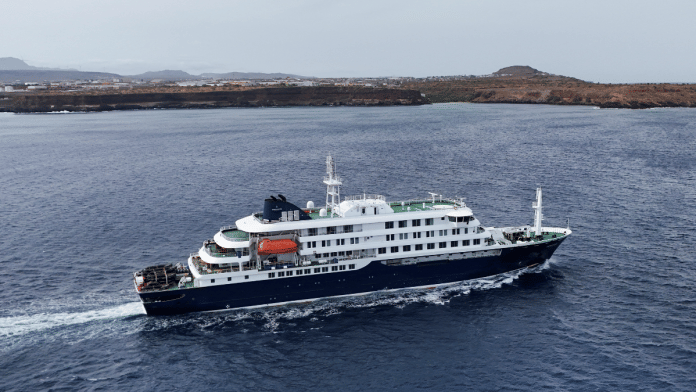


New Delhi: Early April, a cruise ship left Argentina and headed for Antarctica. By the time it docked off the west coast of Africa last week, three passengers were dead and five others seriously ill, struck down by one of the rarest and most feared viruses in the world: Hantavirus.
On Thursday, during a press conference, the World Health Organisation (WHO) Director-General, Dr Tedros Adhanom Ghebreyesus, said there five cases have been confirmed in lab tests, three more are suspected.
“While this is a serious incident, WHO assesses the public health risk as low,” he said.
Maria Van Kerkhove, WHO director of epidemic and pandemic management, told the press conference. “This is not coronavirus, this is a very different virus. This is not the same situation we were in six years ago.”
Earlier, the WHO confirmed that the hantavirus outbreak aboard MV Hondius—a Dutch-flagged expedition cruise vessel— is linked to the Andes strain, which is a rare strain known for its ability to spread from person to person.
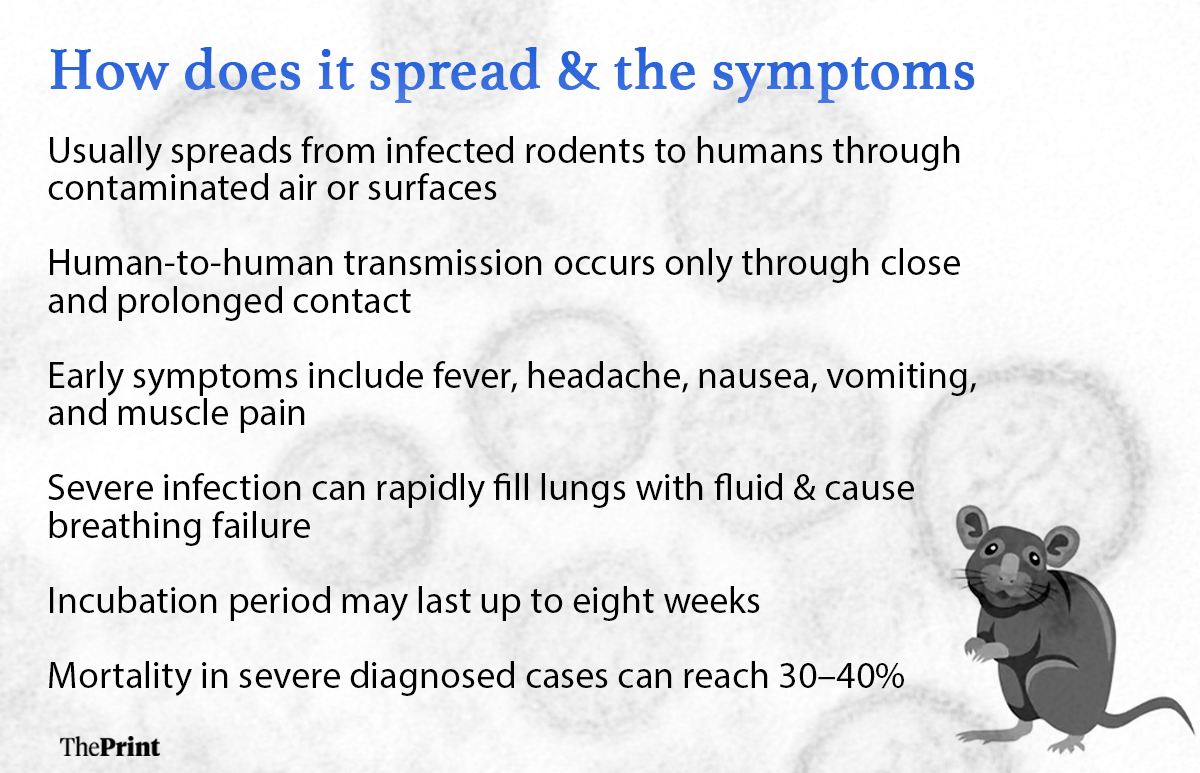
The incubation period for this particular strain can stretch up to eight weeks, meaning passengers who have since returned home across 23 countries may not yet be showing symptoms. Hence, the WHO warned that more cases may follow.
The WHO has deployed an expert on the ship. The global health agency has also shipped 2,500 diagnostic kits to laboratories in five countries.
Three suspected #hantavirus case patients have just been evacuated from the ship and are on their way to receive medical care in the Netherlands in coordination with @WHO, the ship’s operator and national authorities from Cabo Verde, the United Kingdom, Spain and the Netherlands.… pic.twitter.com/olQBk6tdGk
— Tedros Adhanom Ghebreyesus (@DrTedros) May 6, 2026
But scientists say there is no reason to panic.
“Hantavirus is normally spread from rodents to humans, and the human-to-human transmission is quite inefficient,” Dr Shahid Jameel, virologist and research fellow at Oxford University’s Green Templeton College told ThePrint.
“This is the only strain that transmits reasonably between humans, but only among humans who live in proximity and have intimate contact. It’s not something you’ll get if you meet someone on the street,” he added.
Also Read: Wuhan virologists identify new coronavirus in bats. It has a disturbing similarity to COVID-19
What is the Andes strain
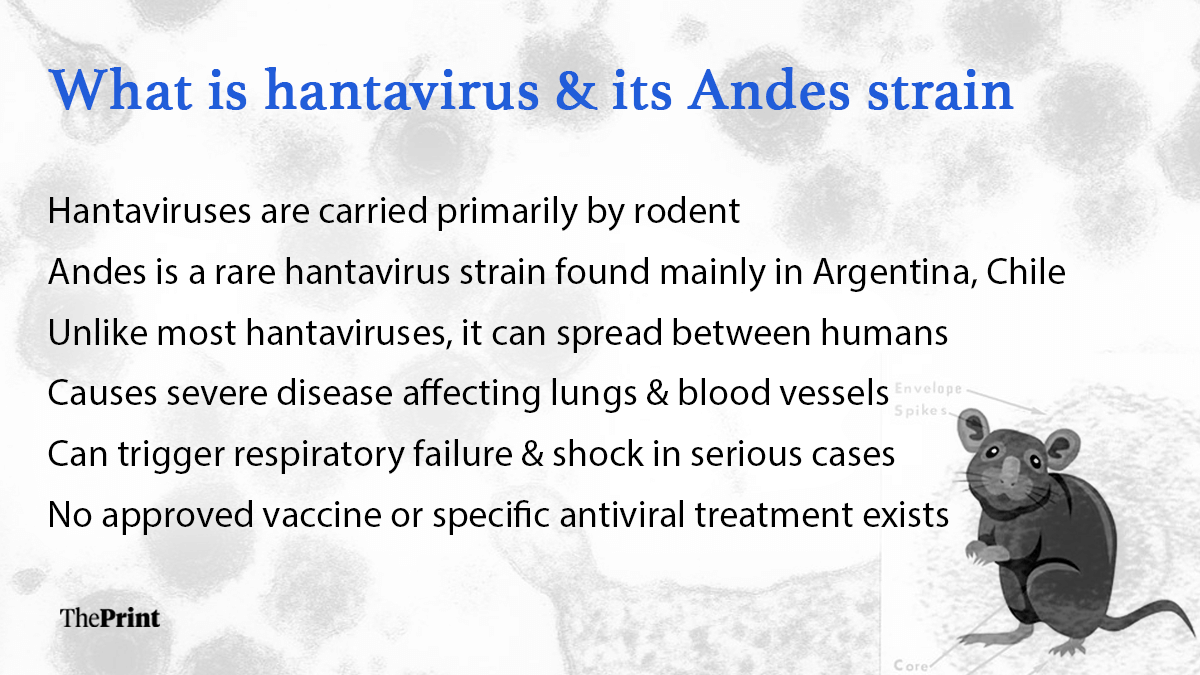
According to the WHO, hantaviruses are a large family of viruses that circulate quietly in rodent populations across the world. Most strains infect humans only through contact with infected rodent urine, droppings or saliva, and the chain of infection almost always stops there. Human-to-human spread, across most of the hantavirus family, is essentially unknown.
However, the Andes strain is the single exception.
The WHO notes that when transmission does occur between people, it involves close and prolonged contact—most often between household members or intimate partners—and is most likely to occur in the early phase of illness.
Even then, the chains are short.
The cases aboard the cruise ship fit this pattern precisely. The first two patients, an adult couple, had travelled through Argentina before boarding. The husband developed a fever and headache on 6 April, deteriorated rapidly, and died on the ship on 11 April.
His wife fell ill after going ashore at Saint Helena, died in Johannesburg on 26 April, and was subsequently confirmed by PCR to have hantavirus. A third passenger was medically evacuated from Ascension Island to South Africa and remains in intensive care. A fourth patient died on 2 May.
This is not, experts stress, a super-spreader scenario.
“If it were a super spreader, you wouldn’t have five or eight cases from a ship that had 150 passengers,” said Dr Jameel.
The first known outbreak of hantavirus in the Americas was in 1993, in the Four Corners region of the western United States, where Nevada, Utah, Colorado, and New Mexico meet.
Dr Jameel said that young, apparently healthy people were dying of unexplained respiratory failure. Epidemiological detective work traced it to the Sin Nombre virus, carried by deer mice.
“I recall that very clearly,” Dr Jameel said. “It was traditional American-Indian knowledge that in years of a very good harvest, a mysterious disease appeared with breathing difficulties. A good harvest meant more mice.”
There was very little human-to-human spread. The Andes virus, found in Argentina and Chile, is distinct — it is the only hantavirus strain for which human transmission has been documented at all.
Virus spreads rarely, but ‘mortality up to 40%’
In the rodents that carry the virus, there are typically no apparent illnesses. Of the many strains identified across the world, only a handful are known to infect humans.
The hantavirus family has two distinct branches that cause entirely different diseases. New World strains, found in the Americas, attack the lungs — infecting the cells lining tiny blood vessels, causing them to leak fluid and triggering respiratory failure, and in severe cases, heart failure.
Old World strains, found primarily in Asia and Europe, target the kidneys, causing haemorrhagic fever and acute renal failure.
Dr Tanu Singhal, an infectious disease specialist at Kokilaben Hospital in Mumbai, explained that in the Americas, hantavirus causes a condition called Hantavirus Cardiopulmonary Syndrome, or HCPS, a disease that progresses with frightening speed once it takes hold.
It begins with fever, headache, muscle aches, and nausea. Then, within days, the lungs fill with fluid, blood pressure drops, and the patient is in shock.
In Europe and Asia, hantaviruses cause an entirely different syndrome called Haemorrhagic Fever with Renal Syndrome, or HFRS, which targets the kidneys and blood vessels rather than the lungs.
Dr Singhal explained the difference, “One presents with pneumonia and respiratory failure, as seen in America. The other presents like dengue or leptospirosis, with haemorrhagic fever and renal failure—that is what is seen in India and Sri Lanka.”
It is not the same virus behaving differently; it is genetically distinct strains, each with its own rodent host and its own way of attacking the human body, Singhal said.
There is no licensed antiviral treatment and no vaccine. The management of the infection is entirely supportive, including intensive care, careful fluids, and mechanical ventilation.
“It’s been shown to cause about 30-40 per cent mortality, which is very high for a virus,” said Dr Jameel. However, he cautioned that this figure only counts people who were sick enough to be tested and confirmed.
Many people who caught the virus but had milder symptoms were never diagnosed, and if those cases were counted too, the death rate would look much lower.
What makes early detection so difficult is that hantavirus’s initial symptoms are identical to those of dozens of far more common illnesses. “The general symptoms are high fever, vomiting, and nausea,” said Dr Singhal.
“Hantavirus is not something you think of at the top of your head. By the time the distinctive respiratory collapse sets in, the disease has already advanced significantly,” she added.
The timing of transmission adds another layer of complexity. “It might transmit better in the four to six week period rather than in the first to second week,” said Dr Jameel. This means a patient can unknowingly expose close contacts during a window when they appear only mildly unwell.
The India question
The WHO has clarified that the immediate global risk is low.
According to sources, the Union Health Ministry is closely monitoring the evolving situation in coordination with the National Centre for Disease Control (NCDC), Integrated Disease Surveillance Programme (IDSP), WHO and other international health authorities.
They said that as per information received under the International Health Regulations framework, two Indian nationals are currently onboard the vessel. “Both individuals are presently asymptomatic and are under observation in accordance with established international health protocols,” said a source.
The Andes strain does not spread through casual contact, does not travel freely through the air, and does not sustain long chains of human-to-human transmission. Even in a closed ship environment, with 147 people sharing quarters for weeks, the case count has remained in single digits.
Dr Jameel illustrated the point with a case that emerged from this very outbreak.
A flight attendant was briefly exposed to a dying patient in Johannesburg — one of the ship’s confirmed cases—infected no one else. “To me, it really illustrates that we live in a connected world. The risk is always there. But to the general population, the risk is low—simply because the virus doesn’t transmit very well.”
The WHO has prescribed 45-day active symptom monitoring for all passengers and crew. Though more cases remain possible, they are not expected to cause community transmission anywhere.
For India, the Andes strain poses no direct threat. What is worth pausing on, however, is how little India knows about its own hantavirus burden.
Dr Singhal noted that outbreaks of the renal syndrome variety, the HFRS, were reported from South India in early 2000s with surveys finding antibodies to hantavirus in communities there.
A 2008 Nature India report highlighted the first strong evidence that hantaviruses were circulating in India. Researchers studying people in Tamil Nadu, including patients with kidney disease, warehouse workers, and Irula tribal communities involved in rodent trapping, found antibodies suggesting past hantavirus infection in 28 individuals.
The study showed that rodent-borne hantaviruses, previously thought uncommon in India, may already have been silently spreading. Scientists identified strains related to Seoul, Thailand and Hantaan viruses, which are associated with haemorrhagic fever and kidney disease in Asia.
The report also warned that many infections may go undiagnosed because symptoms resemble other common illnesses.
(Edited by Ajeet Tiwari)
Also Read: COVID-19 pandemic may have aged your brain, even if you weren’t infected, finds UK study