





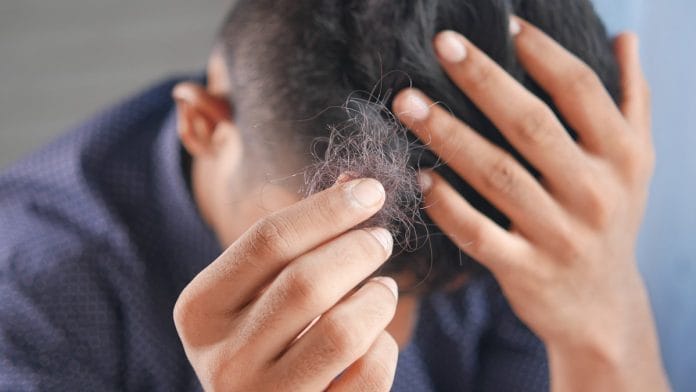

New Delhi: Hair-loss drugs are growing quickly into Wall Street’s latest big bet, but the excitement may have more to do with the size of the market and the opportunity it offers rather than an Ozempic-like scientific breakthrough, medical experts have told ThePrint.
A new wave of hair-loss drugs is drawing investor interest as companies work on alternatives to the limited treatments currently available, Bloomberg reported. The surge has prompted comparisons with the GLP-1 boom, led by drugs like Ozempic.
Shares of US-based, dermatologist-founded biopharmaceutical company Veradermics have risen nearly 500 percent since its February debut. Absci, headquartered in Vancouver, Washington, has more than doubled this year, while Swiss pharmaceutical company Cosmo which is developing the topical hair-loss drug clascoterone, is also attracting investor attention.
Pattern hair loss occurs when genetically sensitive hair follicles shrink, producing thinner and shorter hair. An estimated 50 million men and 30 million women in the US have it, but no new drug has been approved since the late 1990s. Patients largely rely on existing drugs and procedures such as hair transplants, often paid out of pocket.
At the centre of this market rush is Veradermics’ VDPHL01, an investigational extended-release version of oral minoxidil. If approved, it could become the first FDA-approved non-hormonal oral treatment for pattern hair loss in men and women.
The science behind VDPHL01
Minoxidil, sold under brand names, including Loniten and Rogaine, is hardly new. It was originally developed to treat high blood pressure. Doctors later noticed that people taking it developed excessive hair growth, including on the scalp and other parts of the body.
Dr Rohit Batra, dermatologist at Sir Ganga Ram Hospital in New Delhi, said minoxidil was later developed as a topical treatment for hair loss. “Low-dose oral minoxidil has also been prescribed by dermatologists for years, although it is not FDA-approved specifically for hair loss,” he said.
So, he said, Veradermics’ scientific bet is on how minoxidil is delivered.
VDPHL01 is an 8.5 mg extended-release tablet designed to release minoxidil gradually after it is swallowed. The company says this could provide a steadier exposure to the drug instead of the sharper rise and fall associated with immediate-release oral minoxidil. That could matter because minoxidil affects blood vessels throughout the body, not only around the hair follicle. It can lower blood pressure and, at higher concentrations, cause cardiovascular side effects.
The extended-release formulation is designed to maintain the drug’s effect for longer while limiting the high concentrations that can contribute to side effects.
Low-dose oral minoxidil can cause dizziness, weakness or low blood pressure. It can also cause unwanted hair growth on the face and other parts of the body. Rare cardiovascular effects include palpitations, rapid heartbeat and fluid retention, Batra said.
Dr Kabir Sardana, head of dermatology at Dr RML Hospital in New Delhi, said, “Oral minoxidil produces a moderate response in men, while women may be more likely to experience side effects.”
Also Read: Arthritis drugs helps hair loss patients regrow 80% of hair, find 2 clinical trial
Does VDPHL01 actually grow more hair?
Veradermics reported positive Phase 2/3 results from its male trial in April 2026 and positive Phase 2 results from its female trial in July.
In the male trial, 519 men with mild-to-moderate pattern hair loss were divided into three groups. One received VDPHL01 once daily, another twice daily and a third received a placebo.
After six months, men taking the drug once daily had an average increase of about 30 hairs per square cm in the treated area. Those taking it twice daily gained about 33 hairs, compared with about seven in the placebo group.
About 79 per cent of men taking the drug once daily and 86 per cent taking it twice daily reported some improvement in hair coverage, compared with about 36 per cent in the placebo group.
“Based on the results of the ‘302’ trial, VDPHL01, if approved, has the potential to transform how physicians and patients approach pattern hair loss for men,” said Dr Maryanne Makredes Senna, a board-certified dermatologist at Beth Israel Lahey Health, assistant professor of dermatology at Harvard Medical School and member of Veradermics’ scientific advisory board.
These are results on a small cohort and VDPHL01 has not yet been approved by the US Food and Drug Administration.
Veradermics has completed another late-stage trial in men, with results expected in the second half of 2026, and is also testing the drug in women.
Why India could be an important market
The opportunity is not limited to the US. Hair loss is already a sizeable treatment market in India, where people use medicines such as topical minoxidil and finasteride, as well as procedures such as hair transplantation and platelet-rich plasma, or PRP. Wigs, hairpieces and cosmetic scalp-covering products are also used to conceal hair loss.
The market is growing as well. Estimates by market research firm GlobalData suggest that India’s hair-loss treatment market was worth about Rs 175 crore in 2024, having grown 12.8 per cent over the previous year.
But the treatment landscape is fragmented. Alongside established medicines and procedures, Indian consumers are also being offered newer treatments whose evidence is still limited.
A 2025 consensus from the Association of Cutaneous Surgeons of India flagged treatments including exosomes, polydeoxyribonucleotides (PDRN), autologous micrografts, nanofat, stromal vascular fraction (SVF), intravenous (IV) therapy and thread lifts, as areas needing more clinical evidence and longer-term safety data.
This leaves room for treatments that can show clearer evidence of effectiveness, safety and convenience. For drugmakers, it also means a large consumer market in which patients are often willing to pay out of pocket for treatments that promise to slow hair loss or restore hair.
What about the other new hair-loss drugs?
VDPHL01 is only one of several treatments being developed for hair loss. The drugs in the pipeline target different parts of the process that cause hair to become thinner.
In people who are genetically prone to male pattern hair loss, testosterone is converted into a hormone called dihydrotestosterone, or DHT. Over time, DHT can cause some hair follicles to shrink. These smaller follicles produce thinner and shorter hairs, eventually leading to visible hair loss.
Some existing treatments target this hormonal process. Finasteride, for instance, reduces the conversion of testosterone into DHT, lowering the hormone’s effect on susceptible hair follicles.
However, Clascoterone, being developed by Cosmo Pharmaceuticals, takes a different approach. Instead of reducing DHT production, it blocks the action of hormones at the hair follicle itself. It is being developed as a topical treatment for male pattern hair loss.
“The two treatments work in different ways and are sometimes used together,” Batra said.
Another candidate, ABS-201, being developed by US-based Absci, is an injectable treatment that uses a different biological approach.
The comparison with Ozempic, experts say, has limits.
The GLP-1 drugs transformed obesity treatment by targeting a powerful biological pathway and producing significant weight loss. Their established role in diabetes management also gave them major clinical importance beyond weight loss.
Dr Mukesh Manjhi, senior consultant dermatologist at Kailash Hospital in Greater Noida, told ThePrint that the comparison should therefore be viewed cautiously. “Existing treatments such as minoxidil and DHT blockers have been used for years, and the newer formulations of these drugs may not deliver the kind of dramatic results seen with GLP-1 drugs,” he added.
(Edited by Nardeep Singh Dahiya)