





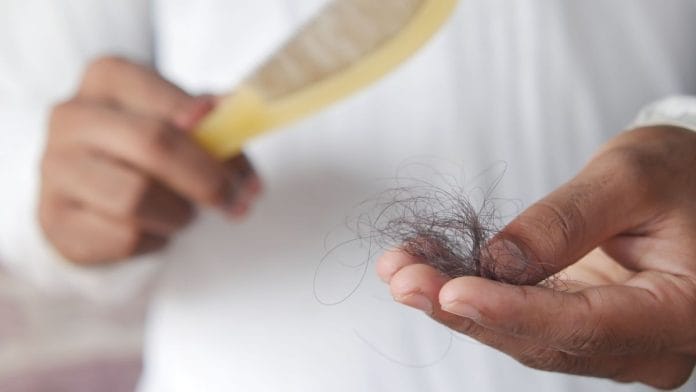

New Delhi: Scientists have found that a drug used to treat rheumatoid arthritis might just cure hair loss too. Two clinical trials involving nearly 1,400 participants showed that a 15 mg daily dose of upadacitinib helped people grow back enough hair to cover nearly 80 per cent of their scalp within 24 weeks.
The study, conducted by a team of international researchers, was published in August in JAMA Dermatology. Upadacitinib, sold under the brand name Rinvoq, is a JAK inhibitor that blocks proteins known as the Janus kinases that trigger inflammation and hair loss.
“I think the results are very encouraging. If upadacitinib ultimately becomes another treatment option for alopecia areata, having another effective drug available to patients is certainly a good thing,” Spencer Kobren, the founder of the American Hair Loss Association, not involved in the study, told Healthline.
Also read: No sirens, just scrambling. The uneven reality of Nepal’s early warning systems
Treating baldness
Alopecia areata is an autoimmune condition where the immune system attacks hair follicles leading to hair loss. While there is no cure for the disease, treatments such as tropical medication, injections, and eve laser therapy have been tried out to regrow hair or slow hair loss.
To see if upadacitinib could treat hair loss, researchers conducted two separate clinical trials from November 2023 to July 2025. The first trial involved 112 clinical centres in 25 countries, the second included 125 centres across 28 countries. Totally, the trials had 1,400 participants aged 12 to 64.
The participants were restricted to people who had severe alopecia aerate and had lost at least 50 per cent of the hair on their scalp. They were divided into three groups and assessed every four weeks for the first three months and then again on week 24.
Nearly 40 per cent of the participants received a daily dose of 15 mg of upadacitinib. Another 40 per cent received a daily dose of 30 mg of the drug. The remaining 20 per cent received a placebo.
Researchers noted that nearly 13 per cent of the participants on the lower dose and 23 per cent of those on the higher dose managed to regrow their scalp hair completely.
However, researchers pointed out that the drug’s common side effects included acne, colds, throat irritation, and even upper respiratory tract infections.
Researchers added that JAK inhibitor drugs, while they have been approved by the FDA, are powerful immune modulating drugs that could have significant consequences. It is also yet to be seen whether the disease returns once the drug use is stopped.