


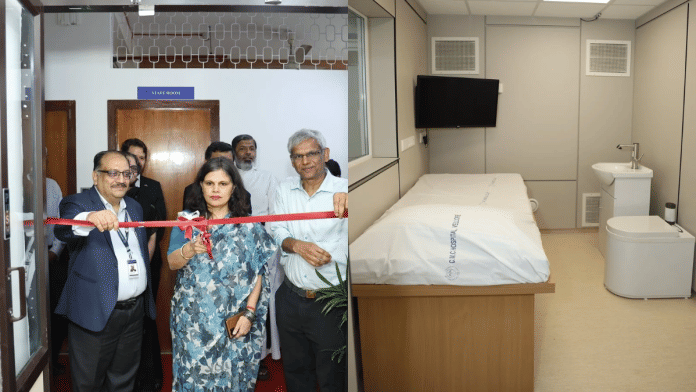
New Delhi: A bed, a desk, a toilet and a network of sensors tracking every breath. Inside this room-sized laboratory, volunteers will eat, sleep, rest and exercise as scientists measure how much oxygen their bodies consume, how much carbon dioxide they produce and how much energy they expend over an entire day.
The Human Metabolic Chamber at Vellore’s Christian Medical College (CMC) was jointly established by the college and the Tata Institute of Fundamental Research’s (TIFR) Advanced Research Unit on Metabolism, Development and Aging (ARUMDA) and is designed to give researchers a more precise picture of how the human body burns calories and uses different sources of energy.
Inaugurated Monday by Union Health Secretary Punya Salila Srivastava, the facility will support research into nutrition, diabetes, obesity, ageing and malnutrition, with a particular focus on generating evidence relevant to Indian populations.
Unlike conventional metabolic tests that measure energy expenditure over a short period, the chamber allows researchers to monitor a person’s metabolism continuously under controlled conditions for 24–72 hours.
Dr Nihal Thomas, senior professor in CMC Vellore’s Department of Endocrinology, Diabetes and Metabolism, told ThePrint that the extended observation period is what makes the facility different. “Calorimetry is done for a very finite period of time, maybe about 20 minutes to an hour…But when you put a person in a metabolic unit, you literally make them live there for one, two, even three days and you measure everything,” he said.
Calorimetry is the measurement of heat exchanged during physical, chemical, or biological processes.
Dr Thomas clarified that the facility at the college is not India’s first metabolic chamber, but probably its first advanced one. An earlier facility was established at St John’s Medical College, Bengaluru, in the late 1980s.
India carries one of the world’s heaviest burdens of metabolic disease, yet it has little direct data on how Indian bodies actually use energy.
A national study by ICMR and INDIAB published in The Lancet Diabetes & Endocrinology in 2023, estimated that India had 101 million people with diabetes in 2021, 136 million with prediabetes and 254 million with generalised obesity. The survey was conducted between 2008 and 2020 and covered 113,043 adults aged 20 and above.
Despite the high number, tools used to explain why people develop these conditions, mainly short resting-energy tests and calorie equations—built largely on Western populations—offer only a partial picture. The chamber is meant to fill that gap.
Also Read: Urban Indian men at higher risk of dying than rural men, finds new study based on NFHS findings
How the chamber measures energy expenditure
In simple terms, a metabolic chamber is a room in which a person lives for an extended period while researchers measure how their body uses energy.
The facility works as a whole-room indirect calorimeter. Sensors continuously measure the oxygen a person consumes and the carbon dioxide they produce. These measurements help scientists calculate energy expenditure and understand whether the body is using carbohydrates or fats as fuel.
What differentiates how the facility operates from conventional indirect calorimetry is the duration and range of measurements. A short test, often conducted using a face mask, captures merely a snapshot of resting energy expenditure. On the other hand, the chamber follows the body through an entire daily cycle, including sleep, meals, rest and physical activity.
The chamber also facilitates the measurement of the amount of energy that the body spends digesting, absorbing and processing food, a process known as diet-induced thermogenesis. “Not only do you measure the amount of oxygen taken and the carbon dioxide given out, but you also have all the body fluids, like urine, stool, everything, and the exact intake of food, and everything is all measured during that period of time,” Dr Thomas said.
The facility can also measure gases beyond carbon dioxide, including hydrogen, which can provide clues about the activity of gut bacteria. Researchers can also collect and store samples, including stool, for further analysis.
Dr Thomas explained that the electronic sensors allow gases to be measured and analysed in real time, rather than requiring researchers to make calculations after collecting readings. Staff can monitor the data remotely from outside the room and adjust experimental conditions during a study.
One important feature is temperature control. The chamber can maintain temperatures within approximately 0.3℃, allowing researchers to study how changes in the surrounding environment affect energy expenditure. Dr Thomas said that conventional air-conditioning systems cannot offer the same precision.
Researchers can therefore expose volunteers to a sustained change in temperature, for instance, keeping the room three degrees cooler for an extended period, and observe how their bodies respond.
The chamber is approximately the size of a hotel room. It can also accommodate exercise interventions, including cycling, allowing researchers to measure energy expenditure during physical activity.
Meals can be supplied through an airlock, allowing volunteers to remain inside while researchers maintain controlled conditions. However, Dr Thomas said studies involving longer stays will require considerable cooperation from participants.
Why India needs its own metabolic data
A major reason for setting up the facility is the limited representation of Indian populations in global metabolic research, researchers said.
Calorie requirements are commonly estimated using equations that take into account a person’s age, height, weight and physical activity. Dr Thomas said that around nine such equations are in use, but many draw on Western populations and may not accurately reflect Indian physiology.
Dietary diversity is another important gap. “In India, there are all kinds of diets. And I don’t think these diets and the impact on the body have been studied adequately,” Dr Thomas said. The chamber could help researchers examine how different Indian diets influence energy expenditure, fuel utilisation and metabolic responses.
This is particularly relevant in a country where undernutrition and obesity coexist, sometimes within the same household. People with similar body weights may also have very different proportions of muscle and fat, affecting their metabolic health and nutritional requirements.
The initial research programme is expected to recruit adults above 18 years across different age groups and body mass index categories. Researchers will document their dietary histories, exercise patterns and occupations to understand how these factors influence energy expenditure.
Equipment standardisation and ethics approvals are currently under way.
The facility could also add detailed metabolic measurements to existing longitudinal research. CMC and TIFR researchers have previously studied a Vellore birth cohort, with a 2026 study reporting a nearly threefold increase in overweight and obesity between the ages of seven and nine, even as around one in five children remained thin. The chamber could help researchers investigate the metabolic changes underlying such trends.
What it could reveal about diabetes and obesity
The chamber could help researchers investigate why some people develop diabetes despite being lean, why others gain weight more easily and how the body responds differently to similar diets and levels of physical activity.
Dr Thomas said diabetes is a multifactorial condition. It is not simply a consequence of inadequate insulin production or insulin resistance in muscles and fat tissue. Excess glucose production by the liver and differences in how efficiently the body uses energy also play a role.
Some people are what he describes as “fuel-efficient”, meaning their bodies burn less energy. This can affect how effectively they use fat and glucose as fuel and may contribute to elevated blood sugar, including among people who are not overweight.
Earlier CMC research using insulin clamp techniques, calorimetry and nuclear magnetic resonance (NMR) spectroscopy has offered clues about these differences.
For instance, people born with low birth weight may be more vulnerable to diabetes later in life. Dr Thomas said they can have greater deposits of fat around visceral tissues even when they appear lean, making them more susceptible to metabolic problems as they gain weight.
The new chamber could allow researchers to examine these patterns more precisely by measuring energy expenditure over longer periods and under controlled conditions.
The chamber will work alongside TIFR’s National Analytical Facility for Nutrition and Metabolism Research, established under ARUMDA.
The project has received funding from the Department of Atomic Energy and corporate social responsibility support from Hindustan Unilever Limited. Maastricht University’s NUTRIM institute in the Netherlands has provided technical advice, while the Embassy of the Netherlands in India has extended support.
(Edited by Chingkheinganbi Mayengbam)