



New Delhi: Another urban legend stands busted. Urban Indian men between 15 and 59 appear to be at a lower risk of dying than their rural counterparts but statistical analysis that accounts for differences in household wealth, social background and state of residence reveals the opposite, a study published in the journal Demographic Research has found.
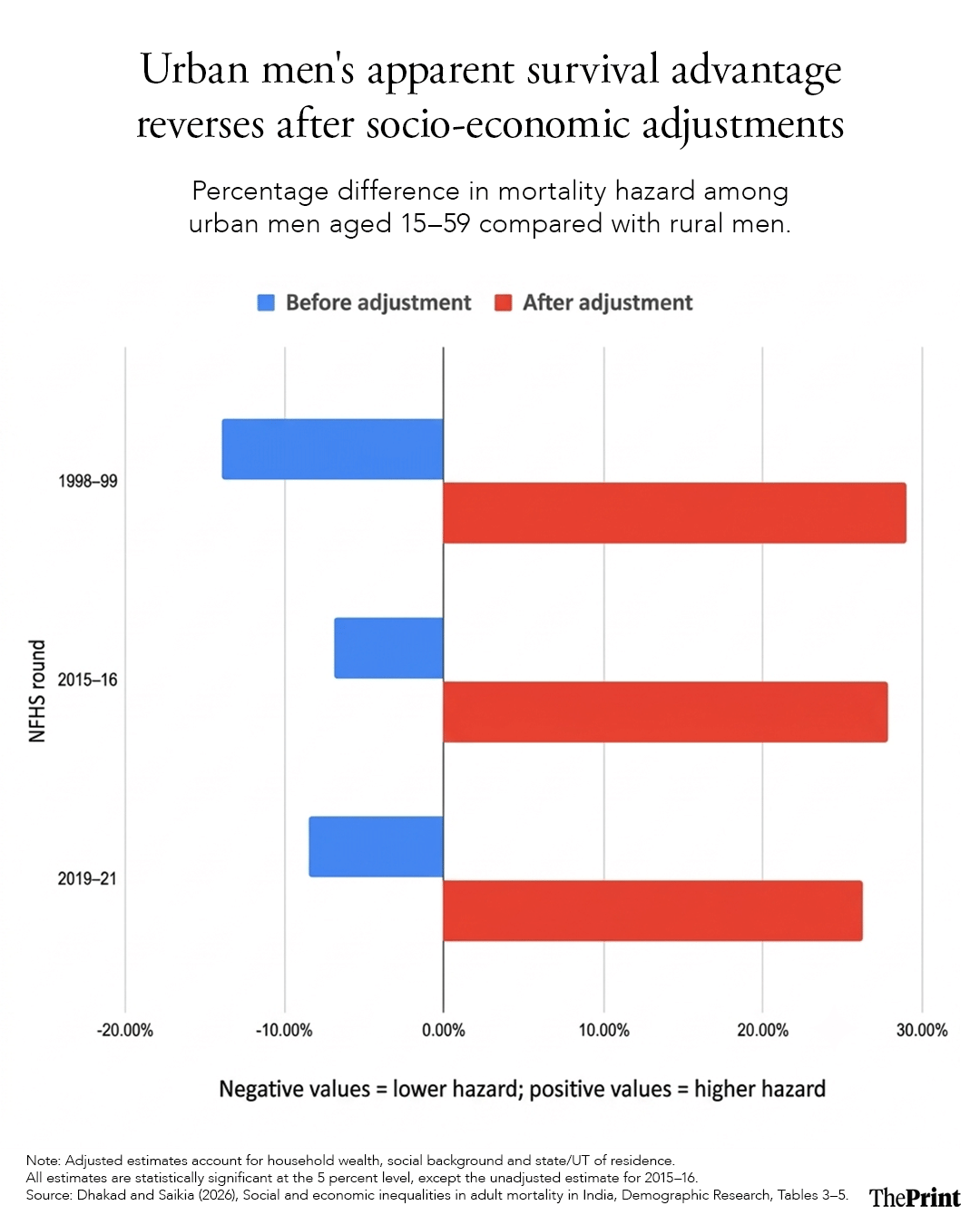
Using data from the National Family Health Survey (NFHS) 2019–21, researchers found that urban men had an 8.5 percent lower mortality hazard than rural men. Mortality hazard is the rate at which deaths can occur at any given point in time among individuals.
It was when researchers statistically compared men from similar household wealth groups and social backgrounds within the same state that the pattern reversed: urban men had a 26.3 percent higher mortality hazard.
Simply put, when comparing an urban and a rural man from similar economic and social backgrounds in the same state, the model estimates a roughly 26 percent higher rate of death for the urban man at any given point in time. This suggests that the relative economic advantage of urban households may be masking a mortality disadvantage among urban men.
Drawing on data from three rounds of the NFHS (1998–99, 2015–16 and 2019–21), the study examined social and economic inequalities in adult mortality in India over two decades. It was conducted by Moradhvaj Dhakad of the Max Planck Institute for Demographic Research in Germany and Nandita Saikia of the International Institute for Population Sciences (IIPS), Mumbai.
Also Read: Gaining weight, losing health: National survey finds India trapped between obesity & undernutrition
A pattern spanning two decades
The higher mortality hazard among urban men, after accounting for differences in their socioeconomic backgrounds, was observed across all three survey rounds, suggesting that it is not a recent phenomenon.
In 1998–99, urban men had a 13.9 percent lower mortality hazard than rural men before differences in their socioeconomic backgrounds were taken into account. After these adjustments, urban men had a 29 percent higher mortality hazard. In 2015–16, the corresponding adjusted figure stood at 27.8 percent.
The higher mortality hazard among urban men after these adjustments was statistically significant across all three survey rounds.
It’s different for women
Across all three NFHS rounds, urban women had a lower mortality hazard than rural women before differences in their socioeconomic backgrounds were taken into account.
After adjusting for household wealth, social background and state of residence, however, the urban–rural difference was no longer statistically significant.
The study does not establish why urban men have a higher mortality hazard after accounting for differences in their socioeconomic backgrounds.
The researchers acknowledge that limited information on deceased individuals prevented them from including several factors known to influence mortality, such as education, employment status, substance use, diet and sleep patterns.
Further, household wealth is measured using the NFHS wealth index, which is based on household assets and living conditions rather than income. The study also relies on deaths reported retrospectively by household members, leaving room for underreporting and inaccuracies in reporting.
The findings, therefore, do not establish that living in urban areas itself increases the risk of death.
(Edited by Nardeep Singh Dahiya)