





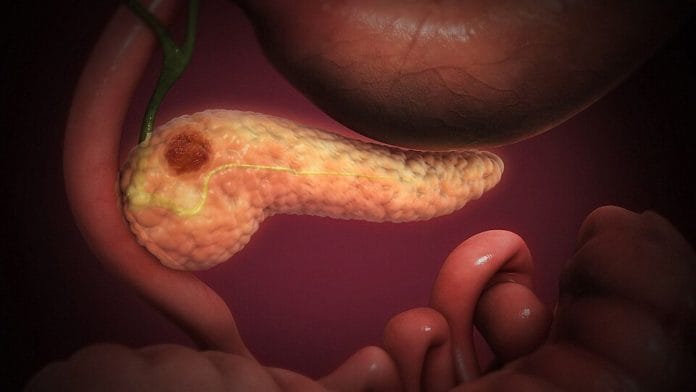


New Delhi: A new drug has cracked the code that oncologists have spent four decades trying to, successfully attacking the genetic switch that drives more than 90 per cent of all pancreatic cancers.
The breakthrough was announced last month when Revolution Medicines, a California-based biotechnology company developing targeted cancer drugs, announced results from its Phase 3 trial that showed patients with advanced pancreatic cancer who received daraxonrasib survived a median of 13.2 months compared to just 6.7 months for those on standard chemotherapy. The results were published in the New England Journal of Medicine early this month. The United States Food and Drug Administration (FDA) has since permitted expanded access to the drug even before formal approval.
Daraxonrasib is a targeted oral drug that blocks a protein called KRAS — a gene present in every human cell that, when mutated, loses the ability to switch off. “In normal cells, KRAS is present, but in abnormal cells, it is mutated, so it keeps on dividing,” explained Dr Rashi Agrawal, Senior Director and Clinical Administrator at Max Hospital in Delhi-NCR. “Till now, we did not have any drug which can actually target this mutation,” she added.
Dr Agrawal explained that daraxonrasib zeroes in on this particular mutation, cutting off the signal that tells cancer cells to keep growing. It is being studied specifically for metastatic pancreatic cancer, a condition where the disease spreads beyond the pancreas.
This means that the drug is used as a second-line of treatment, only on patients who have already gone through chemotherapy.
Pancreatic cancer is one of the deadliest cancers, with very few new treatment options available to patients with advanced disease for several decades. This new drug is thus being seen as one of the most important advances in pancreatic cancer treatment in a generation.
Also Read: This tiny ‘mysterious organ’ is no useless lump. 2 global studies link it to longevity & cancer
The deadliest cancer
Pancreatic cancer is not among India’s most common cancers. It is, however, the deadliest of them all.
“It contributes to around 2 per cent of all cancers, but almost 3.4 per cent of cancer-related deaths,” said Dr Mohit Saxena, Consultant in Medical Oncology at Manipal Hospital in Gurugram. “That gap between how often it occurs and how often it kills tells you everything about how dangerous it is,” he added.
The pancreas is tucked deep at the back of the abdomen, on the posterior wall, which means routine ultrasounds often miss it. Early symptoms like mild stomach discomfort, indigestion, fatigue, unexplained weight loss, are easy to dismiss.
By the time something more alarming appears, like jaundice (when the tumour blocks the bile duct) or a sudden spike in blood sugar (because the pancreas also produces insulin), the cancer has often already spread. “Most of the time it is detected late, either locally advanced or already metastatic,” said Dr Saxena. “That is the unfortunate part.”
Dr Niti Raizada, Principal Director of Medical Oncology and Haemato-Oncology at Fortis Hospitals, Bengaluru, explained that pancreatic cancer is also a very aggressive cancer. When caught early and confined to the pancreas, surgery offers a slim chance of cure. But most patients never reach that point.
“For advanced disease, we are left with chemotherapy, the drug combinations that slow the cancer but rarely stop it. Another option, immunotherapy, which has transformed treatment for several other cancers, has had almost no impact here,” Dr Raizada told ThePrint. “Only a tiny fraction of pancreatic cancer patients, those whose tumours carry a marker called MSI-high, respond to it. Everyone else has very few options,” she added.
MSI-high (microsatellite instability–high) is a condition where cancer cells have defective Deoxyribonucleic Acid (DNA) repair, leading to lots of mutations and making them more likely to respond to immunotherapy.
The 40-year problem
The story of daraxonrasib really begins in 1982, when scientists first identified a gene called KRAS, short for Kirsten RAS Sarcoma Viral Oncogene. In a healthy cell, KRAS turns on briefly when a growth signal arrives, then switches off. In cancer, the gene mutates and the signal stays on permanently. The cell then keeps dividing endlessly.
“From the late 80s, we knew there is something called the KRAS oncogene. Almost 90 per cent of pancreatic cancer has this oncogene,” explained Dr Raizada.
The problem was the molecule’s size and shape. “It was a large molecule, so it was difficult to block it,” said Dr. Saxena. Every time researchers tried to design a drug to latch onto KRAS, the protein would shift its form, slipping out of reach. For nearly three decades, the medical consensus was that KRAS simply could not be targeted. Hence, it was called “undruggable”.
The first breakthrough came in 2013, when scientist Kevan Shokat and his lab found a small hidden pocket on one specific variant of the protein, called the G12C mutation, that a drug could bind to. That discovery led to two FDA-approved drugs for lung cancer, sotorasib (approved in 2021) and adagrasib (approved in 2022).
Also Read: Cancer therapy may soon skip the lab step — and cut costs
But G12C is relatively rare in pancreatic cancer, which more commonly carries different variants.
The search then shifted to finding a drug that could block the entire RAS protein across all its mutations — what scientists call a pan-RAS inhibitor.
Daraxonrasib is that drug. “This drug does not work on one point mutation. It acts on the RAS molecule itself,” said Dr. Raizada. By blocking the protein, it cuts off the signal that tells cancer cells to keep dividing.
In simple terms, chemotherapy kills all rapidly dividing cells, healthy or cancerous, which is why it causes hair loss, nausea, and low blood counts. Immunotherapy trains the immune system to fight cancer.
Dr Saxena explained that targeted therapy, like daraxonrasib, is more like a lock and key. “It works only if the cancer has the right ‘lock’, or mutation. If you are having the same lock, the key will open it. Otherwise it will not,” he said.
Trials and prospects
Latest trials reportedly show that patients who received daraxonrasib after failing first-line chemotherapy survived nearly twice as long as those who received further chemotherapy. The drug is taken as a daily oral pill, unlike intravenous chemotherapy, which matters for patients already weakened by disease.
According to the California-based biotechnology company Revolution Medicines, the data presented at the American Association for Cancer Research meeting earlier this year showed that when daraxonrasib is combined with standard first-line chemotherapy in previously untreated patients, the response rate jumps to 58 per cent, with 90 per cent of patients achieving disease control.
The question of side effects is relevant too. Unlike chemotherapy, daraxonrasib’s side effects are typical of targeted therapy: for instance, skin rashes, mouth ulcers, nausea, and diarrhoea. “Most of them are easy to manage with local therapies,” said Dr Raizada. Trials have reported no unexpected safety signals.
Beyond pancreatic cancer, KRAS mutations are also common in colorectal and lung cancers, which are two of the most prevalent cancers in India. If the drug proves itself in pancreatic cancer, oncologists expect it to be tested there next.
For Indian patients, though, the wait will be long. The FDA has only granted expanded access; full approval is yet to be granted.
Dr Saxena said that the question of whether the drug will actually work in Indian patients will be answered only in the future. “Not every promising drug in trials survives contact with real-world patients at scale. Some are withdrawn after unexpected post-marketing side effects,” he added.
The full Phase 3 trial results are set to be presented in a plenary session at the American Society of Clinical Oncology annual meeting in Chicago later this month.
The FDA has granted daraxonrasib breakthrough therapy designation, a status reserved for drugs showing substantial improvement over existing treatments, and Revolution Medicines has said it intends to file a formal approval application. Whether that translates to approval later this year remains to be seen.
(Edited by Nardeep Singh Dahiya)
Also Read: New pill targets mutated lung cancer, shrinks tumours in 70% of patients