



New Delhi: The Ministry of Health and Family Welfare has proposed reserving 112 treatment packages under Ayushman Bharat Pradhan Mantri Jan Arogya Yojana (ABPM-JAY) exclusively for government hospitals, up from the existing 23—a move that could significantly change where patients can access treatment under the Centre’s flagship health insurance scheme.
The proposal would mean that beneficiaries may no longer be able to seek cashless treatment for these procedures at private hospitals empanelled under the scheme, depending on the decisions taken by individual states.
In an Office Memorandum dated 13 October, the National Health Authority (NHA) that implements the scheme asked state health agencies to review the proposed list and submit their suggestions by 25 November. The change is proposed to come into effect from 1 December after consideration of the feedback received from states.
Since 2019, a total of 23 procedures under the National Health Benefit Package (HBP) Master have been reserved exclusively for public health facilities empanelled under the scheme. Of these, 13 are linked to obstetrics and gynaecology, and 10 to mental disorders.
“Based upon the review of existing state-level reservation practices and the expected service delivery capacity of public health facilities, it is proposed to expand the existing national list of 23 reserved procedures to 112 procedures,” the official memorandum stated.
On Wednesday, NHA officials clarified that states and Union Territories may increase the number of packages reserved. Any decrease, however, can be made only with written approval from the respective state government’s health and family welfare department.
Launched in September 2018, ABPM-JAY provides eligible families with health cover of up to Rs 5 lakh a year for secondary and tertiary hospitalisation. Beneficiaries can access cashless treatment at empanelled government as well as private hospitals.
Also Read: Recycled plastic likely to find its way into food packaging. FSSAI proposes new draft safety rules
What treatments will be reserved for govt hospitals
The expanded list of 112 packages covers common medical conditions and routine surgical procedures that the government believes can be managed at public healthcare facilities, particularly community health centres (CHCs) and sub-divisional hospitals (SDHs).
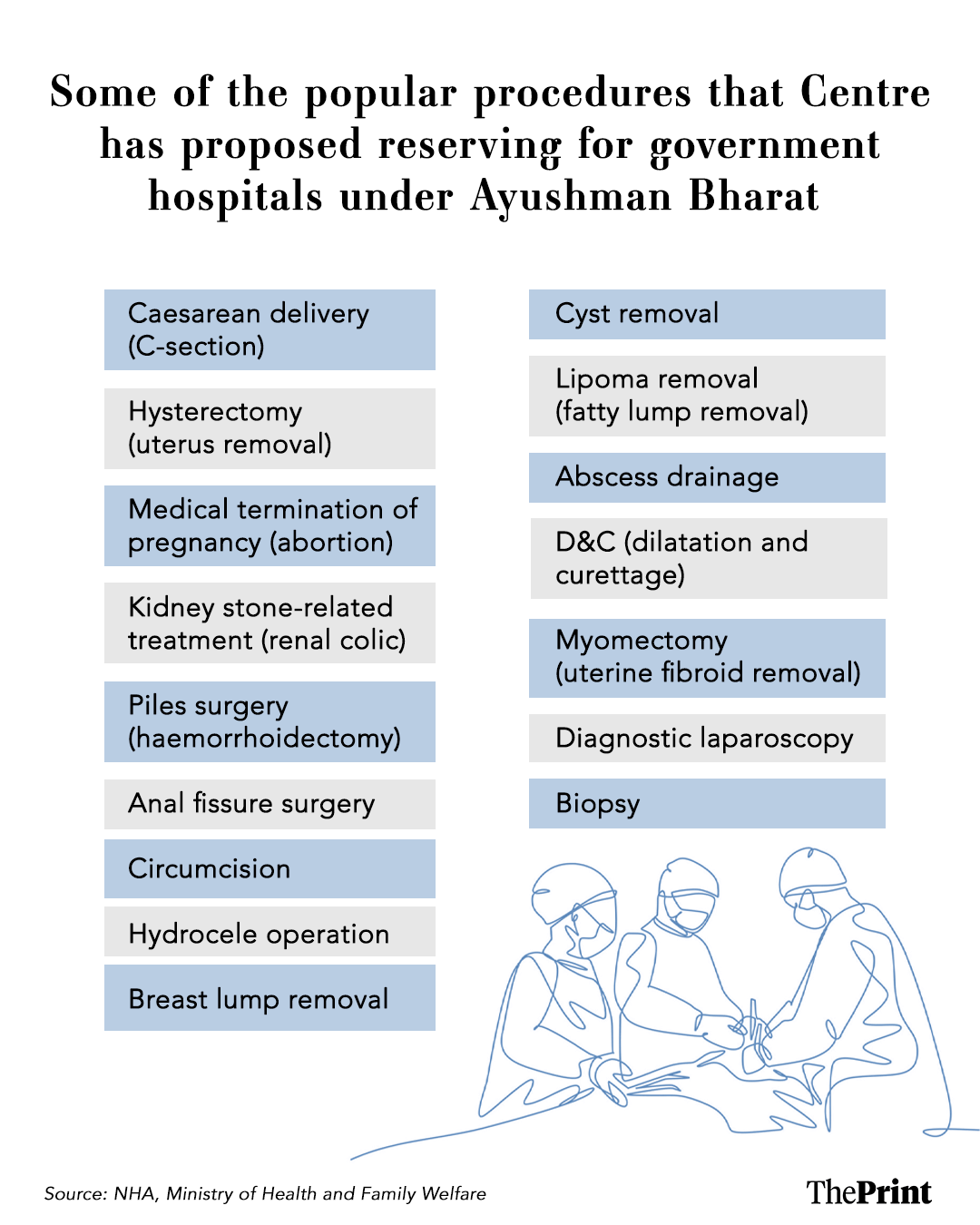
The existing list of 23 nationally reserved packages already includes Caesarean deliveries (C-sections) and some types of hysterectomy (removal of the uterus). The proposed expansion adds other hysterectomy procedures, including vaginal and laparoscopically assisted surgeries.
Other surgical procedures on the expanded list include medical termination of pregnancy (MTP), circumcision, hydrocele operations, surgery for piles (haemorrhoids) and anal fissures, breast lump removal, biopsies, and removal of cysts and lipomas (fatty lumps). Gynaecological procedures such as dilation and curettage (D&C), myomectomy (removal of uterine fibroids) and diagnostic laparoscopy are also covered.
The packages also include treatment for several common medical conditions, including severe anaemia, accelerated hypertension, acute bronchitis, diarrhoea, dysentery, gastroenteritis, urinary tract infections, renal colic (pain commonly associated with kidney stones), acute febrile illnesses and diabetic foot complications.
Screening for diabetic retinopathy and glaucoma is also included. Another 12 packages cover mental health conditions, particularly those affecting children and adolescents, including Attention Deficit Hyperactivity Disorder (ADHD), anxiety and depressive disorders, conduct disorders and developmental disorders.
According to NHA officials, the focus is on conditions and procedures that can be handled within the existing clinical capacities of government institutions, subject to the availability of necessary infrastructure, equipment and trained personnel.
Also Read: ‘Not through this dacoity’: SC questions Rs 1.3 lakh hospital charge for Rs 11,000 cancer injection
NHA’s rationale
The NHA’s stated rationale is to bring commonly needed treatments closer to beneficiaries, particularly those in rural and underserved areas, while increasing the utilisation of government hospitals.
NHA officials said the move has two key objectives: bringing commonly required services closer to people, and strengthening public hospitals through greater use of their existing infrastructure and additional financial resources. A senior NHA official said many of these treatments could be provided at public facilities with the infrastructure, equipment and trained medical personnel already available.
“The idea is to ensure that patients do not have to travel long distances for treatments that can be effectively provided at government hospitals closer to their homes. At the same time, greater utilisation of these facilities will help strengthen their infrastructure and improve the quality of services,” the official said.
Officials said this would particularly benefit people in rural and underserved areas, reducing the need to travel to distant hospitals and cutting associated expenses, loss of wages and inconvenience to families.
Under the scheme, government hospitals receive reimbursements for treating eligible beneficiaries. The NHA expects the additional funds generated through higher patient numbers to be used for infrastructure upgrades, medical equipment, medicines, consumables, operational expenses and hiring healthcare professionals.
“Greater utilisation of public hospitals will also mean more resources flowing back into these institutions through PM-JAY reimbursements. These funds can be reinvested in improving facilities and patient care, creating a sustainable cycle of better service delivery and stronger public hospitals,” the official said.
Concerns over public hospitals’ capacity
The proposal comes amid concerns over the misuse of certain treatment packages under PM-JAY, including unnecessary caesarean sections and hysterectomies. Indu Bhushan, former Chief Executive Officer of the National Health Authority, said reserving certain treatments for government hospitals could help address fraud and abuse, particularly in cases where medical claims were difficult to verify.
He explained, “Some of these health conditions are prone to fraud and abuse. For example, in mental health, if a hospital says a patient has depression and needs counselling, it is difficult to audit. In surgery, you can see what operation was performed. But if a hospital says a patient had a high fever, it is much harder to verify.”
Bhushan said shifting treatments that were difficult to audit to government hospitals could reduce incentives for misuse, as reimbursements would flow to government institutions rather than private providers.
He also acknowledged that restricting packages to public hospitals could reduce access to private facilities to some extent. However, he said beneficiaries should be allowed to approach private hospitals when government facilities did not have the necessary beds or capacity.
K.M. Gopakumar, Senior Researcher and Legal Advisor at the Third World Network, also said there was a case for shifting treatments vulnerable to fraud and unnecessary interventions to public hospitals. But he questioned whether government facilities were equipped to handle the additional patients. “In many places, these public health facilities do not exist. There are shortages of primary health centres and community health centres. Many of them do not have functioning operation theatres. Without ensuring adequate facilities, you suddenly cut this… People will be forced to go to the private sector and pay the money,” he said.
Government data underscores these concerns. According to the Health Ministry’s Health Dynamics of India (Infrastructure and Human Resources) 2022-23, formerly known as Rural Health Statistics, rural community health centres across the country had 13,232 sanctioned posts for specialists as of 31 March 2023, but only 4,413 were filled.
The gaps are wide in the specialties that many of the proposed packages depend on, Gopakumar said.
The report also found that a large number of sub-centres, the first point of contact between the primary health system and rural communities, do not have their own buildings and operate from rented premises or space provided by village panchayats or voluntary societies.
He also questioned the NHA’s assumption that additional reimbursements under PM-JAY would automatically strengthen public hospitals. These improvements would take time, he said, and should not be used to justify restricting treatment options in the interim.
He also cautioned against overlooking charitable hospitals, which depend on reimbursements under government health schemes to sustain their services. Gopakumar said the government should strengthen regulation of private hospitals alongside efforts to expand public healthcare capacity.
“One of the objectives of Ayushman Bharat has been to leverage the capacity of the private sector. But there also have to be checks and balances. The public sector needs to be strengthened, but that should happen alongside ensuring that people have access to treatment,” he said.
(Edited by Nardeep Singh Dahiya)