



New Delhi: On 17 September, Kanhaiya Lal sat outside Dr B.R. Ambedkar Institute Rotary Cancer Hospital at the All India Institute of Medical Sciences (AIIMS) in New Delhi, holding medical documents belonging to his 77-year-old father, Ratan Lal. They had travelled from Madanpur Khadar in south-east Delhi to find out which anti-cancer drug the doctors would prescribe, and whether the family could afford it.
In April, a biopsy had confirmed that Ratan Lal had renal cell carcinoma. His oncologist has recommended pembrolizumab, 200 mg, every three weeks.
Sold in India as Keytruda, pembrolizumab costs around Rs 1.95 lakh per 100 mg vial. A 200 mg dose would cost about Rs 3.9 lakh. At that price, 17 doses over roughly a year, would cost Rs 66.3 lakh.
The family’s predicament highlights the limits of the Centre’s latest attempt to make cancer medicines affordable.
On 17 October, the National Pharmaceutical Pricing Authority (NPPA) capped trade margins on 137 anti-cancer medicines at 30 percent of their maximum retail price (MRP), excluding goods and services tax (GST).
Trade margins are the mark-ups added to a medicine’s price by distributors, stockists and other intermediaries before it reaches the patient. Capping these margins at 30 percent limits how much these intermediaries can add to the price, but does not directly cap what manufacturers charge when they first sell the medicine. If the starting price is high, the medicine may remain expensive despite the margin cap.
The revised prices come into effect 9 November onwards. The government expects MRPs to fall by up to 70 percent, estimating annual savings of Rs 2,500 crore for patients.
Industry experts told ThePrint that the actual savings of the patients will depend on manufacturers’ prices, competition between brands and whether hospitals pass on the reductions to patients.
Also Read: A daily pill to fight breast cancer? Swiss firm’s new drug completes 3 phases of human trials
How the cap works & why expensive drugs may remain expensive
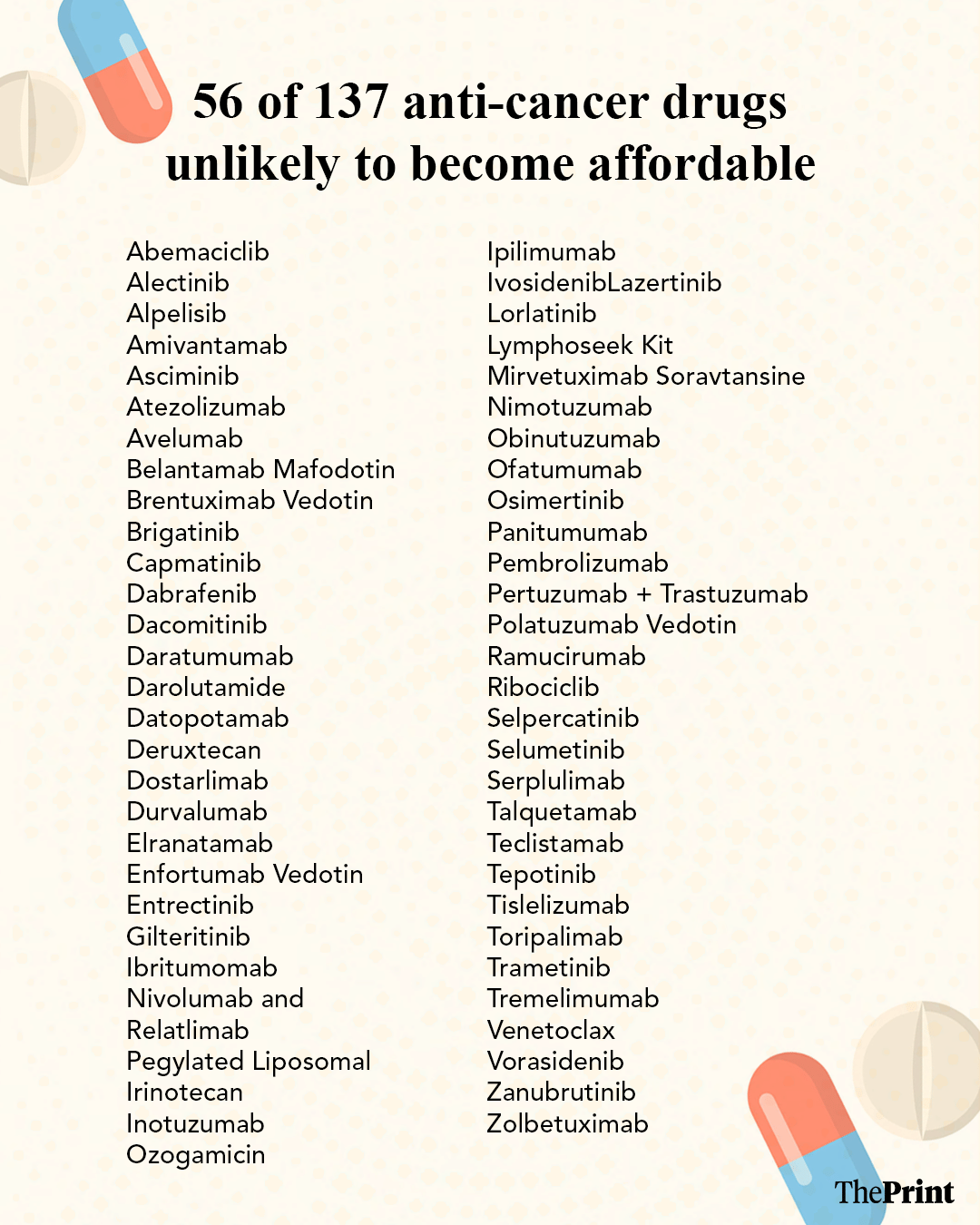
An analysis by the Working Group on Access to Medicines and Treatments—a network of patients and activists fighting for affordable healthcare—identified around 56 of the 137 medicines as having a single source of supply, limiting competition between manufacturers. With few alternatives available, manufacturers face less competitive pressure to lower prices, meaning patients may see limited benefit from a cap on trade margins if the starting price remains high.
When a pharmaceutical company sells a medicine, stockists, distributors and retailers can add margins before it reaches the patient. The new order limits the total trade margin on the 137 medicines to 30 percent of the final price before GST.
For example, if a pharmaceutical company sells a medicine to a stockist for Rs 100, the stockist and other distributors can add a total margin of 42.86 percent, the exact mark-up percentage applied to a cost price to achieve a 30 percent profit margin.
The total price then rises to Rs 142.86, before GST. The margin would be 30 percent of final price before GST.
In pharmaceutical pricing, capping the margin at 30 percent of the final selling price means the mark-up added to the distributor’s cost must be exactly 42.857 percent (rounded to 42.86 percent).
The 137 medicines are non-scheduled drugs under the Drugs (Prices Control) Order, 2013, and are not on the National List of Essential Medicines. Their prices are not fixed through the same ceiling-price formula used for scheduled medicines. Annual price increase for non-scheduled medicines are generally limited to 10 percent, and the NPPA can intervene in public interest under paragraph 19 of the order, which it has now used to cap trade margins, including on patented drugs.
For scheduled medicines, NPPA calculates ceiling prices using market data, with a 16 percent retail margin.
K.M. Gopakumar, co-convenor of the Working Group on Access to Medicines and Treatments, said, “Medicines supplied by single manufacturers, mainly patented medicines, are sold to stockists and hospitals at high prices. Hence, their prices are unlikely to fall to affordable levels, even after the trade margins are capped.”
He explained that manufacturers retain considerable freedom to set the price at which they sell medicines to stockists or distributors, known as the price to stockist or price to distributor (PTS/PTD). This price forms the basis for calculating the revised MRP.
Take ribociclib, for instance, a drug used to treat certain types of breast cancer and covered by the new order. The NPPA had capped trade margins on the drug in 2019. Yet a 21-tablet pack of Kryxana, a branded version of ribociclib marketed by Novartis India, is listed at an MRP of Rs 24,435. Three packs a month would cost Rs 73,305 at the listed price. Gopakumar cited monthly costs rising from Rs 58,000 in 2022 to Rs 78,000 in 2025.
Similarly, AstraZeneca’s cancer drug osimertinib, also covered by the 2019 trade-margin cap, remains listed above Rs 1.5 lakh on several online pharmacies, he said.
Prescribing practices also influence which medicines patients receive. Dr Aashish Chaudhry, managing director of Aakash Healthcare Super Speciality Hospital in New Delhi, said cancer specialists often rely on newer patented drugs.
“Cancer doctors are hardly using generics,” he said. “Because in cancer, if the generic doesn’t work, the cancer is going to flare up in no time.” About 50 percent of the cancer drugs used at his hospital, he said, are newer molecules and patented products.
Medicines with multiple manufacturers may see greater reductions because patients have more alternatives. Off-patent drugs such as trastuzumab, palbociclib and sorafenib are sold under different brands, sometimes at printed prices well above what hospitals pay.
“The cap could narrow these price differences, although the extent of any reduction will vary by product,” Gopakumar said.
Mumbai-based Dr Abhay Shukla, national co-convenor of Jan Swasthya Abhiyan, a coalition of NGOs and health professionals across the country, said the government may be overstating the benefits.
“The capping on trade margin is a step forward, but is of limited value,” he said.
He argued that all approved medicines should instead be brought under government-fixed ceiling prices by including them in the scheduled list.
ThePrint has reached out to the NPPA for a comment on the concerns over the order and how it will ensure that the trade-margin cap translates into lower prices for patients. This report will be updated if and when a response is received.
Why free medicines & hospital purchases could affect savings
The order contains two other provisions that could affect the prices patients ultimately pay. One concerns free medicines supplied through patient assistance programmes; the other pertains to hospitals that buy medicines directly from manufacturers.
Under paragraph 12(d) of the government notification, qualifying free supplies under patient assistance programmes (PAPs) run by pharmaceutical companies can be excluded from certain price calculations, subject to conditions.
The calculation uses net sales revenue and quantity sold. If free vials are excluded, the calculated price per paid vial could increase.
For example, if a company sells 50 vials for Rs 50 lakh and gives another 50 vials free to patients under a patient assistance programme, the free vials may be left out of the price calculation. The calculation would then divide Rs 50 lakh by 50 vials, giving a price of Rs 1 lakh per vial. If all 100 vials were counted, the average would be Rs 50,000 per vial.
This, Gopakumar said, means excluding free vials can double the price of paid vials, potentially reducing the impact of the 30 percent trade-margin cap.
He added that more than half the pembrolizumab used in India was supplied through assistance programmes.
The second provision concerns hospitals that buy medicines directly from manufacturers. The government’s order treats these hospitals as stockists or distributors when calculating the MRP.
In simple terms, if a drug company sells a medicine directly to a hospital for Rs 1 lakh, the hospital is treated as a stockist or distributor under the order. The permitted mark-up is up to 42.86 percent of that price—applied to cost price to achieve 30 percent profit margin. An addition of Rs 42,860 would take the price to Rs 1,42,860 before GST.
Gopakumar said this could create a financial incentive for hospitals to source more medicines directly from drug company, and sell more expensive brands when cheaper versions of the same medicine are available.
For example, if a hospital buys one brand of a medicine for Rs 1 lakh and another brand of the same for Rs 50,000, it can add up to Rs 42,860 to the price of the first brand, but only Rs 21,430 (42.86 percent of Rs 50,000) to the second.
Gopakumar said the order allows hospitals buying medicines directly from manufacturers to add a mark-up of up to 42.86 percent, higher than the 16 percent retail margin allowed for scheduled medicines.
However, Bengaluru-based Dr Chandrasekar Chikkamuniyappa, chairman and managing director of DHEE Hospitals—a 207-bed multi-super speciality tertiary care hospital—said the 42.86 percent mark-up was a ceiling or the maximum hospitals are allowed to charge, not a mandatory margin. Hospitals can charge less than that, he said.
“A percentage margin yields more money on a more expensive medicine, but as it did before the order also, when margins were wider. The new cap narrows that incentive but does not eliminate it,” he said.
He said oncologists should decide which medicine to prescribe, while hospitals should document brand selection and discuss costs and alternatives with patients.
The cap may encourage the use of generics and biosimilars where doctors have confidence in their quality and supply. But where no generic exists, it does little to lower the price of a patented medicine, which manufacturers set and the order does not directly cap, he said.
Dr Chaudhry said hospitals’ margins on newer cancer medicines were generally 10 to 12 percent, far below the 30 percent the order allows. Hospitals prefer buying from distributors because holding large inventories of cancer medicines is expensive and difficult, he said.
“A hospital may be doing 40 chemotherapy cycles in a week. It cannot hold inventory for 500 or 1,000 cycles and operate at the same margins,” he said. Hospitals typically keep 14-15 days of stock and rely on distributors to source from multiple manufacturers and ensure timely supplies, he added.
ThePrint has also approached patented drug manufacturers AstraZeneca and Novo Nordisk for a comment on how the order could affect the pricing of their patented cancer medicines, patient assistance programmes and access to newer treatments, besides generic drugmakers Dr Reddy’s and Cipla on its impact on brand-wise price differences and trade margins. This report will be updated if and when any responses are received.
‘Lower listed prices must translate into actual savings’
Even if the cap reduces the printed price of a medicine, patients’ total treatment bills may not fall by the same amount. Hospitals can charge separately for chemotherapy administration and day-care services.
Dr Chaudhry said hospitals cannot charge more than the printed MRP for medicines. At his hospital, a chemotherapy day-care procedure may cost around Rs 8,000 to Rs 10,000, compared to about Rs 40,000 at some other hospitals, he said.
Dr Pragya Shukla, head of clinical oncology at the Delhi State Cancer Institute, New Delhi, said the policy should focus on the total cost of treatment rather than medicine prices alone. “There should be greater transparency across the supply chain to ensure that reductions in listed prices translate into actual savings for patients.”
Dr Chikkamuniyappa said patients should see the printed MRP, the amount actually charged for the medicine, and separately itemised charges for preparation, administration and monitoring. He cited the 2017 knee implant price cap as an example. While implant prices fell, patients saved more at hospitals that offered all-inclusive packages. At other hospitals, the savings were offset by other charges.
“What protects patients is a transparent, itemised bill; the cap alone does not do it,” he said.
A second industry source, requesting anonymity, said the impact of the NPPA’s 30 percent trade-margin cap should be assessed by whether patients could access and complete treatment, not simply by reductions in listed prices.
“A reduction in the price of a medicine is valuable. But affordability also depends on diagnosis, availability of treatment, infrastructure, insurance coverage, reimbursement and continuity of care,” the source said.
The cap should be based on evidence and designed with a long-term perspective, the source further said, adding that price controls should not inadvertently penalise innovation.
(Edited by Viny Mishra)
Also read: Cancer drug prices may fall 70 percent under new government cap. Will it make treatment affordable