



New Delhi: Indians paid more from their own pockets for healthcare in 2022-23, reversing a decade-long trend, according to the latest National Health Accounts (NHA) report, released by the Union Health Ministry.
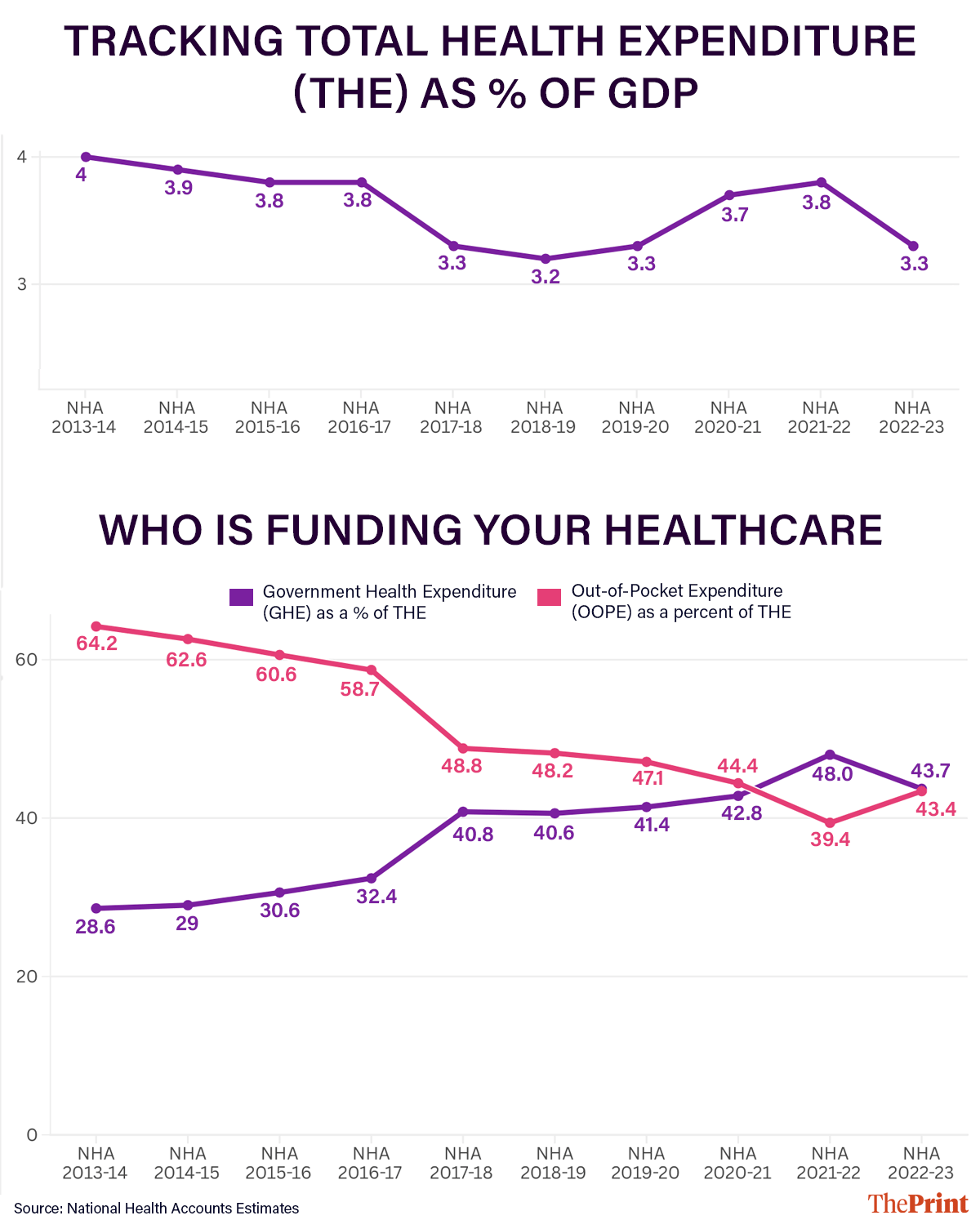
Out-of-pocket expenditure (OOPE), the money households spend directly on doctors, medicines and tests without any reimbursement from insurance or government schemes, rose to 43.4 percent of total health expenditure in 2022-23, up from 39.4 percent the previous year.
That is a four percentage-point jump in a single year. In absolute terms, households paid Rs 3,82,629 crore, or Rs 2,767 per capita, according to the report.
The data was released Wednesday as part of the 10th NHA estimates report 2022-23, prepared by the National Health Accounts Technical Secretariat under the Ministry of Health and Family Welfare. The report tracks how much India spends on health, who pays for it, and where the money goes.
The picture is more encouraging over the past decade.
The share of healthcare costs paid directly by households fell steadily from 64.2 percent in 2013-14 to a record low of 39.4 percent in 2021-22, before rising again in 2022-23. A decade ago, nearly two-thirds of every rupee spent on healthcare came from the patient’s own pocket. By 2021-22, that had dropped to less than two-fifths.
The health ministry attributed the decline over the decade to increased government spending, expansion of public health schemes and emergency expenditure during the Covid-19 pandemic.
“To address the emergency COVID pandemic situation, the Government increased the health expenditure significantly to 1.84 percent of GDP in 2021-22 towards managing the pandemic situation and mass COVID vaccination programme. Given these additional spending by the government as a one-time measure, OOPE as a percentage of Total Health Expenditure during this period declined to 39.4 percent,” according to the Union health ministry.
Government spending rose over a decade, but fell sharply after the pandemic.
Government health expenditure, what the central and state governments together spend on health, rose from 28.6 percent of total health expenditure in 2013-14 to a peak of 48 percent in 2021-22.
That was the first time government spending overtook what households were paying out of pocket, which stood at 39.4 percent of total health expenditure that year. The remaining share was split between social security schemes such as Ayushman Bharat at 8.7 percent, private health insurance at 7.4 percent and other sources including employer contributions.
As pandemic spending ended, the government’s share fell back to 43.7 percent in 2022-23. In absolute terms, the government spent Rs 3,85,332 crore on health in 2022-23, which is 1.48 percent of GDP.
Within government spending, the Centre pulled back more sharply than states.
The Union government’s share of total government health spending fell from 41.8 percent to 36.3 percent, meaning states are now funding nearly two-thirds of all public health expenditure.
At the same time, government health expenditure formed a smaller share of the General Government Expenditure, falling from 6.12 percent to 4.89 percent, meaning both the Centre and states collectively chose to spend a smaller proportion of their total budgets on health in 2022-23 than the year before.
Total health expenditure is the sum of everything spent on healthcare in India in a year: by the government, households, private insurers, companies and donors combined.
In 2013-14, this was 4 percent of GDP. In 2022-23, it stood at 3.3 percent, down from 3.8 percent the previous year.
The 2021-22 figure was elevated by COVID spending; as that ended, overall health spending contracted. This means that the country is spending a smaller share of its economy on health than it was a decade ago, even as the population has grown and healthcare costs have risen.
In per capita terms, Indians spent Rs 6,373 on health in 2022-23, down from Rs 6,602 the year before. But prices also rose over this period. Once inflation is accounted for, the decline is sharper.
The real value of health spending per person fell from Rs 4,205 to Rs 3,831. In other words, Indians were getting less healthcare for their money in 2022-23, and were paying a bigger share of that reduced spending from their own pockets.
Also Read: India is facing a silent elderly care crisis. Budget 2026 must confront it
Health insurance spending
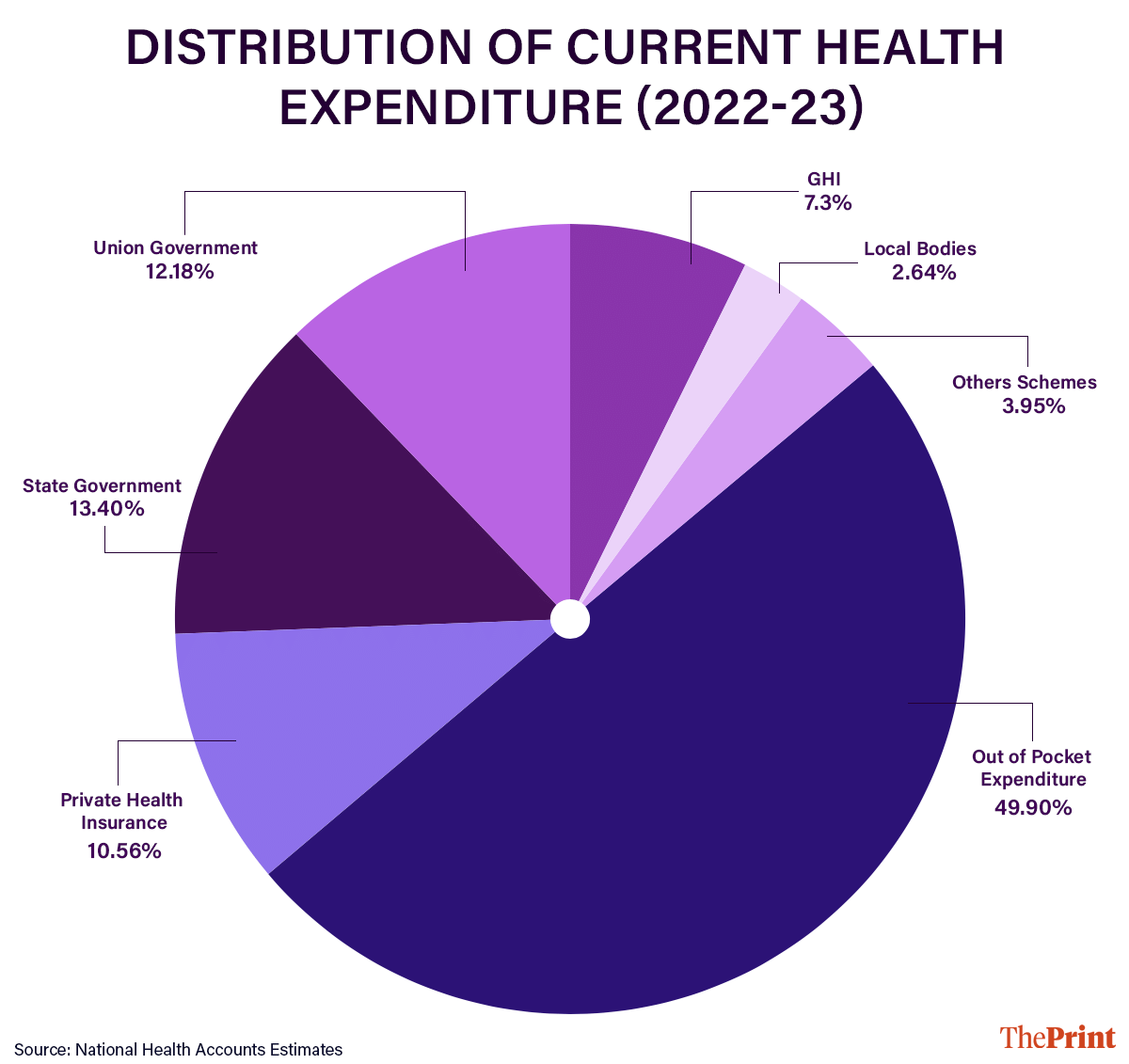
Two types of health insurance spending grew in 2022-23. Social security expenditure—which covers government-funded schemes such as Ayushman Bharat, the Employees’ State Insurance Corporation (ESIC) and the Central Government Health Scheme (CGHS)—rose from 8.7 percent of total health expenditure in 2021-22 to 9.9 percent in 2022-23.
A decade ago it was just 6 percent.
Private health insurance, where individuals or employers pay premiums to insurance companies, also grew from 7.4 percent to 9.2 percent, compared to just 3.4 percent in 2013-14.
On paper, more Indians are covered by some form of health insurance than ever before. But the simultaneous rise in out-of-pocket spending suggests that insurance, whether government or private, is not covering enough of what people actually spend when they fall sick.
Private hospitals and pharmacies absorb over half of all health spending
Of every rupee spent on healthcare in India, private hospitals received 30.83 percent of current health expenditure, at Rs 2,36,410 crore, nearly double the 16.73 percent that went to government hospitals.
Pharmacies accounted for another 21.19 percent, at Rs 1,62,511 crore. Together, private hospitals and pharmacies consumed more than half of India’s total current health expenditure of Rs 7,66,814 crore, and a large part of that cost falls directly on households.
Household health expenditure including insurance premiums stood at 56.44 percent of current health expenditure in 2022-23, up from 50.6 percent the year before.
This means that more than half of all money spent on healthcare in India came from ordinary people, either paid directly at hospitals and pharmacies or as insurance premiums, rather than from the government or employers. That share grew by nearly six percentage points in a single year.
The NHA estimates are based on a global standard framework used by countries to track health spending. The out-of-pocket expenditure figures in this report are drawn from a household survey conducted in 2017-18. The report extrapolates those figures forward to 2022-23 by adjusting for inflation and population growth.
(Edited by Ajeet Tiwari)
Also Read: Safdarjung Hospital says govt, not doctors, provides beds—after woman exposes chaos in wards