



Mumbai: When dancer Sherlyn Fernandes posted a video of herself dancing to ‘Aa Zara’ on Instagram in 2019, she probably did not expect Sunidhi Chauhan to show up. But there it was: a like and a follow. For Fernandes, it was a fan moment. For Chauhan, it was the beginning of something neither of them could have anticipated.
It was the moment when Sunidhi Chauhan rose, renewed, re-invented herself — from a place Bollywood had archived her in.
“Our collab started as an online dance class in 2019. Three years later in December 2022, one day Sunidhi ma’am said, ‘let’s do dance for our shows.’ That’s it. We started with college fests and events like IIFA,” Fernandes told ThePrint.
“It gave us confidence. And, August 20, 2023, we all will remember this date. We did our first concert of ‘I Am Home’.”
That’s how Sunidhi Chauhan’s second act began. Her phoenix moment when she rose from the ashes of a crowded industry and rebuilt herself, as a concert star. In her resurgence, she has redefined female playback singing as a faceless, second-tier role. She is now front and centre on stage with her unapologetic persona and performance.
“I have always been this free, this happy, this liberated on stage from the time I started singing on stage. As for the recent success, I didn’t intend to make my fans wait, but as they say, ‘It’s never too late’,” Chauhan said, reflecting on why this scale of recognition has arrived now.
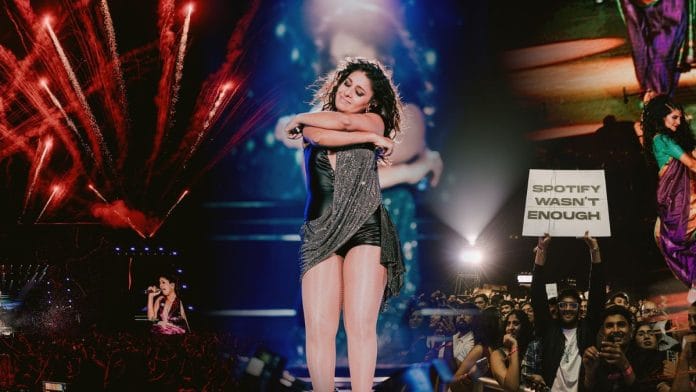
Chauhan opened the ten-city ‘I Am Home’ India tour at Mumbai’s NESCO Centre on 24 December 2025, to a crowd of more than 20,000. It was one of the largest single-artist concert turnouts the city had seen all year. Mid-way through the night, she brought out a special guest, Alisha Chinai, the singer widely regarded as the first to give Hindi film music a glimpse of the same full-throttle, Western-leaning voice.
Then, in the finale of her tour in Kolkata on 25 March this year, Chauhan’s collar mic hit a technical snag mid-performance. She tried switching to a handheld one while a member of the crew rushed on the stage to fix it. But the audience wasn’t willing to lose even a minute. They simply took over, singing ‘Parda’ back to her, word for word, loud enough to carry the song themselves while the fix was underway.

Clips went viral within hours, with fans calling it “the best concert ever” and even comparing her live command to that of Shakira and Taylor Swift.
In the same concert, she also broke into an impromptu Bengali song and the Kolkata crowd, already fully in her hands, lost it all over again.
“Over the past 10 years, the shows have turned into something else. Social media has been so strong in the last decade that if you perform in the smallest region, people come to know about it. So it’s just that people get to see me more because of social media. Nothing has gone unnoticed,” she said.
It helps that Sunidhi Chauhan 2.0 is coming at a time of social media stardom when you don’t need movies to keep a career going. Lyricist and singer Piyush Mishra’s and Vishal Dadlani’s live concerts are sold-out events. And Chauhan has captured the promise of this moment.
“Earlier, singers came from only two schools of singing, either Lata ji-Asha ji or Chitra ji. But, Sunidhi wasn’t influenced by either of them. There was a unique texture and huskiness in her voice which she was capable of adjusting. It was like a breath of fresh air,” composer Ehsaan Noorani, of Indian musical trio Shankar-Ehsaan-Loy, told ThePrint.
“She created a third school.”
The song ‘Bumbro Bumbro’ from the 2000 film Mission Kashmir was Ehsaan’s first collaboration with Sunidhi Chauhan. The composer recalled how she was ideally supposed to just sing an antra, but ended up recording the full song.
“Jaskinder Narula had already recorded the full song, we needed Sunidhi for one antra. But when she came to the studio, Vinod Chopra asked her to record the full song. Then he said: ‘I can see Preity Zinta singing this.’ That’s how Chauhan sang the whole song and Narula had one antra,” Ehsaan recalled.
Charting own course
Sunidhi Chauhan has always been a rule breaker.
For decades, the archetypal female playback voice was expected to be soft, sweet, and restrained. Lata Mangeshkar and Asha Bhosle defined that sound so completely that an entire industry mistook it for the only sound a woman’s voice could make on a Hindi film soundtrack. Then Chauhan arrived at full volume with her full-throttle voice, and redefined Indian women’s selfhood.
It was the decade of Channel V and MTV India. It unleashed several non-signature female voices. Indie music threw up talent from across India who went beyond the dominance of ‘nasal’. The time was right. It made Sunidhi Chauhan cruise in with her full-throttle singing. Chauhan didn’t fight for space in the room, she created one for herself and left the door open behind her for the likes of Richa Sharma, Shilpa Rao, and Rekha Bhardwaj. She ruled the charts for more than two decades and her songs have become part of the country’s pop-culture vocabulary, from ‘Beedi’ and ‘Dhoom Machale’ to ‘Sheila Ki Jawani’. From singing at temples at the age of five to the reigning star of Bollywood playback, Chauhan demonstrated sheer range.
But playback singing is an unforgiving business. New voices arrive every season, in every TV talent show, trends turn over fast, and yesterday’s chart-topper becomes tomorrow’s elevator music. Women, especially, get written off first and fastest.
And the industry has its own parameters for when that clock starts ticking: marriage, then motherhood. Sunidhi Chauhan’s life has moved through very different chapters, but she kept working.
“Singing is a different kind of fun. It gives me a different kind of perspective. It’s difficult. And I love doing difficult things. I used to love singing the most difficult songs even in school. It started as a challenge. Doing this on the mic is not easy, but I love it. So, I am going to continue doing it,” the singer added.
In 2012, she married composer and musician Hitesh Sonik, whom she had known for years through the music industry, and the couple welcomed their son, Tegh, in 2018. Sunidhi Chauhan juggled motherhood and a new career with a finesse only women know.
At 39, she bounced back as a stage performer. She didn’t need the big daddies of Bollywood to sign her in, give her contracts. She chartered her own course this time, and didn’t wait on anyone’s largesse.
Making a mark
Her concerts now carry the scale and adrenaline of a pop spectacle.
Her ‘I Am Home’ India tour moved through venues including Delhi’s Jawaharlal Nehru Stadium and Bengaluru’s District Arena at Terraform, where more than 18,000 fans turned up. What makes these shows special is how physically involved she is in them.
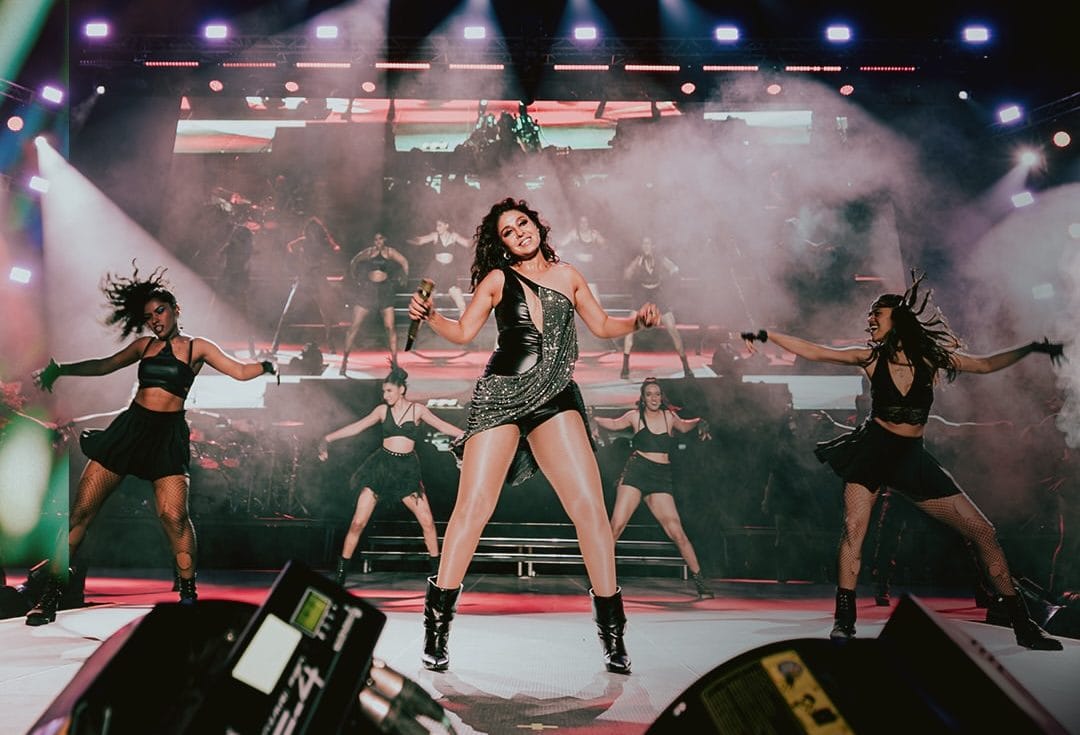
Chauhan dances through, works the crowd, changes costumes, and sustains that intensity for close to three hours. In Dubai, at the Coca-Cola Arena, she performed ‘Crazy Kiya Re’ and ‘Desi Girl’ with the kind of high-octane stomping, hip-driven physicality that is more associated with international pop performers, while also moving between Hindi numbers and English tracks like ‘Unholy’.
Her 2025 international run took in major venues, including the Gas South Arena in Georgia and H-E-B Center in Texas, and the EagleBank Arena in Virginia.
And she is firing up her fanbase like never before. Her fan pages and communities have largely grown organically. Across all her fan pages, there is a following of over 2 lakh. They share candid shots, concert news and videos, BTS moments, and special photos from concerts.
Offline, they don’t miss any chance to catch a glimpse of her. And, concerts aren’t the only way. Sukanya Ball, a professional dancer and a fan of Chauhan for as long as she can remember, would regularly visit one of the singer’s favourite spots in Andheri West — most likely KEFI Eatery & Cafe — and wait for hours, sometimes as long as three, hoping to see Chauhan.
For nearly a year, she did this almost every day. Yet Chauhan always seemed to elude her by minutes.
Then, one day in April, during a workshop hosted by Kian Gupta, the moment finally came.
“We were doing the ‘Lucky Boy’ workshop and she actually appeared. My phone fell, and I was crying. I couldn’t stop,” Sukanya recalled.
When she finally went up to meet her, Chauhan recognised her immediately: “You are Sukanya, right?”
For Sukanya, it’s a memory she will take to her grave.
Chauhan’s ‘first meeting’ impact on her fans, contemporaries, and seniors have always been alike. They all get mesmerised, for different reasons.
Ehsaan remembers being “amazed and shocked” by Chauhan when she, for the first time, walked into his studio and straight up started singing George Benson’s ‘This Masquerade’.
“She was a kid at that time. Her parents had got her to our studio. But, the confidence was way beyond her age. So, Loy was playing ‘This Masquerade’, and she simply started singing along and with such perfection… I was shocked,” he said.
Though Ehsaan doesn’t remember the year or Sunidhi Chauhan’s age at that time, that moment is still fresh in his memory.
Later, the same girl went on to win three Filmfare Awards, two for Best Female Playback Singer and one RD Burman Award for New Music Talent for ‘Ruki Ruki Si Zindagi’ (Mast, 1999), the song that first put her on the map.
Not just a fanbase
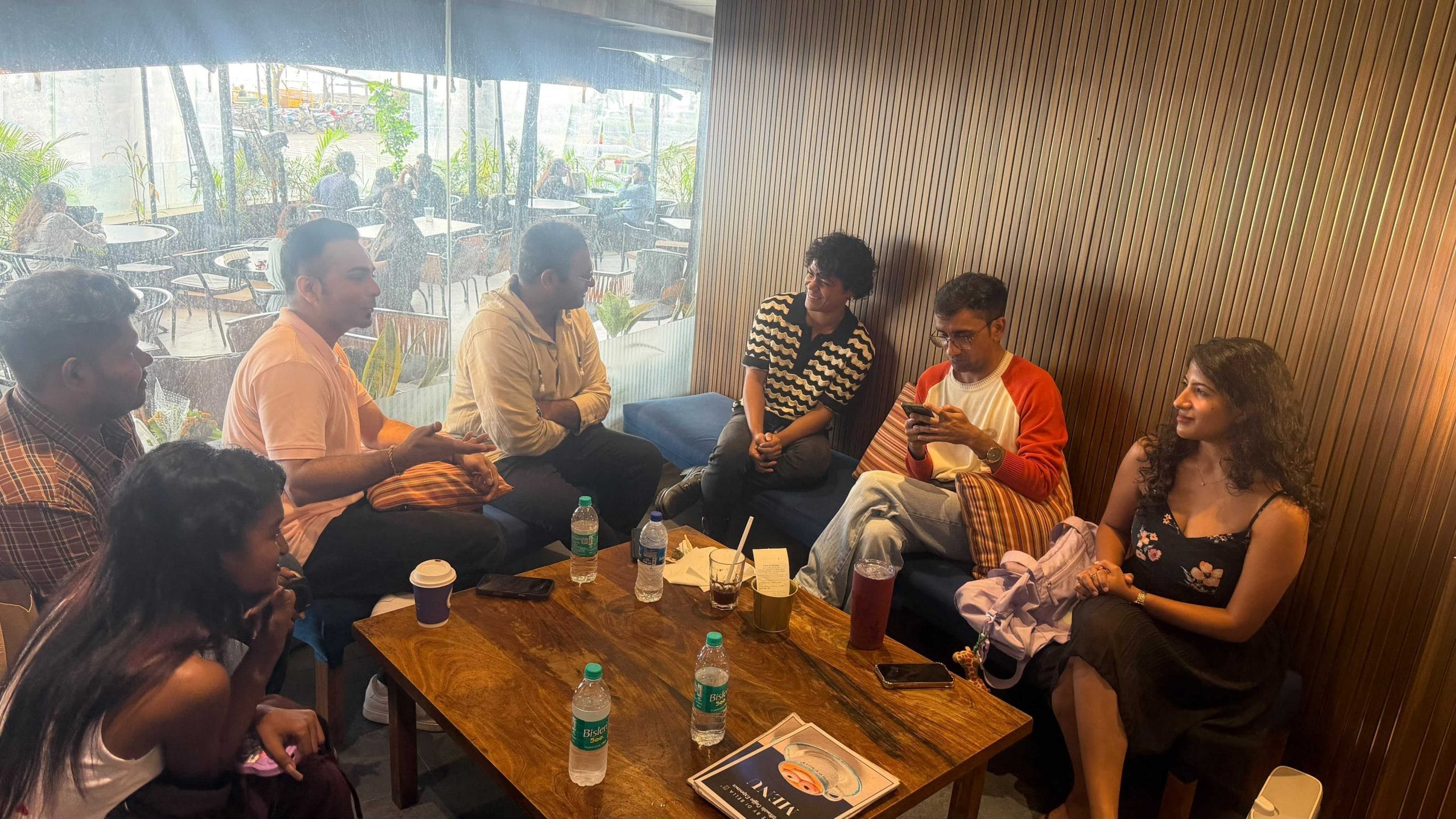
At a coffee shop across from Bandstand, a group of Sunidhi Chauhan fans argued over what actually makes the singer different from others. Her team choreographer Kian observed silently.
“Her versatility,” one said. “She can cater to every emotion,” another countered. A third one stepped in to sum it up: “She can make you dance, and then make you miss your ex.”
Then a video call on Kian’s phone made the table go silent. It was Sunidhi Chauhan herself calling her fans during a short break in between her ad shoots.
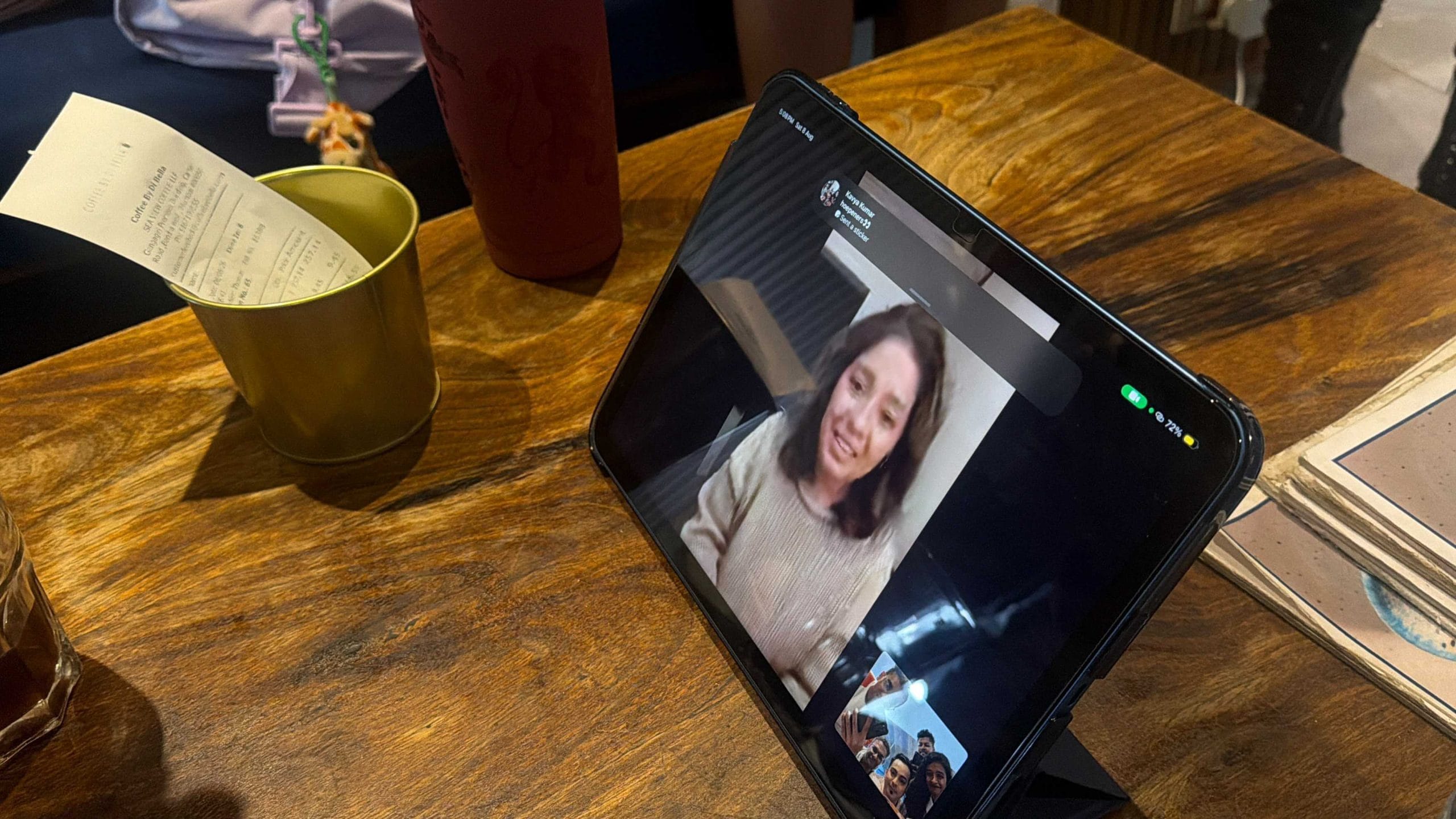
Phones came out instantly, with everyone scrambling to capture the moment. One hand was visibly shaking, one face frozen from being starstruck. Awkward laughs broke the silence. Still, no one knew what to say.
“I am so lucky to have you guys. I don’t know how you find time from your busy schedules to do these activities,” Chauhan told them, her voice suddenly filling the coffee shop and making her fans comfortable.
The 15-minute video call said everything about why Chauhan’s fandom feels different from most in the industry. She doesn’t just perform for her fans. She connects with them and treats them like one big family.
The fans wished her a happy birthday in advance, and the call ended. But the wide smiles and the sparkle in their eyes stayed.
“Oh my god. It was so unexpected. My hands are still shaking. Wow, this is the best day of my life,” said Sukanya, who was also there at the cafe.
As the group ran through their favourites, ‘Vo Tere Mere Ishq Ka,’ ‘Janib’, ‘Yaaram’, ‘Kande Pohe’, ‘Mast’, ‘Janiye’, it was Sukanya who jumped in saying, “How can you forget ‘Beedi’ and ‘Sheila Ki Jawani’?”
Altering the vocabulary
It’s a question that says more than it lets on. Artists in the Indian music industry, women especially, get stereotyped fast. And, Sunidhi Chauhan was no exception. On the strength of songs like ‘Beedi’ and ‘Sheila Ki Jawani’, she was, for a stretch of her career, branded as Bollywood’s undisputed queen of item numbers — the racy, glamour-forward songs that rarely had anything to do with the film’s actual story.
‘Sheila Ki Jawani’ from Farah Khan’s Tees Maar Khan (2010) drew its own scrutiny over the years, largely for its lyrics. That scrutiny hasn’t entirely faded. In January this year, a professor, Pandit Dharennavar, filed a complaint objecting to several of Chauhan’s songs, including ‘Beedi’, her 2006 track from Omkara.
In response, the District Child Protection Officer in South Goa issued an advisory ahead of one of her Goa concerts, asking organisers not to play songs promoting tobacco or alcohol, given that children would be attending the event.
Chauhan’s fans have a strongly worded answer to those who question the morality of her songs.
“I would ask them about the ‘thekas’ and cigarette shops operating within a few kilometres of schools and colleges, and the children who encounter these things every day,” said Gaurav Arora, a die-hard Sunidhi Chauhan fan.
According to him, and most of her fans, the idea of ‘Children must not hear this’ shouldn’t become an excuse to control what they can understand.
The industry, too, backs her. Chauhan’s long-time collaborator Ehsaan dismisses the debate around her performance style and songs as a matter of individual opinion.
“Everyone has an opinion. All we know is that she is very successful, and she has had to work for every bit of it,” he said.
A classical singer may not be entirely sold on Chauhan’s electrifying and Shakira-esque moves. But for Abhilasha Ojha, the singer’s willingness to take that risk is part of what makes her different.
“It doesn’t compel me to go and watch her live shows, but she is bold. She is taking that risk. She knows people can say whatever they want, but she is doing what she wants. She has that spunk,” Ojha said.
For her, Chauhan’s ability to challenge convention extends beyond her stage presence. She points to ‘Bhaage Re Mann’ from Chameli (2003) as an important example of how Chauhan altered the vocabulary of playback singing.
“She is one singer who made breathing into the mic normal,” Ojha said.
At a time when singers, including Ojha, were trained to ensure that the sound of their breathing did not come through the microphone, with Lata Mangeshkar and Asha Bhosle representing that ideal of controlled, polished playback, Chauhan allowed the breath to remain audible. She made it a part of the song. For example, in Bhaage Re Mann, she sings, “Behta hai man kahin”, and then softly breathes into the mic.
That instinct, to leave the seams visible, whether in her singing or her physical performance, is also why Ojha says Chauhan’s evolution cannot be separated from the life she has lived.
“Her growth and entire life needs to be understood, because that also holds a piece of the puzzle as to where she gets that boldness of her voice and moves from,” she said.
That said, Ojha highlighted an interesting contrast between the woman on stage and the woman off it.
In appearances on Farah Khan’s YouTube channel and Shekhar Tonite, she has seen a Chauhan who is “very calm, restrained, very different from what she’s on stage.”
This transformation, from the composed woman in conversation to the feisty performer on the stage, takes Ojha back to one of Chauhan’s early interviews. The young singer back then spoke about idolising Whitney Houston and wanting to win an Oscar someday.
Her ambition was always audacious. So, the reinvention on stage now suggests that the scale of that ambition has never really changed.
‘Not a diva’
Kian Gupta has performed alongside Sunidhi Chauhan since her very first concert in August 2023, and he still gets goosebumps talking about how it started. The 29-year-old was the choreographer behind ‘Aa Zara’, the same video that first connected Fernandes to Chauhan online.
So when Fernandes called him in to help choreograph the first concert, the moment landed with real weight. He was, in his own words, “overwhelmed and emotional.”
Somewhere in the process of working, Kian said, he started to understand the woman behind the voice.
“People might think she is some diva but Sunidhi is the most down-to-earth person you will ever meet,” he said.
The dancers who work with her are equally taken by the child-like excitement she brings to every performance. They speak of her enthusiasm to attempt even the most demanding choreography, sometimes in heavy corsets and restrictive costumes, simply because she wants to try every step.
For the team, there is one word that defines their relationship with every performance: ‘responsibility’. They see it as their job to ensure that Chauhan is never let down on stage, no matter how physically demanding the show gets.
Before they step on the stage, they have their own ritual. Much like Shah Rukh Khan’s ‘70 minutes’ speech to his team in Chak De! India, Chauhan’s dancers gather for a short prayer, taking a moment to express gratitude for the work, the opportunities, and the chance to perform together.
Fernandes, asked to describe Chauhan, hesitated at first. The words didn’t come easily. Then, she settled on “a diligent student.”
She recalled dance sessions where she had to physically stop Chauhan from practicing, because the singer simply won’t quit until a move is exactly right.
“Not only in music, her rhythm in dance is equally good. Her memory is also sharp, which helps. She watches and learns choreographies,” Fernandes said, calling Chauhan a natural dancer.
That instinct went fully public in 2023, when Sunidhi Chauhan walked onto a concert stage in a striking silver co-ord set and performed ‘Saaki Saaki,’ ‘Hips Don’t Lie’, and ‘Sheila Ki Jawani’ back to back. The outfit, paired with dancing that held nothing back, became as much a talking point as the songs. It was proof that Chauhan had entered a new phase of her career.
Clips of the set went viral almost immediately, and the internet was divided. While some praised the sheer confidence of it, others called the look too revealing, insisting the styling and choreography “didn’t suit her”, and coined her as a “wannabe.”
Kian doesn’t see it that way at all.
“In my personal opinion, there have always been people crying about why don’t any of our artists put on a show that’s of international standards and it’s always this rave about artists from outside. She just changed that, she just showed and completely owned the stage,” he said.
For him and countless fans, Sunidhi Chauhan, who collaborated with Enrique Iglesias on ‘Heartbeat’ in 2011, has helped put India on the world stage. It showcased that India too has artists that can do big production shows, who can sing and dance live for three hours, who can have fashion and get everyone on their feet.
“She changed the game for concerts here and we are just happy to have helped play a part in it,” Kian added.
Chauhan has spoken before about her early pull toward dance. As a child, she loved both singing and dancing in equal measure, but when it came to choosing one, she picked music.
Everyone on Chauhan’s team speaks about her work ethic with something close to reverence, but for Kian, what stands out is deeper than discipline. It’s how unguarded Sunidhi Chauhan is.
Both Kian and Fernandes admit that working this closely with her has, in a sense, ruined them for anyone else. After Chauhan, they say, it’s genuinely hard to imagine working with most other artists in the industry.
Kian, who has spent a decade in the business, working with a long list of artists, pointed to something small.
Most performers, however grounded they appear in public, still maintain a quiet hierarchy on tour.
“They stay in better hotels while the team stays separately,” he said.
“Sunidhi ma’am has always been like, ‘I want to be with my team. I want them next to me.’ It might be a small gesture, but it is so rare. You as a performer feel seen. She doesn’t treat us as background dancers.”
World beyond the ‘patli awaaz’
Kumar Sanu was among the first few singers Chauhan collaborated with, on the duet ‘Meri Zindagi Mein’ from Ajnabee in 2001, five years after she made her playback debut with ‘Ladki Deewani Ladka Deewana’ in Shastra (1996).
“Voh tayyar hokar aayi thi industry mein, something everyone should learn from her,” Sanu told ThePrint.
What stayed with him was the voice. “It was unique and damdaar,” he said. Something which became the foundation of her career.
‘Beedi’ remains perhaps the clearest demonstration of what that voice could do. Chauhan attacks the song with a raw, earthy energy and it gives the track its swagger and friction. But the significance of her voice lies precisely in the fact that she never allowed it to become a one-note signature. Chauhan knows when not to use that force. She can make her voice thin, soften its edges, and allow its texture to emerge without overpowering the composition.
The singer who could tear through ‘Beedi’ could also disappear into the intimacy of ‘Bin Tere’, ‘Te Amo’, and ‘Bhaage Re Mann’, and turn ‘Darkhaast’ into something almost weightless.
For some younger singers, that had a consequence beyond music.
Singer Anjana Padmanabhan, who has lent her voice to several Tamil and Kannada film soundtracks including ‘Sattru Munbu’ and ‘Rajathi Raja’, remembers worrying when her own voice, initially soft and thin, began becoming coarser.
The change unsettled her. But, Chauhan unknowingly gave her another way of hearing it.
“Her voice gave me the confidence that patli aur soft awaaz sab kuch nahi hoti. She gave me that confidence,” said Padmanabhan.
That may be one of Chauhan’s less visible contributions to Hindi film music.
But while she may be a legend, she maintains that she has no advice for the younger generations.
“I don’t think today’s singers need any kind of advice. They are already very prepared. They are exposed to a lot more than we were exposed to. The whole music is right in front of you because of the social media and all the apps and everything. The whole world is in your hands right now,” Chauhan said.
The only advice she has for anyone though is simply:“Be true to yourself. Be honest with your art. That’s all you need. Rest will be taken care of.”
Singer Vaibhav Gupta, who made his playback debut with ‘Mann Atkeya’ in Dhurandhar: The Revenge, remembers encountering that voice from the audience before understanding what it meant from inside a recording studio. He attended one of Chauhan’s concerts in 2018 and was stunned by the sheer physicality of the performance.
“She taught the industry and audiences that female vocals can also sound like this. Earlier, it was all about patli awaaz which suits love songs. We were so used to it that we never expected to hear something like what Sunidhi Chauhan offered,” he said.
For Gupta, ‘Chhaliya’ remains one of Chauhan’s most revealing performances. He calls the song different and underrated, particularly because its “apparent simplicity conceals the technical control behind it.”
“People think it is easy. When I heard the song, I thought, pata nahi kaise gaya (don’t know how she sang),” he said.
Chauhan arrived at a moment when Hindi film music was becoming more receptive to Western pop, rock, and electronic influences, but the female voice was still largely expected to conform to a familiar template.
“Before Sunidhi, Alisha Chinai ji would sing with a western feel. After her, there was a gap in the industry. That’s when Sunidhi came, captured it and then expanded it,” said Kumar Sanu.
Gupta also described Chauhan as someone who brought “westernised female singing” to India, particularly through her ability to alter the quality and weight of her voice from one song to another.
Gupta recently found himself recording in a studio where Chauhan had recorded several songs before him. He had heard stories about her efficiency in the booth.
“I have heard that she is a different person in recording studios. One-two hours mein gaana done. How can someone be so precise? How is it even possible I don’t know but that’s why she is who she is,” he said, laughing.
Also read: Johnny Walker quit Bollywood because comedy was getting vulgar, says son Nasir Khan
Her ‘rivalries’
She pours over even the smallest production details.
Kian said that Sunidhi Chauhan personally signs off on things as granular as which stones go on a performer’s dress. For her, the small details aren’t an afterthought. They are what makes and breaks the act.
Her career, for all its scale, has stayed largely free of the kind of public feuding that often shadows artists at her level. There have been no verbal battles, no known falling-outs with peers. Except when she spoke about singing reality shows.
In 2021, when Indian Idol 12 came under fire over allegations of manufactured praise for contestants, Chauhan came out and confirmed it.
The singer admitted that she also had once been told to praise performances regardless of what she genuinely thought.
“I couldn’t do what they wanted and I had to part ways. Hence, today, I am not judging any reality show,” she said.
This comes after her own breakout came through winning a reality show, Meri Awaaz Suno.
The professionalism Chauhan’s team boasts about remained intact even during the most difficult turns in her personal life. Ehsaan recalled that during her divorce, she never allowed the turmoil to spill into the recording room.
That same sense of professionalism has perhaps also shaped her equation with her contemporaries.
Shreya Ghoshal and Sunidhi Chauhan have been compared and pitted against each other almost from the beginning of their careers, something Ghoshal now finds amusing.
The duo have defied lazy predictions of woman-vs-woman rivalry. Their friendship deepened through motherhood. And, then the 2024 independent duet ‘Chhaila’ offered another glimpse of their camaraderie.
Ghoshal tried rap for the first time, the two traded playful verses, danced together, and spent hours laughing in the studio.
“People somehow derive pleasure from painting an image about women artists and feeling that they are in competition, in some kind of battlefield,” Ghoshal said in a 2024 interview. “Sorry to disappoint everyone but Sunidhi and I are besties.”
Chauhan, for her part, put the relationship more simply: “Our choices may not be alike, but our souls are.”
(Edited by Aamaan Alam Khan)
The correct headline for the article would have been ‘Eminently putdownable Sunidhi Chauhan …’.
Skimpy clothes and sexually suggestive dancing on stage don’t make you a ‘star’. You need to have actual singing talent. Hard work, dedication and commitment to the craft are non-negotiable.
Talk to anyone and they would rate Shreya Ghoshal head and shoulders above Sunidhi Chauhan.