






Karnal: Rajesh Narwal keeps going over it in his head, trying to make sense of what happened—but every road leads back to guilt. The 54-year-old government employee finds himself guilty of marrying off his son, Vinay Narwal, too early. Of not stopping him when he changed his Kashmir itinerary at the last minute. Of not calling him again that day.
And most of all, he feels guilty for not listening when his son spoke about fertility preservation.
“He used to say that nowadays, people do family planning at a very late stage, so it is better to take the help of a doctor. If I had listened to him then, at least I would have had his child with me today—something of him would still be here,” he said, voice carrying the weight of the tragedy that continues to haunt him a year later.
On 22 April 2025, terrorists opened fire in Pahalgam’s Baisaran Valley, killing 26 people—25 tourists, many of them honeymooners, and a local pony handler. It was the deadliest civilian attack in Kashmir in over two decades.
Among those killed was 26-year-old Lieutenant Vinay Narwal from Karnal, a young Navy officer posted in Kochi. Just six days after his wedding, he was shot in the neck, chest, and thigh and collapsed in front of his wife, Himanshi. In a video that later spread widely, she recalled, “A man came, asked if he was Muslim, and then fired.”
In the days that followed, Vinay was mourned across the country as a “newlywed martyr” and a “brave son of Haryana”. He was cremated with full honours, with senior Navy officials paying their respects.
But as the investigation moved forward and those responsible were identified, the national anger began to fade. The country mourned and moved on. The family never could.
The family still speaks of Vinay in the present tense, as if he never left. Calls and visits haven’t stopped—his colleagues drop by often, and even strangers, some calling from as far as London, have become familiar voices checking in on them.
For Rajesh, the grief is tied not just to what happened that day, but to what could have been. He has accepted grief as a permanent companion now.
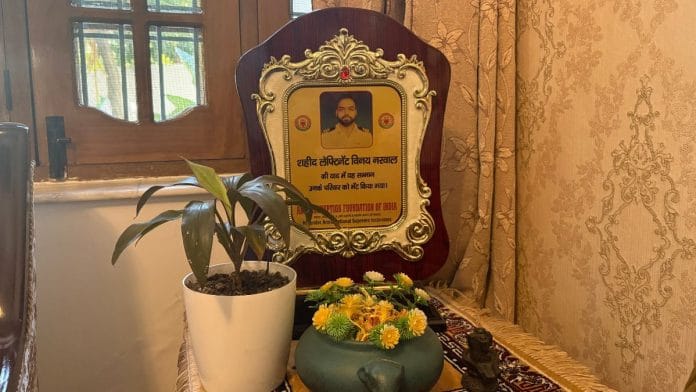
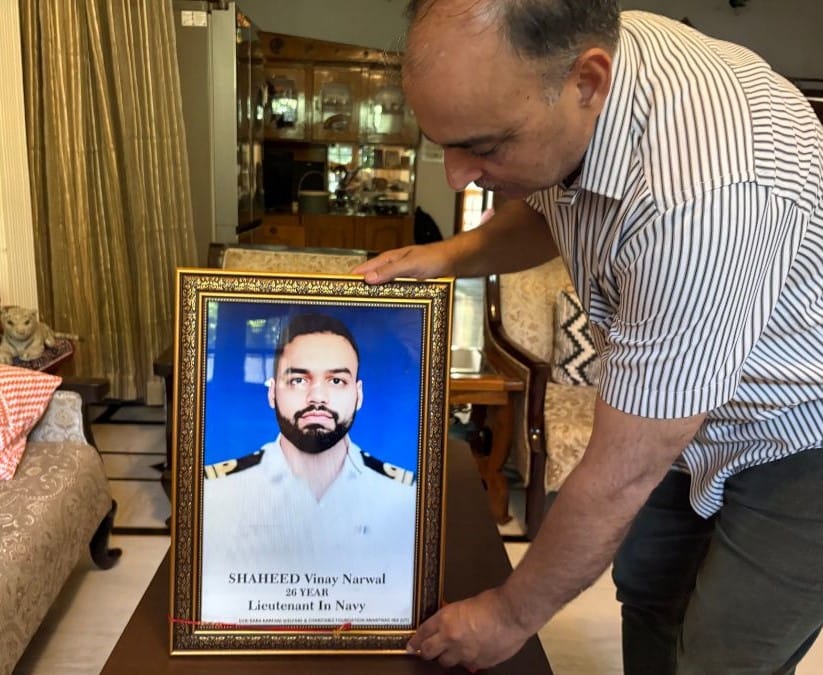
In the dining room, a photograph of Vinay carries the words: “Shaheed Vinay Narwal, 26, Lieutenant in the Navy.” In the living room, a corner has been turned into a small memorial—a framed tribute from the Anti-Corruption Foundation of India, with a small plant and a shivling placed in front.
He wants to dedicate a bench in his son’s memory, but hasn’t been able to bring himself to do it. The thought feels too heavy—a father memorialising a son in his 20s, someone he talked to for hours every single day.
“Sometimes I don’t feel like staying at home. I just leave, go to a friend’s place or to my sister’s nearby. I stay there for a week. I’ve been doing this for the past year,” he said.
Time hasn’t healed him in the way people expect—the pain hasn’t eased. Like him, the family has found small ways to cope.
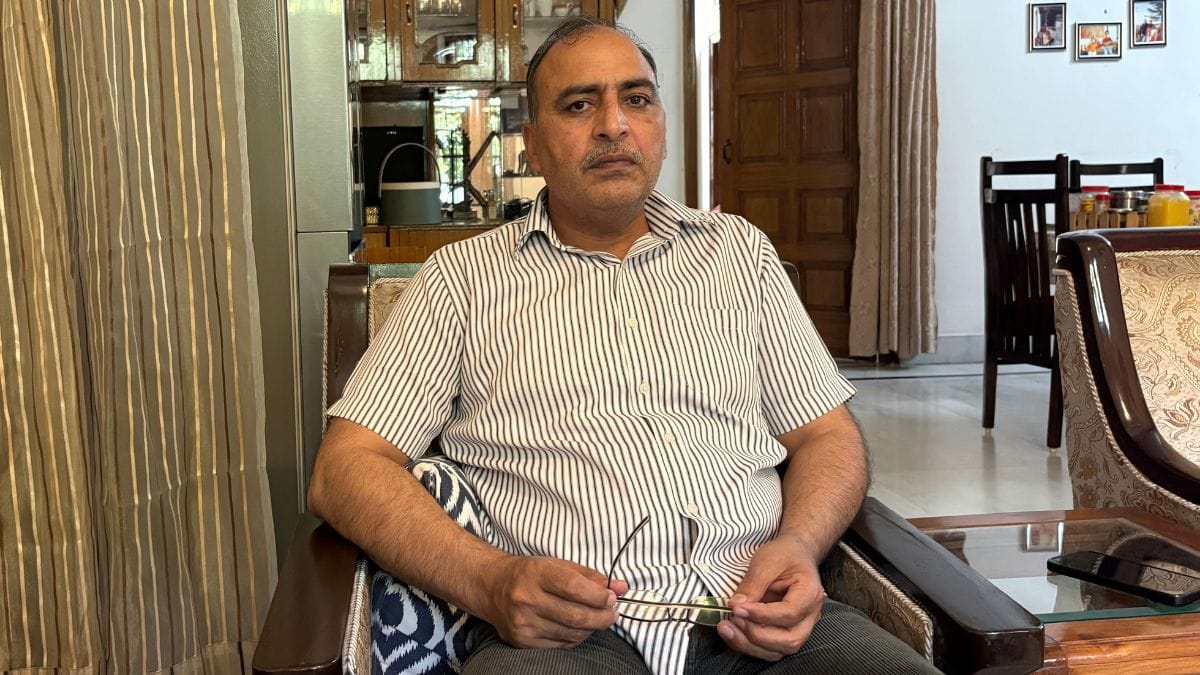
Stream of visitors
The family—Vinay’s grandparents, his parents, and his younger sister Srishti—still sits down for breakfast together. But their evenings are much lonelier now.
Rajesh returns home from his GST office in Panipat, but the old routine is gone. There was a time he would spend at least half an hour with his parents playing UNO, chatting, or just sitting together. That time is long gone.
“They start talking about Vinay and break down, and I can’t bear to see them like that. They remember him every single day,” he said.
The family still speaks of Vinay in the present tense, as if he never left. Calls and visits haven’t stopped—his colleagues drop by often, and even strangers, some calling from as far as London, have become familiar voices checking in on them.
At their home in Karnal, the door is often open, with people coming in. They don’t ask intrusive questions or reopen wounds. They just come to see how the family is holding up.
There are no wedding photographs on display in the house. The walls carry only older memories—pictures from Vinay and Srishti’s childhood, their grandparents, and a younger Rajesh and Asha. The families never even got a wedding album made, Rajesh said.
“Some time ago, one of Vinay’s friends came all the way from Andaman just to meet us. He stayed for three to four hours and then left. Vinay had many friends. They all keep calling, asking if we’re doing okay,” said Srishti. Her father agreed, adding that Vinay was a good person who left a lasting impression on the people he met.
Moments like these blur the line between strangers and family, but the grief cannot be shared in any real sense.
“It cannot be shared with relatives, friends, or acquaintances; it doesn’t lessen that way. This kind of pain belongs entirely to the one who carries it,” said Rajesh.
Becoming a parent changes a person. But for Rajesh, the loss of his son has reshaped him in ways that can’t be undone.
Earlier, news of someone else’s loss—a son, a daughter—would pass him by. Now, having lived through it himself, it affects him.
“Now I deeply feel the pain of other families,” he said.
Also read: Bohra Muslim women are fighting against FGM anonymously in SC—they fear community boycott
‘Protocol has been done’
Rajesh sat on the sofa, questioning the illusion of control—the idea that life can be planned and carried out the way one intends.
His wife, Asha Narwal, has been seeing a psychiatrist since the incident. She is on medication now. Rajesh, too, went for a few sessions, but stopped after a while.
“What they were telling me, I already knew. What was I supposed to do with it?” he said.
He admitted that without medical help, his wife may not have been able to come out of the shock.
Yet, Rajesh has also withdrawn emotionally. He avoids speaking about Vinay with his parents, and the only conversations he has about his son are with his wife and daughter. Even those are rare.
He has never questioned the idea of young people joining the Indian Armed Forces. What happened to his son, he said, could have happened to anyone—it did happen to others who were there that day.
“A relative’s son, just 17, has recently cleared the Navy exam. He’ll soon become a Lieutenant at a very young age,” he added with pride.
As far as the government is concerned, Rajesh said the process was followed. “There is a system. The protocol has been done.”
The Haryana government had announced an ex gratia payment of Rs 50 lakh and offered a government job to one family member, to be appointed according to the parents’ preference.
According to Ravi Rathi, a neighbour of the family, the loss has changed others in the family, too. Vinay’s grandfather, who was not very religious earlier, now visits the temple every day.
Srishti, just over a year younger than Vinay, had skipped a class and studied with him all the way until Class 12. She is now 26, the age he was when he died.
“We were very close. We spoke every day. It was almost like telepathy. I would randomly call him and ask what was wrong, and he would tell me. He used to do the same with me,” she said.
Now an HCS officer, Srishti is pursuing a PhD in Sociology from Panjab University.
Also read: Kashmiris with Pakistani MBBS degrees are desperate for jobs. ‘My father was militant, not me’
No wedding photos on display
Vinay’s wife Himanshi now lives with her family in Gurugram and works there. The Narwal family is no longer in close touch with her, but they do speak occasionally.
Rajesh said he had known Himanshi’s father for nearly 30 years. Their families had, at different points, considered matches for both Vinay and Himanshi, but never thought of bringing them together until one day, when Himanshi’s father asked for Vinay’s profile, and the marriage was decided.
“They had a destination wedding in Mohali. Both families shared the expenses equally,” Rajesh said.
Now, he questions that decision. He often returns to the same thought—whether the marriage was arranged too quickly, whether there was a rush. “It happened in April, in peak summer. People don’t usually hold weddings in that season, but we did,” he said.
There are no wedding photographs on display in the house. The walls carry only older memories—pictures from Vinay and Srishti’s childhood, their grandparents, and a younger Rajesh and Asha. The families never even got a wedding album made, Rajesh said.
In the days after the attack, Himanshi found herself at the centre of an online backlash after she appealed for calm and asked people not to target Muslims or Kashmiris. “We don’t want this. We want peace—only peace. Of course, we want justice. The people responsible should be punished,” she had said.
Her words drew criticism online. Many who had earlier expressed sympathy began posting abusive comments. Some questioned her right to speak, saying the marriage had lasted only a few days.
“I don’t know whether she feels the same loss, or whether her family does. It’s possible they haven’t been able to move on either,” Rajesh said.
ThePrint reached out to Himanshi, but she declined to comment.
(Edited by Prasanna Bachchhav)