





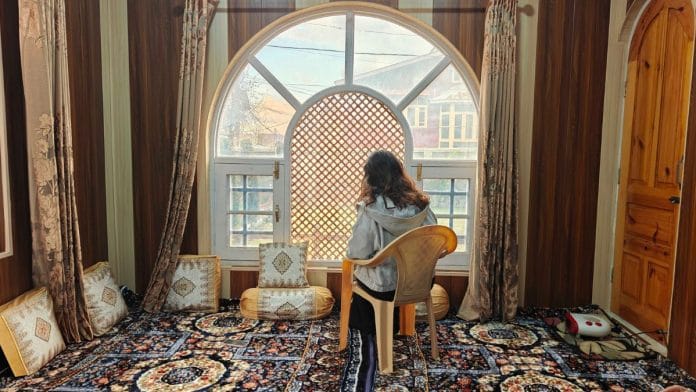

Baramulla: T completed her MBBS in Pakistan in 2022, but in India, her degree is considered null, reducing her to a Class 12 pass. Everything in between—her five years in medical college, a one-year ‘mandatory’ internship, her stay in Pakistan’s Faisalabad, and her return to Kashmir—is under suspicion. Now, her degree hangs like a decorative piece of paper in her home in Baramulla.
“My MBBS degree is not valid in India. I can’t practice here. For the last three years, I have been confined to my room, unemployed,” said the 28-year-old, fumbling as she rubbed her hands. T was visibly anxious while talking to ThePrint. The anxiety, she said, is driven by the uncertainty of her future.
When T returned to Kashmir in 2023, her phone buzzed with calls from the security officials, followed by rigorous interrogation about her stay in Pakistan. The calls soon transformed into monthly visits to her home. Her visa, MBBS degree, and her family’s bank records for the last six years were scrutinised. It was for security clearance, she was told. A ‘clearance’ which never came.
Hundreds of similar certificates are now stuck in a liminal space of state suspicion, security fears and stigma in Narendra Modi’s India. What was once kosher in Kashmir’s separatist political culture, which recognised no borders, is today an unacceptable practice.
Kashmiri students began going to Pakistan for MBBS in the early 2000s. Pakistan offered a special quota for students from Kashmir for all professional courses, especially MBBS and engineering, covering lodging and tuition fees. The arrangement was facilitated by Hurriyat Conference leaders like Syed Ali Shah Geelani, who provided recommendation letters.
Initially, the preference was given to the families of militants, those killed by the security forces in Kashmir and those associated with the separatist groups. Most of these students, after returning to Kashmir, were absorbed into the medical system after basic security clearance.
Over time, the pool widened. Soon, students with no separatist links and those unable to secure seats through regional and national medical entrance exams began opting for Pakistan. A degree that would cost them a hefty amount was available for Rs five to six lakh in the neighbouring country. Every year, 50 students go to Pakistan to study medicine.
Soon, the allegations surfaced that separatists were demanding monetary benefits from students seeking admission in Pakistan.
“This was Pakistan’s attempt to create a soft corner among Kashmiris by offering special packages. The Hurriyat leaders and agents who sold these seats to Kashmiri students for minimal prices used to demand a huge chunk of money for themselves. Families of students desperate for an MBBS degree—at almost no cost—would pay,” said a senior police officer.
‘I fully cooperated with the authorities’
The policies, however, changed soon. In 2019, the University Grants Commission (UGC) and the All India Council for Technical Education (AICTE) declared degrees from institutions in Pakistan-occupied Kashmir (PoK) invalid. The move followed cases in which 25 students sought attestation at the Indian High Commission in Islamabad.
In 2020, the Medical Council of India (MCI) stated that degrees from PoK would not be recognised in India. The decision came amid plans by then Pakistan Prime Minister Imran Khan to allocate around 1,600 seats for Kashmiri students.
In 2021, the State Investigative Agency (SIA) of Jammu and Kashmir filed a chargesheet against nine people for selling Pakistani MBBS seats to Kashmiri students for huge amounts. It was found that the separatist groups channelled the money to fuel unrest in Kashmir, including the unrest following the killing of Burhan Wani, the poster boy of the banned Hizbul Mujahideen.
“For instance, an MBBS degree costs Rs six lakh, but the separatists would ask for 20 lakh, of which they would keep 15 lakh for themselves,” said a senior police official.
A year later, the National Medical Commission (NMC) issued a public notice warning students against pursuing medical education in Pakistan. “Any Indian national/overseas citizen of India who intends to take admission in MBBS/BDS or equivalent medical course in any medical college in Pakistan shall not be eligible for appearing in FMGE or seeking employment in India on the basis of educational qualifications acquired in Pakistan…,” the notice states, adding that an exception has been made for those who had joined Pakistan degree colleges/institutions before December 2018 after obtaining security clearance from the Ministry of Home Affairs (MHA).
But T had gone to Pakistan in 2016. She still awaits security clearance from the MHA. Around 256 graduates from the 2014-2018 batches are awaiting clearance to practise in India.
Initially, when security officials approached T, she was told that they were checking her details for terror funding.
“I fully cooperated with the authorities and gave everything they asked for, even my family’s land records. But they didn’t find anything,” said T, adding that she was 18 when she went to Pakistan for MBBS.
Also read: Meet the Kashmiri Muslim leading the ABVP in the valley
The 10 November doomsday
Last September, more than three dozen students received a clearance letter. As their phones beeped, they couldn’t believe their eyes. They kept rereading the mail. One amongst them was T’s friend, who cried for hours, overwhelmed by emotions.
The mail planted a hope in T’s heart. And now, her clearance letter shall be on its way too. But then, 10 November happened. A car laden with explosives blew up near the Red Fort, killing over a dozen people. At the centre of it was suicide bomber Umar un Nabi from Pulwama. Nabi was also a doctor. Following the incident, the security clearance again came to a halt, and the process of scrutiny started again.
“The Red Fort attack got these Kashmiri students under the lens once again. Since the culprit was also a doctor, although not trained from Pakistan, the police increased the vigilance around everything that had to do with Pakistan,” the police officer said, adding that before the attack, the MHA had cleared more than 50 submission for security clearance.
T said that her first reaction after watching the news was a sense of dread that the incident would cast a shadow over her and other students.
“Everyone was upset. This unfortunate incident put all Kashmiris in the medical field under scrutiny,” she said.
Following the incident, the Delhi police had sought details from private hospitals on doctors who had earned their MBBS degree from Pakistan, Bangladesh, the UAE and China.
The students said that their lives have been put on hold. Men, in their late twenties, are unemployed. And the families are now struggling to find marriage proposals. While women are being rejected by the potential matches wary of any association with Pakistan and the trouble it could bring.
Parents of several students claimed that their children have slipped into depression. Former Municipal Council President of Baramulla, Touseef Raina, said that the students should not have to bear the cost of what Hurriyat leaders did.
“What Hurriyat leaders did should not cast its shadow on these students. They have been waiting for security clearances for almost a decade now. If the security checks have found these students to be innocent, their degrees should be validated,” said Raina.
Some of these students are still working at the private hospital for Rs 6,000-8,000. They have the consensus of the neighbourhood who sympathise with them. But they are mostly engaged in rudimentary roles such as first aid, as they are not licensed and don’t have practical experience.
Broken dreams
When T was pursuing her MBBS in Faisalabad, the east-central part of the Punjab province in Pakistan, she was not alone. There were at least 30 other Kashmiri students with her. They lived together, sharing not just space but also a dream—a dream to work in India.
“We always wanted to serve India,” she said. “Many of my school seniors had gone to Pakistan, studied there, and came back to become reputed doctors in Kashmir and other states of India.”
Today, that dream has collapsed into something far smaller. T is now considering a job at a call centre. On her phone, she scrolls through AI-generated suggestions for “jobs for 12th pass”—results vary from call centre executive to computer assistant.
“The dream of being an independent woman, with a stethoscope around my neck, is over,” she said. “There are no jobs in the market for a 12th-class pass.”
Her mother, a government employee, has run from pillar to post, knocking on every possible door.
“There is no department, no politician we haven’t approached. You name it, and we have been there,” she said, breaking down.
In Anantnag, the father of another MBBS student is facing a similar ordeal. Every month, he receives a call from the security forces, sometimes CID, other times SIA and other investigative agencies, to answer the same set of questions again.
“When I ask why now, reminding them that I had been there just last month, they tell me, ‘ek baar aa jao, phir se woh jawab de dena,” the 60-year-old said.
And now, he remembers all the questions on the tip of his fingers: Why did you go to Pakistan? Where was your son studying? How much did you pay? When did he return?
His son had already completed two years of MBBS at a college in PoK when the notification came. However, he did not return. Instead, he moved to Jinnah Medical College in Karachi, where he went on to complete his degree in 2024. Now, he and his father and their entire family of seven have given their bank records to the authorities to rule out anti-terror funding.
“And till now, there is no student against whom there are criminal proceedings or allegations of foreign funding. So, why are we harassed like this?” he asked.
Also read: Gurugram, Noida, Ghaziabad RWAs are fighting among themselves. Temples are the new flashpoint
‘My father was a militant, not me’
K was six months old when his father, a Hizbul Mujahideen commander, was killed in the 1990s. His mother remarried in 2010. He has no memory of his father. The constant scrutiny of security forces and agencies has shaped K’s life in the Valley.
However, when he chose to opt for MBBS in Pakistan, no one stopped him. Neither at the Wagah Border nor the security forces within the valley.
“We were never told on the border not to visit Pakistan,” he said. K joined Liaquat University of Medical and Health Sciences in Pakistan’s Jamshoro, Sindh. He returned in 2021 and is facing a similar ordeal.
His fate had other things in store for him. Between 2022 and 2024, K applied for a passport at least four times; each application was rejected without explanation. And the only reason he could think of was that his father was a militant.
“But if my father was a militant, that doesn’t mean that I too am a militant. I never saw my father. How can he influence me?” he asked.
But now, he has given up. He has given himself time for six months to wait for the clearance, else he said that he will start doing odd labour jobs for survival.
While these students are not doctors in India, their Pakistani MBBS degree is valid in Ireland, the UK and other countries. And that is what prompted another student from Budgam to register at the Irish Medical Council (IMC). He paid Rs 60,000 for registration and applied for a passport simultaneously. But the registration is valid only for six months, and the passport hasn’t come yet.
And he is also uncertain whether, even if the passport does come through, he will be able to clear the required exam, given his lack of clinical experience.
“Whichever country I am applying to, they are asking me about the gap. If I tell them about security clearance, they won’t ever hire me,” the 28-year-old said.
He had appeared for the Jammu and Kashmir Common Entrance Test (JKCET) twice and fell short of .5 marks and .25 marks. Then he took admission at a college for BDS, but his parents and relatives kept insisting that he should go for MBBS in Bangladesh.
“Kashmiri society is obsessed with doctors. When I checked the fee structure, it was far beyond my means. That’s when a neighbour suggested that I go to Pakistan to pursue an MBBS,” he said, as he brushed his long, flowy beard.
T checks her phone every now and then. The website still reads “awaiting” for her security clearance.
(Edited by Saptak Datta)
Getting a Pakistani degree!!!Serves them right!! They can now go and serve on the Afghan border and take care of the 100s of Pakistani army personal.
Does it matter where they are educated? Lol
Well, the reality is far from this. Geelani got them admissions but the funds were used for terrorism in kashmir. Thats how the syndicate worked. Promise folks MBBS seats in Pakistan, use the funds to sponsor terrorism
Why would a Paki degree be recognised in India ? That should have been the question to parents sending their kids there
This is why militancy or terrorism is a sin. It is a direct affront on basic human rights and if somebody picks up the gun they should think long and hard about the long term implications of the same including the brunt their own loved ones may face in the future. Imagine the pain of lives cut short by that very gun which was wielded by the militant. Not one but tens of lives are lost when a bullet takes the life of some innocent.