



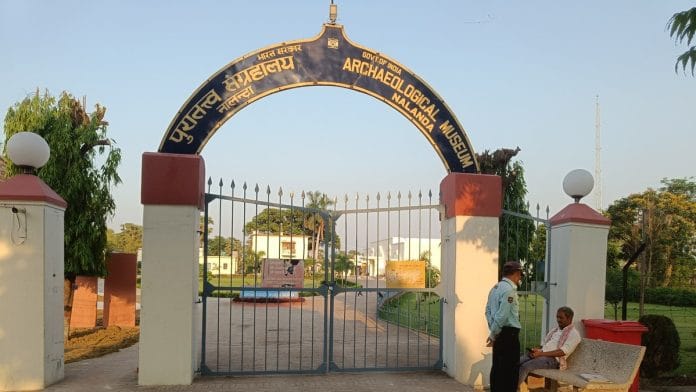
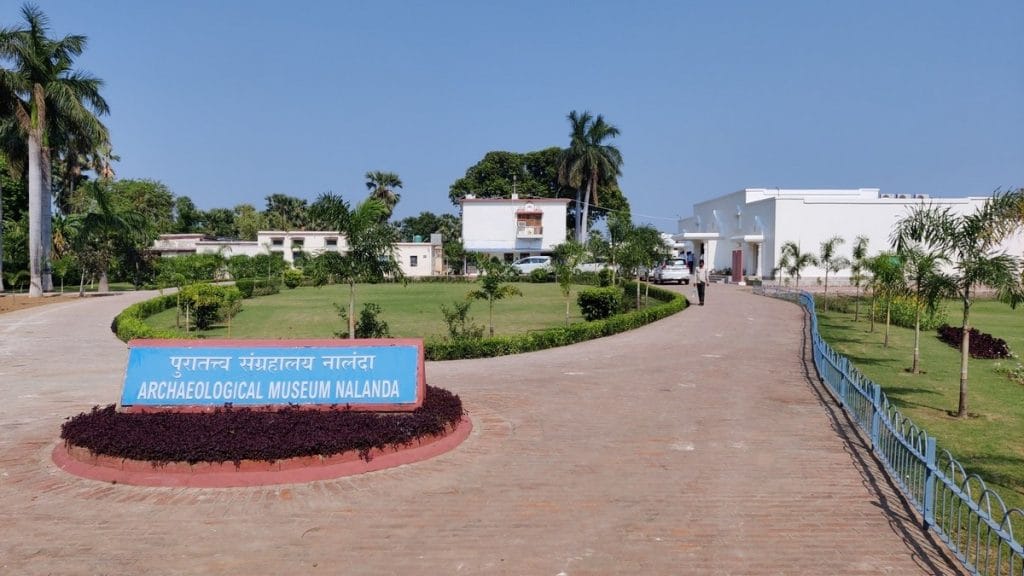
Nalanda: It is the hottest new museum that Indian scholars, historians, and tourists have been waiting for. It is India’s tryst with pride and pain — an ancient global university that was razed to the ground by Islamic invaders. With less than a week to go, the makeover of Bihar’s Nalanda Museum is a hushed secret for now. Tourists peer through iron rods to catch a glimpse. Security guards shoo outsiders away.
At the rusted iron gate of the Nalanda site museum, a white board in Hindi hangs like a warning and a promise: entry is prohibited without permission. Behind it, drilling machines whirr, tractors trundle, and workers rush about as Archaeological Survey of India (ASI) officials buzz in and out, scrambling to finish one of the country’s most prestigious site museums before its long-awaited reopening.
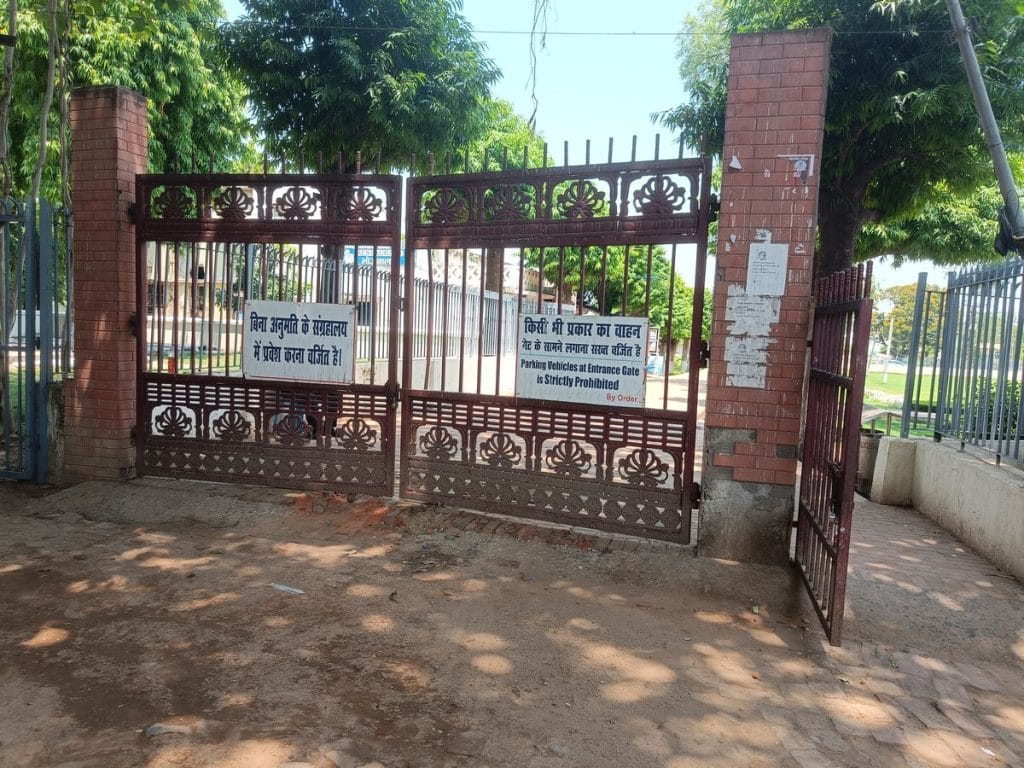
On 18 May, the warning board will come down. The race is against time and against another delay at Nalanda, 90 km from Patna. For too long, the site museum at the Nalanda ruins was a disappointing spectacle and an opportunity lost for the annual 5 lakh visitors. The story of the flourishing global centre of learning for Buddhism and Ayurveda set up during the 5th century AD in ancient Magadha, and how it was destroyed and burned, remained frozen in deadpan language in school history textbooks. There was no three-dimensional museum storytelling. Powerful artefacts like burnt rice and a broken sculpture of tantric deity Trailokyavijaya trampling Shiva-Gauri were displayed with little imagination.
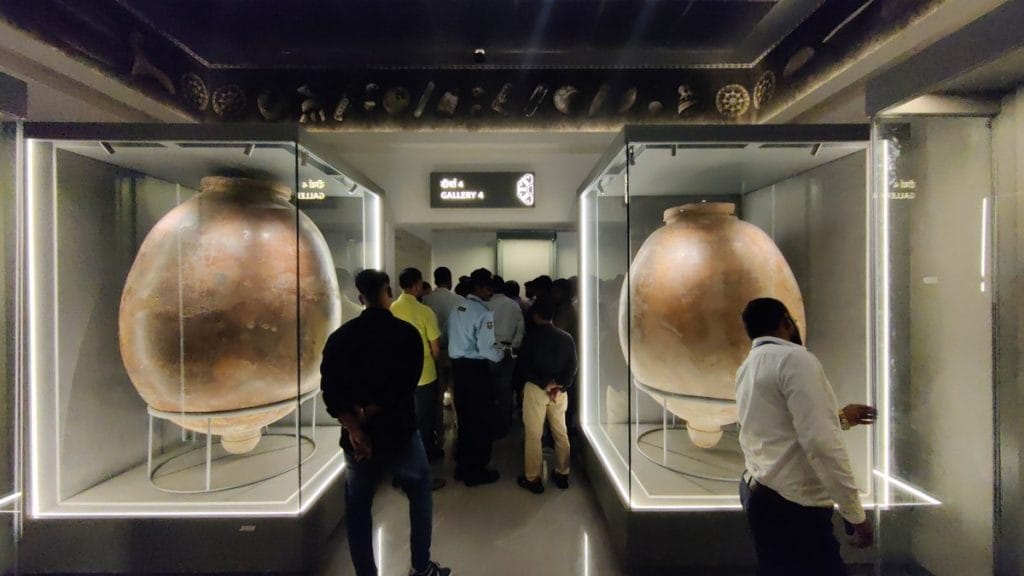
All that is about to change now, after 26 months of closure and repeated extensions of deadlines. In an exclusive view that ThePrint got of the museum, two big earthen jars in the third gallery stood under focused light at the entrance corner, giving a fuller view of storage vessels used in ancient times. Smaller Buddha artefacts, fixed with clamps but made to look almost suspended in air, have been displayed so the visitor’s eye stays on the object. A dramatic new 10-minute documentary on Muhammad Bakhtiyar Khilji’s 12th-century destruction of the monastery imagines him watching as the flames of Nalanda reflect in his eyes.
“We can’t afford to delay this anymore,” said Anand Madhukar, additional director general (administration) at the ASI, who arrived in Nalanda on 11 May to inspect the restoration work ahead of the inauguration, which coincides with International Museums Day. The estimated cost of the renovation is around Rs 19 crore.
“The old museum was in a dilapidated state. Nalanda has long stood as a symbol of a rich tradition of knowledge, and it is essential that people are able to gain an accurate understanding of this legacy through its artefacts. This new, modern museum offers a glimpse into the magnificent history of Nalanda.”
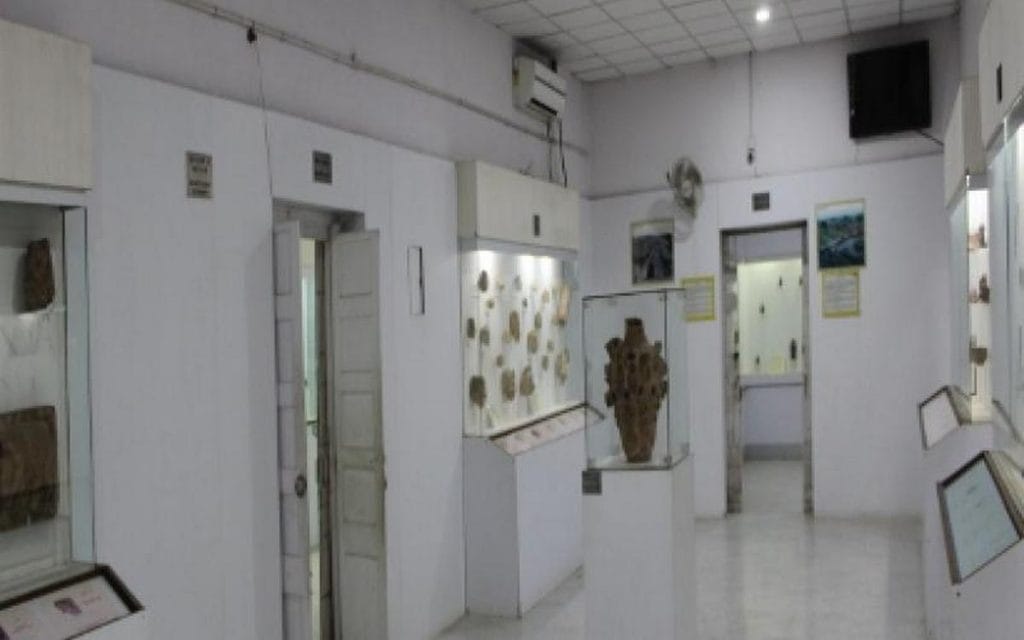
For years, historians have called India’s museums shockingly underfunded and neglected. Nalanda’s modern plight sat at the heart of this official apathy. Last week, author William Dalrymple called its site museum “fourth-rate” when it could be India’s “best advertisement” to the world. Built in 1917, the museum had fallen into disrepair over the decades, with leaking roofs, peeling walls, faded labels, and dim lighting that barely illuminated the priceless artefacts inside.
The Nalanda makeover fits into the bigger government drive to recover and retell India’s ancient past, from the grand celebration of Somnath Temple’s reconstruction to the National Museum’s remaking as Yuge Yugeen Bharat Museum — a common running theme being one of how the greatness of India was punctured by Islamic invasion and colonialism.
“The two-year journey of restoring the Nalanda site museum was full of challenges. Now it is ready to give a holistic view of Nalanda’s history, architecture, remarkable collection of antiquities, and a digital presentation which showcases the intellectual and artistic brilliance of ancient India,” said Vasant Swarnakar, regional director (North), ASI.
All restoration work over the past two years has been carried out under his supervision. He said the site came with constraints such as limited space and low roofs, but they have managed to rejig it.
“The newly renovated space will be more engaging and technologically sound,” he added.
Also Read: An IAS officer is bringing a golden era in Haryana archaeology. Narnaul is the crown jewel
An official relic-to-roof inspection
At 2:30 on Monday afternoon, the hustle and bustle inside the Nalanda Museum intensified as Anand Madhukar stepped out of his car after a two-hour drive from Patna. He immediately began his inspection.
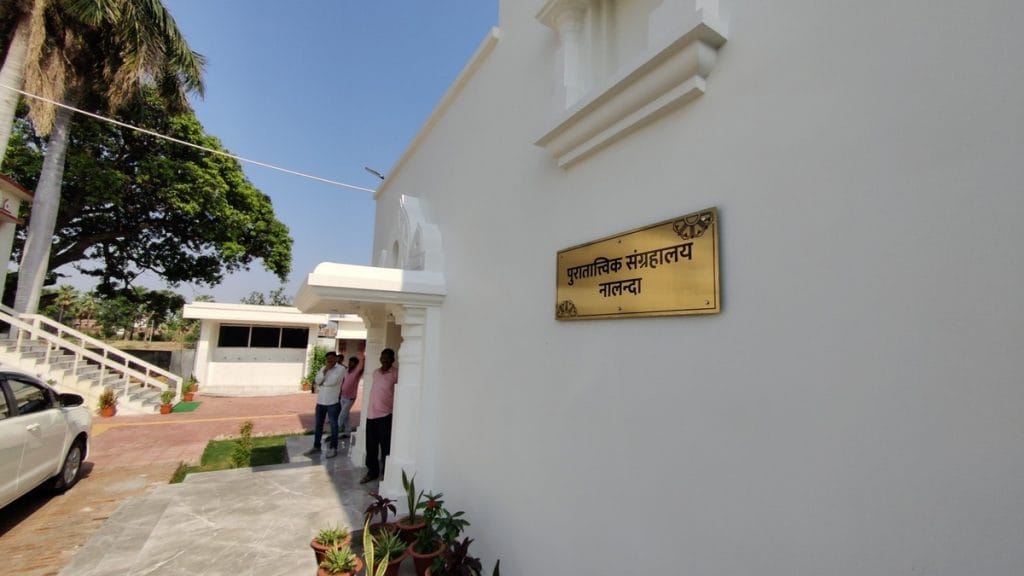
The first thing that caught his eye was the gleaming white building’s new golden signboard. The words— Archaeological Museum Nalanda—were written with very tight spaces between the words. He asked for it to be corrected at once.
“We should change this. This is not looking good,” he told junior colleagues at the site as he moved toward the Nalanda Experience Centre, a new multimedia venue near the main museum.
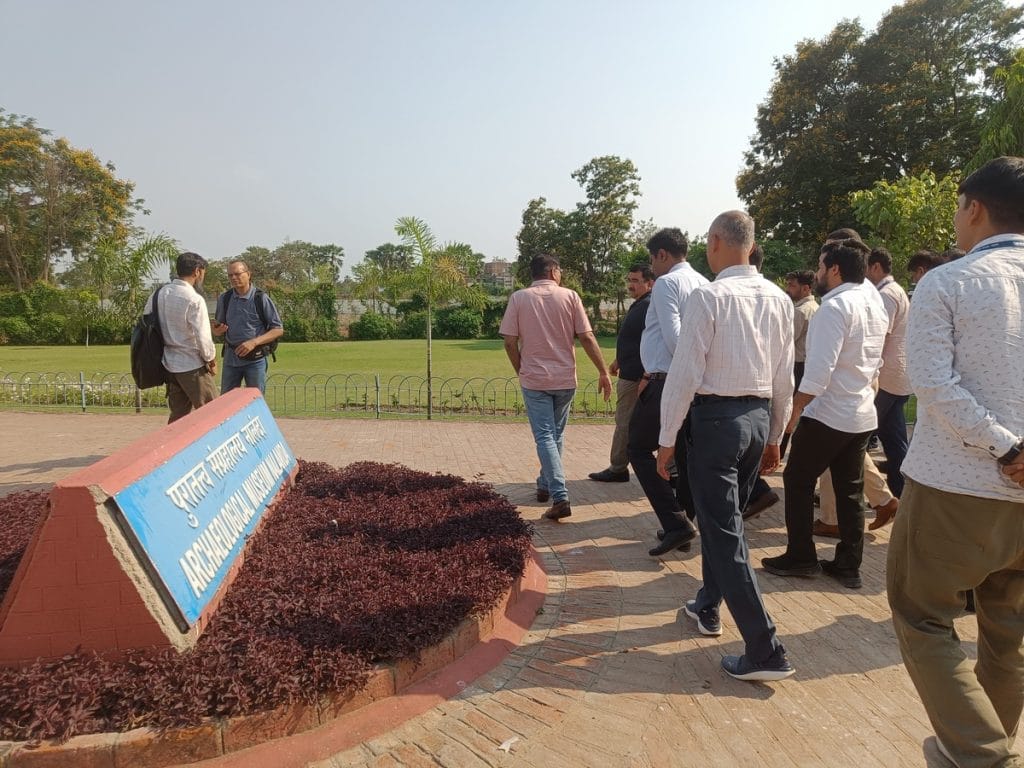
A pink stone board announced that the immersive show was an attempt to transport visitors into the history of Nalanda University. Labourers were still levelling the soil around it. Two large posters flanked the entrance — ‘Story of Nalanda, Penned by Hiuen Tsang’ and ‘Discovering the Great Centre of Education’.
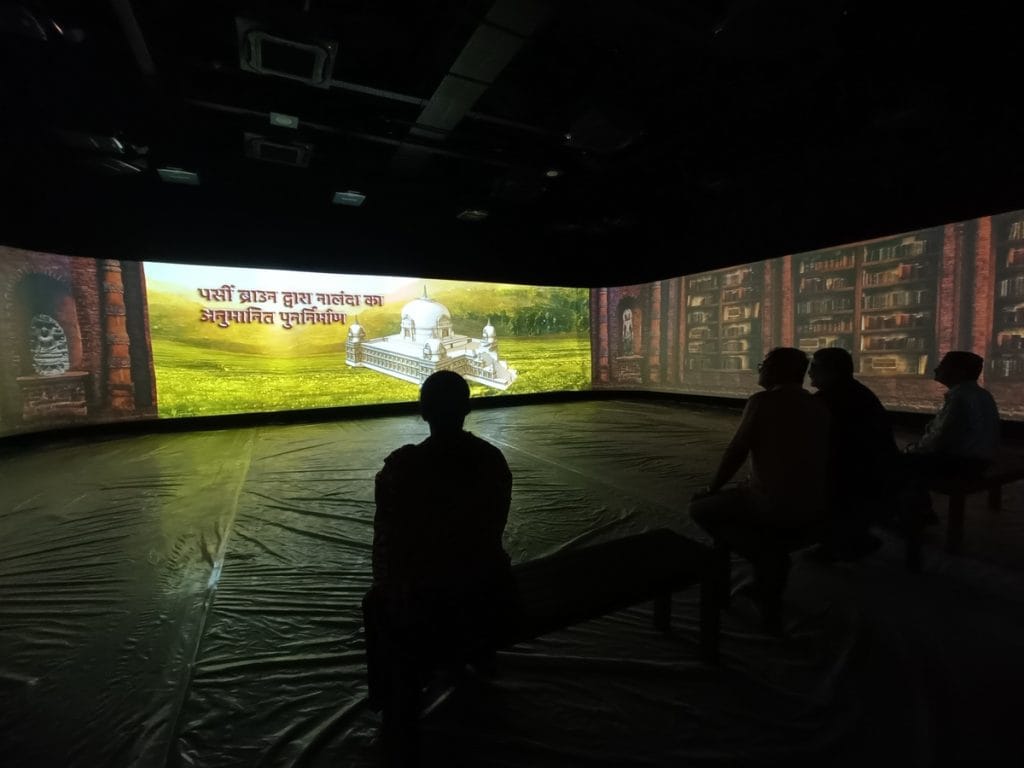
Inside, a 270-degree screen dominated the room, powered by 20 projectors. Eight air conditioners cooled the room and three wooden benches faced the screen, where the officials sat down to watch a 10-minute documentary called Nalanda ki Vaibhavshali Parampara— Nalanda’s glorious tradition.
Nalanda has long stood as a symbol of a rich tradition of knowledge, and it is essential that people are able to gain an accurate understanding of this legacy through its artefacts
– Anand Madhukar, additional director general (administration), ASI
The huge screen engulfs visitors in the rise and destruction of Nalanda Mahavihara through moving illustrations, archival imagery, and cinematic narration of how students arrived from across Asia, the monasteries and temples, the libraries filled with manuscripts, the organised system of education and residence. The film ends with Bakhtiyar Khilji’s 12th-century destruction of Nalanda, portrayed as a devastating blow to India’s intellectual heritage.
“He (Khilji) destroyed India’s infinite wealth in his personal greed,” the voiceover says. But it is the first few lines that truly set the tone for the display: “The ruins of the ancient city of Nalanda are evidence of the great achievement of ancient history.”
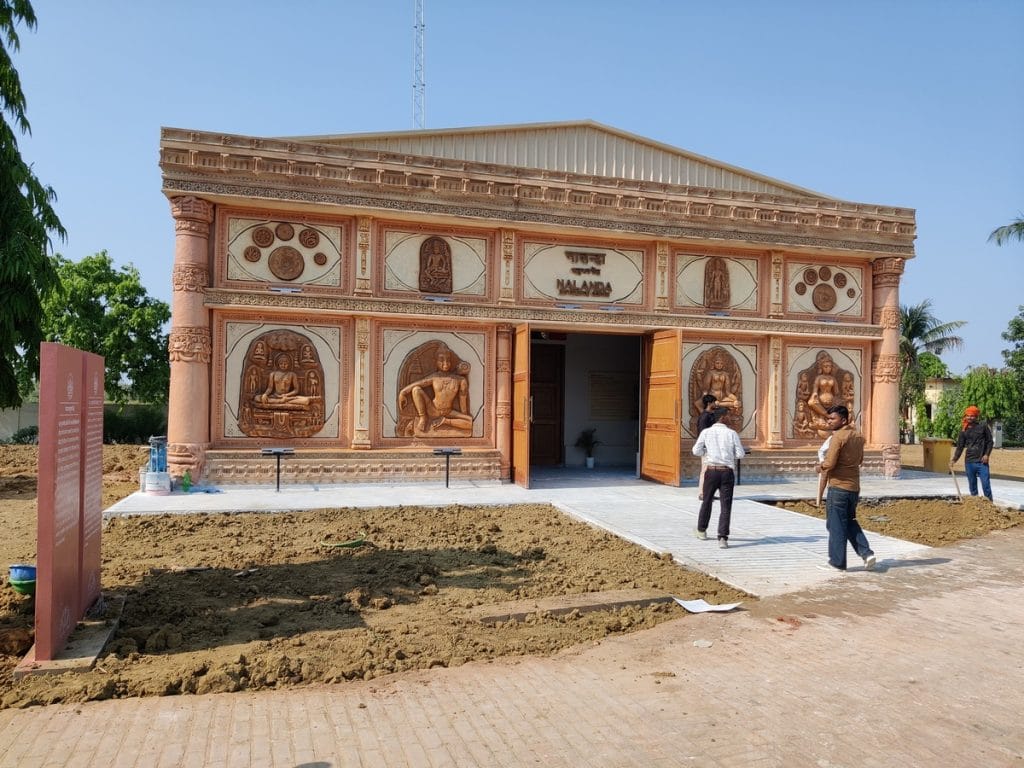
Gone are the worn wooden showcases and faded handwritten captions that once reduced historic treasures to static relics. In their place stands a carefully choreographed visual journey, where new grey-toned flooring, calibrated lighting, and spacious displays make stone Buddhas, Bodhisattvas, and terracotta figurines emerge dramatically from the darkness.
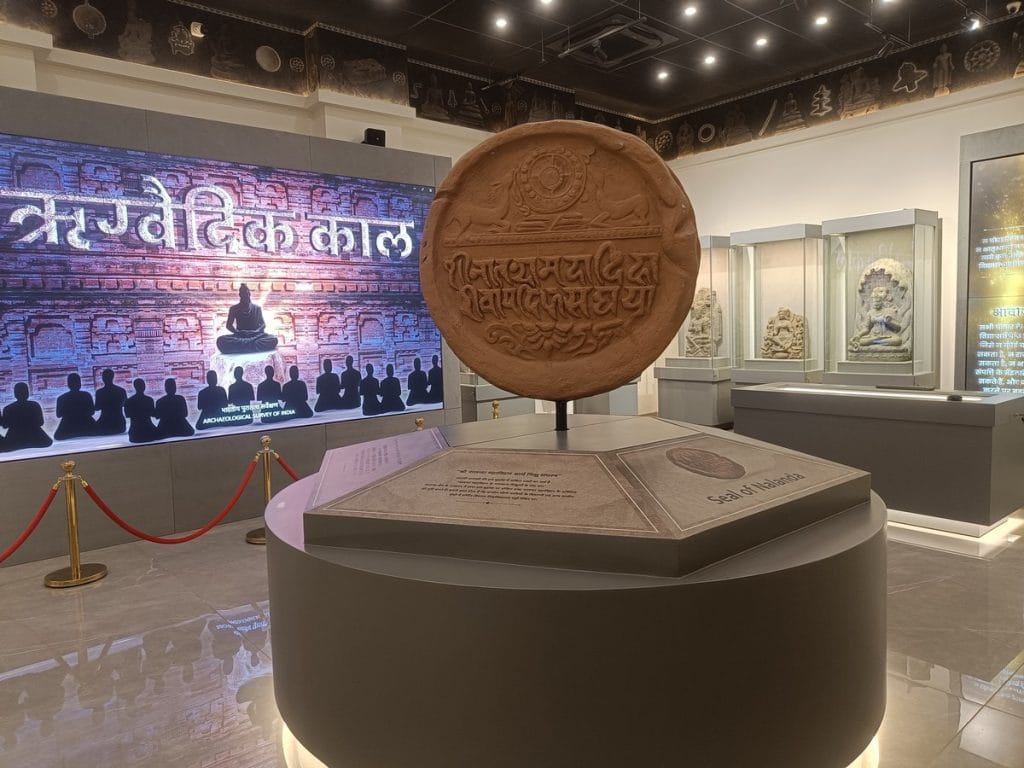
A massive rotating replica of the famous Nalanda seal, featuring the Wheel of Dharma and once the official insignia of the monastery’s correspondence with kingdoms across Asia, invites viewers to see it in a way the tiny original cannot.
But even recreations and replicas have to be authentic. While watching the screening, Madhukar caught an error. The books shown in one of the documentary visuals were English-language volumes.
“Remove the English books from the video and instead of that use manuscripts there,” he told his juniors, as they jotted down his directions.
The artefacts at the museum were great but it lacked storytelling and narrative. For that, we planned more than restoration and pitched to develop an immersive show
– Aakash Johry, assistant professor, IIT Delhi
Madhukar and Swarnakar were accompanied through the inspection by two IIT Delhi professors, who had helped the ASI with the design and curation of the museum. As Madhukar walked around the galleries, he peppered his juniors with questions about the architectural plan, the flow, the content of the captions, and when the QR codes linking to extended details would go up next to each object.
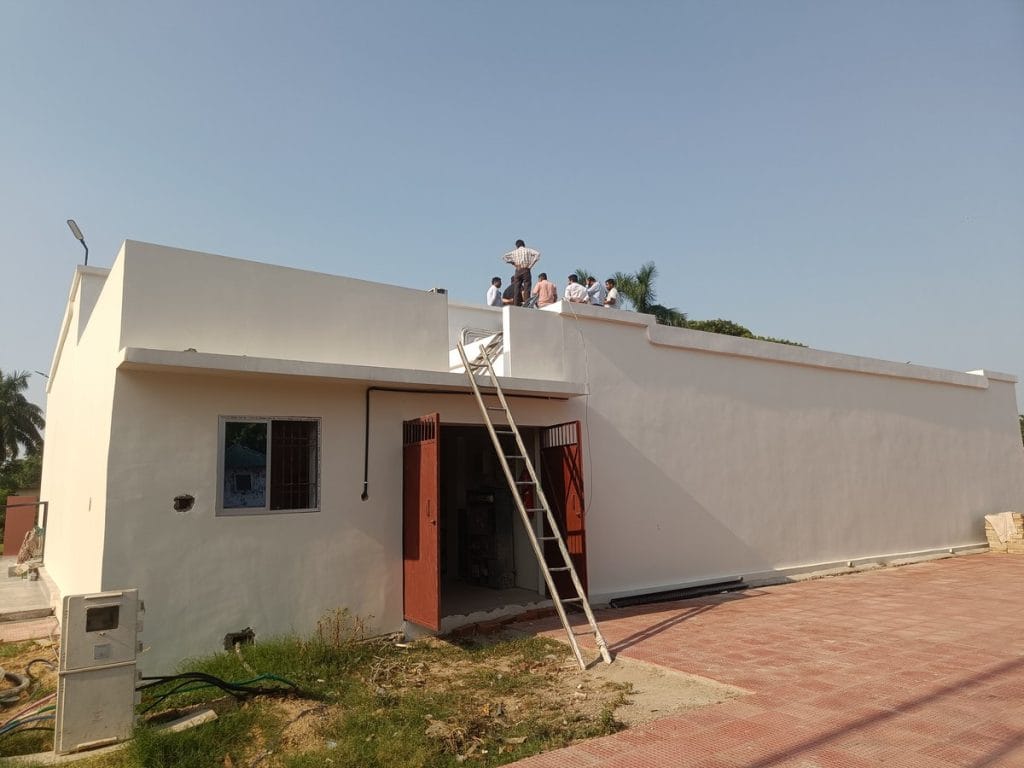
But the biggest worry lay overhead. The roof of the 100-year-old structure had been seeping for years. A ladder was brought out and the ASI officials climbed up to check the condition themselves.
Swarnakar said that during restoration, the team had deliberately inundated the roof with water for a month to test for leaks.
“For the ASI, it’s a historic building and we were clear from the beginning that we are not destroying it. Our focus was to use this heritage building and give it a new look,” said Swarnakar, who inspected the site with his colleagues for nearly two hours.
What’s new at the museum
For the first time, the original terracotta Nalanda seal—among the most important archaeological discoveries from the site—is being shown to the public. Until now, it had been kept hidden away in the reserve collection at the museum complex.
The seal bears the Sanskrit inscription: Sri-Nalanda-Mahavihariyarya-Bhikshu-Sanghasya, which means ‘Of the venerable community of monks of the great monastery at Nalanda’.
“It confirms the identity of the site as the famed Nalanda University mentioned in our texts and travel accounts,” said Swarnakar pointing to the seal. By placing the replica at the threshold, the ASI aims to immediately anchor the visitor in the physical reality of the Mahavihara.
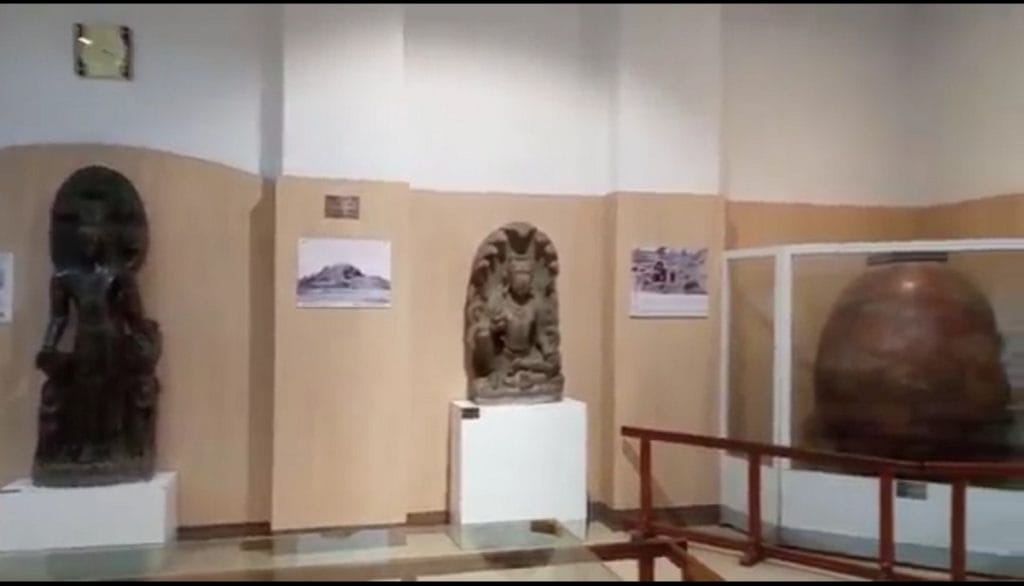
But this is the only notable new exhibit of an antiquity. The museum displays around 350 artefacts, curated from a reserve collection of nearly 13,000 objects, which is the same as before, ASI officials said. What has changed is the way they have been displayed.
Before the restoration, the antiquities had been boxed inside dimly lit glass cases. There was no curatorial design — only the need to fit every object onto a shelf, with no hierarchy by historical significance or clear logic of arrangement.
The two-year journey of restoring the Nalanda site museum was full of challenges. Now it is ready to give a holistic view of Nalanda’s history, architecture, remarkable collection of antiquities, and a digital presentation
— Vasant Swarnakar, regional director (North), ASI
The new layout has four galleries, though they have not been given specific names or themes. Instead, the displays are broadly organised around stone sculptures, terracotta artefacts, interactive panels, and a final section on the excavation of the site itself.
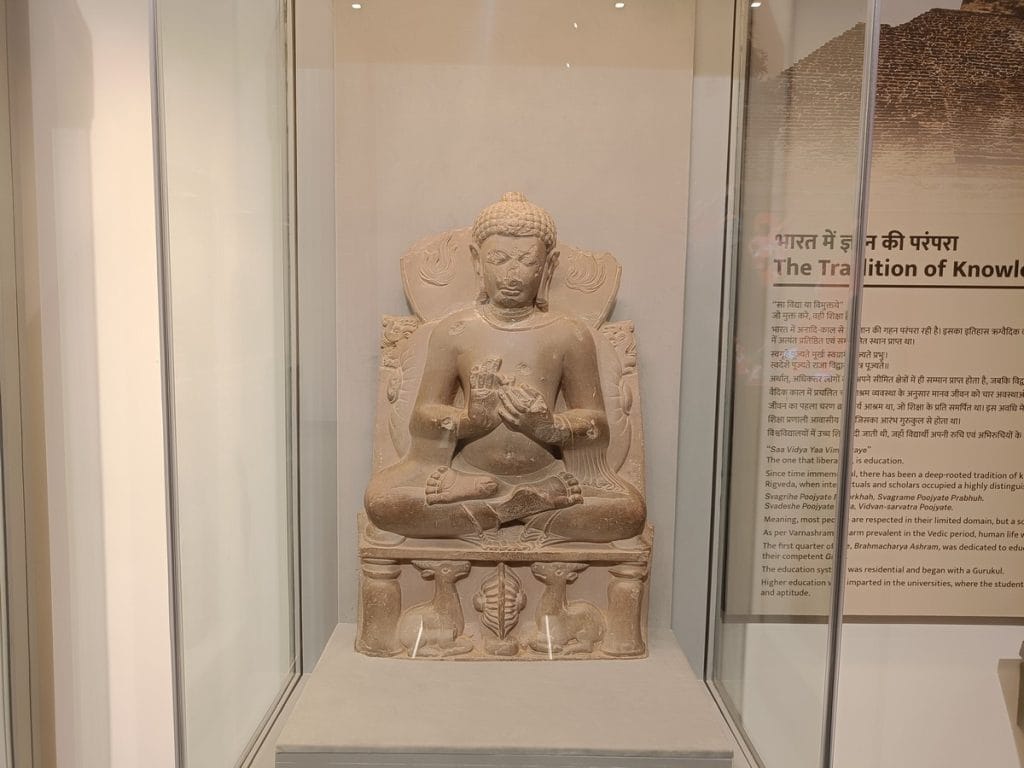
The first gallery is introductory. Stone sculptures excavated from the site are displayed around the room.
“Here, a film on a big screen gives an idea about the Nalanda site,” said Swarnakar. This two-to-three-minute film, according to him, uses 3D visuals, illustrations, graphics, commentary, and drone views of the ruins.
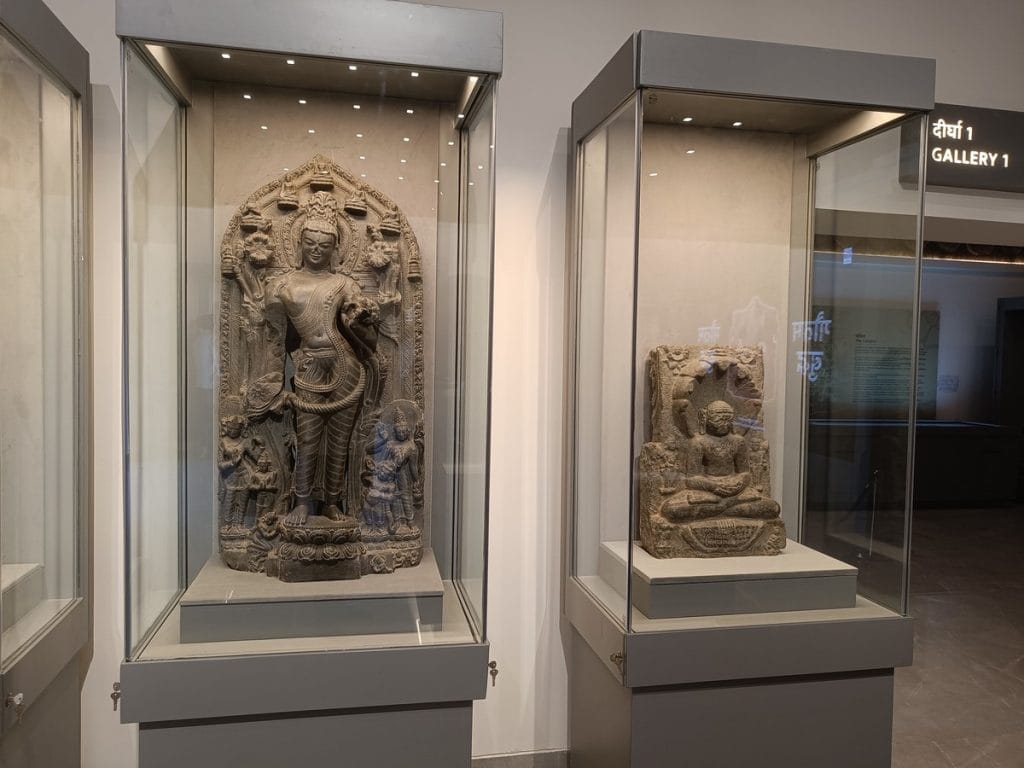
Storytelling through the actual artefacts, though, is still a work in progress. One display brings together 16 objects, including Kuvera, Buddha, Chhatra, and Vajrapani. When ThePrint visited, the text panels had not yet been pasted as the installation team was still finalising them. Even the captions already in place were spare, giving only the name and period of the artefact.
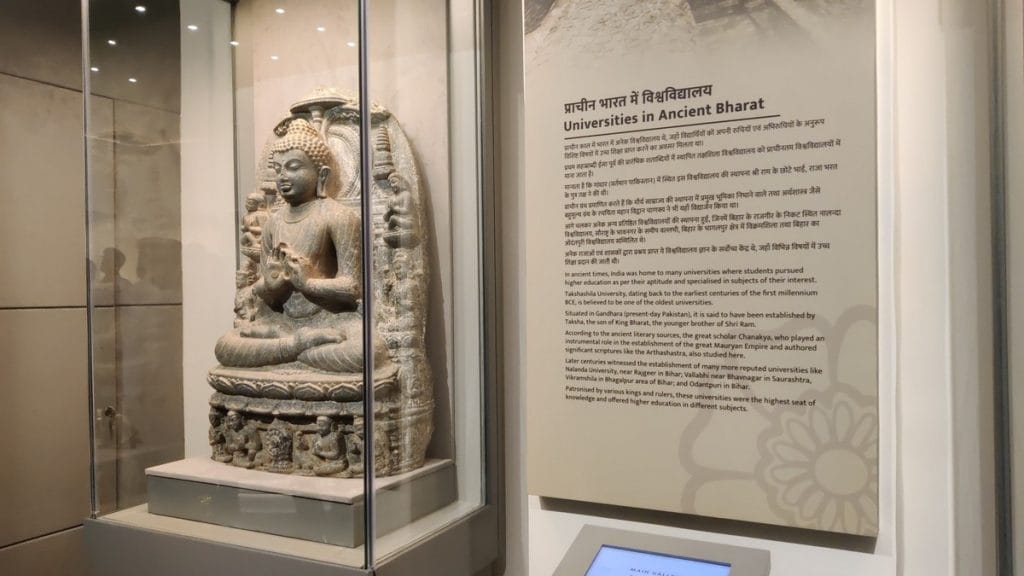
Another section lays out information through digital kiosks and large interpretive text panels on the tradition of knowledge in Bharat, ancient universities, the Nalanda campus, the history of the Mahavihara, its library, and the excavated sites.
“As a cradle of knowledge and spirituality, Nalanda became a confluence of philosophies, nurturing exchanges that refined views and inspired new visions,” reads one panel titled ‘History of Nalanda’. Another panel, titled ‘The Library’, says: “The library of Nalanda was among the greatest repositories of knowledge in the ancient world. It housed hundreds of thousands of manuscripts and was organised subject-wise.”
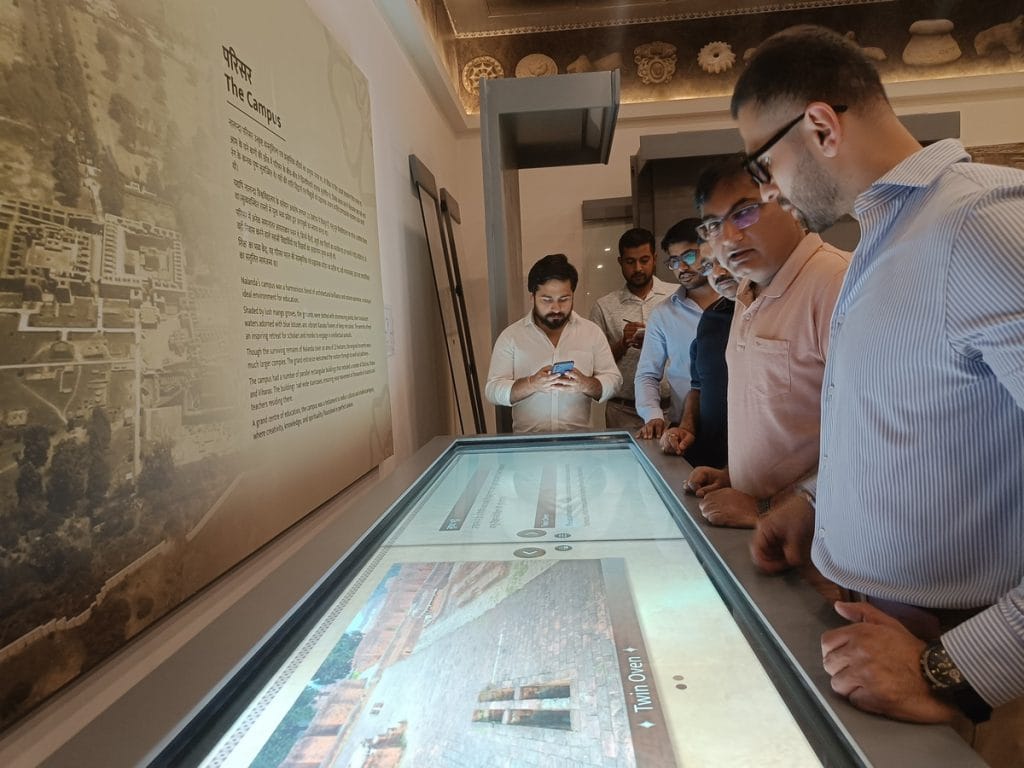
A digital kiosk also places Nalanda among other ancient centres of learning, including Takshila, Somapura, Odantapuri, Pushpagiri, Vallabhi, and Jagaddala, with ASI archival images and short notes on their origins and patronage.
The last panel offers extensive references and bibliography, from works by the late archaeologist Amalananda Ghosh to colonial-era scholar Thomas Watters, who wrote several books about Buddhism.
For Indian museums, this kind of pedagogy is still rare.
In the third gallery, the museum turns to student life and the subjects taught at Nalanda. One interactive panel describes the campus as “a harmonious blend of architectural brilliance and natural splendour”, designed as an ideal environment for education.
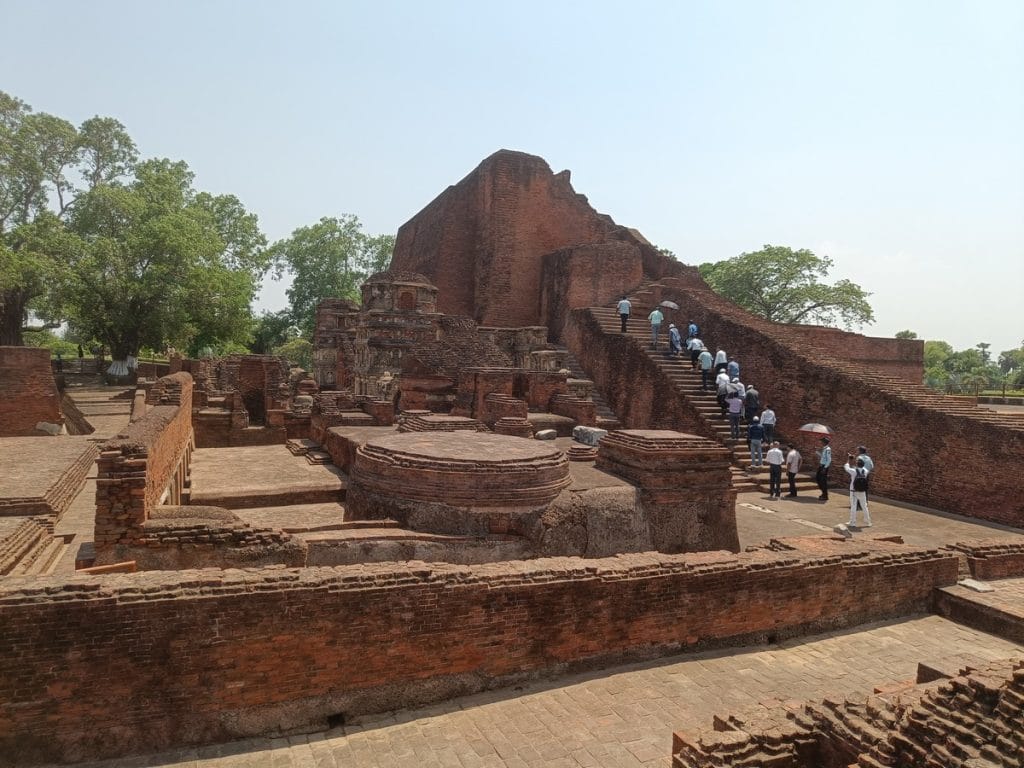
“The campus had a number of parallel rectangular buildings that included a number of Chaityas, Stupas and Viharas. The buildings had wide staircases, ensuring easy movement of thousands of students and teachers residing there,” it reads.
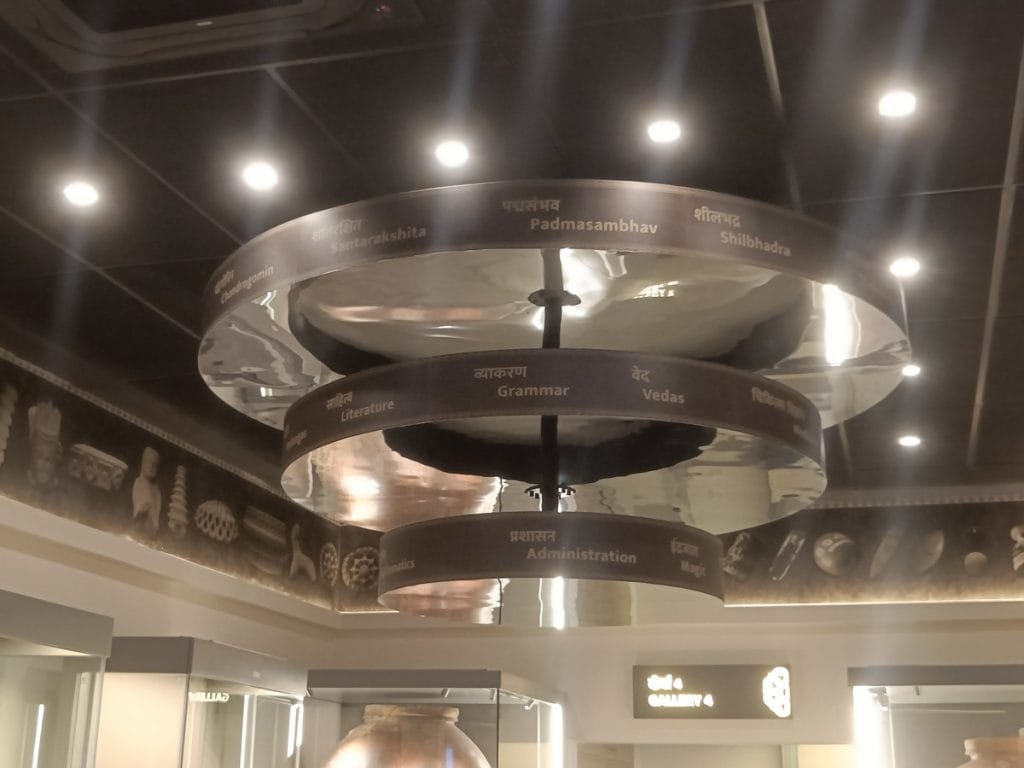
Suspended from the ceiling here, a three-tier rotating panel highlights the disciplines taught at Nalanda — grammar, the Vedas, astrology, astronomy, administration. It also includes the names of its most famous disciples: Shilabhadra, who taught the Chinese pilgrim Xuanzang at Nalanda in the 7th century, and Padmasambhava, the tantric master who later helped take Vajrayana Buddhism to Tibet.
The fourth gallery focuses on archival photographs taken during early 20th-century excavations at Nalanda.
“So that people can witness how the ASI, through years of painstaking effort, brought this to light, and understand why this site holds the status of a World Heritage Site,” said Swarnakar.
Lost treasures, new crowds
Not everything has been brought to light, though.
Two thefts at the museum in the early 1960s led to the loss of 16 bronze statues, including a seated Buddha in Bhumisparsha Mudra, Buddha Shakyamuni, and Bodhisattva Manjushri. Two of the stolen statues were repatriated to India in recent years— a 12th-century bronze Buddha in 2018 from the UK and the 8th-century Buddha Shakyamuni from the US in 2022. The repatriated statues are now in the ASI collection at Purana Qila, and there is no plan yet to move them to the renovated Nalanda Museum. Several others are still missing or held in foreign museums and private collections.
But if the museum has recorded losses, it expects to register a huge gain in visitors.
ASI officials estimate 1,500-2,000 visitors per day after the inauguration, which would translate to roughly 5.5 lakh visitors each year. The site museum recorded 98,635 visitors in 2022-23, 1,28,648 in 2023-24, and 14,197 in 2024 (it was closed in March that year), according to government data.
With the large influx of visitors expected to arrive in this limited space after opening day, officials are banking on the digital displays doing double duty.
“We have made technological interventions such as informative panels and kiosks to divert the crowd,” said Swarnakar. At ASI’s Dharohar Bhawan in Delhi, his desk was still full of caption drafts and corrected panels, but he too can rest easier knowing that write-ups are not cast in stone.
“The museum has been designed in a way that if in future we have to change something, it will be easy to change interactive panels with fresh information,” he added.
Also Read: ASI’s ghost campus in Noida—grand new Rs 289-cr facility, 15 students, no faculty
Team behind the museum
The talks on restoring the Nalanda site museum had been bubbling away inside the ASI for nearly a decade. The preparation of the detailed project report began in 2015, with the work going to Astro Links Consultants, according to the National Culture Fund’s annual report.
“The physical structure of the building needs to be conserved with only minimum interventions to protect the original fabric of the museum,” the report noted.
Over the next several years, the project was essentially stalled. A fresh start came only in 2023, when the ASI signed a Memorandum of Understanding with IIT Delhi to take on the design and planning of the British-era building, which spans 390 square metres.
The collaboration brought in two faculty members from IIT Delhi’s department of design — Sabyasachi Paldas, a professor of practice, and Aakash Johry, an assistant professor. In the last 26 months, both have visited Nalanda at least eight times and were present when Madhukar inspected the museum days before the inauguration.
Their first task was to figure out how to fit a modern museum into an old, small building. The structure was built during the British era, and at just over 100 years old, it now qualifies as a heritage building itself — demolishing or expanding it was never an option. But the team completed the design within a few weeks of starting work.
The proper placement of a sculpture is a highly intricate task… This type of work is a time-consuming endeavour. It is not the kind of job where one can simply get it done and walk away
– Somnath Ganguly, national head of operations, Grace Relocations
“The artefacts at the museum were great but it lacked storytelling and narrative. For that, we planned more than restoration and pitched to develop an immersive show,” said Johry, adding that inside the museum, they focused on space and visual design.
For Johry, the goal was to present the grandeur Nalanda once possessed without straining a building that was never quite made for the task. The team’s answer was to leverage technology — the QR codes, the interactive panels, the kiosks— to present the sweep of history as well as to allow for flexibility.
“There is now a digital layer to the whole museum experience, which allows for easy content changes in the future,” said Johry.
The actual installation and display of the artefacts went to a separate firm. Vizara Technologies was engaged by IIT Delhi to supervise artefact shifting and installation. The ASI hired Grace Relocations, a logistics company whose service lines include fine art handling, to do the physical work of mounting the sculptures and other displays inside the renovated galleries.
Somnath Ganguly, the company’s national head of operations, said the work was complicated at times.
“The proper placement of a sculpture is a highly intricate task. In the [terracotta] display, the sculpture appears to be suspended in mid-air, yet it is actually secured by a string attached behind it,” he said.
More than 160 artefacts had been placed by the time of the inspection.
“This type of work is a time-consuming endeavour. It is not the kind of job where one can simply get it done and walk away,” Ganguly added.
For Swarnakar, a visit to the museum will give visitors something the ruins and bricks outside could not — a vision, for the first time, of just how magnificent Nalanda had been.
“The new museum is poised to evoke a profound sense of India’s glorious past,” he said.
(Edited by Asavari Singh)