





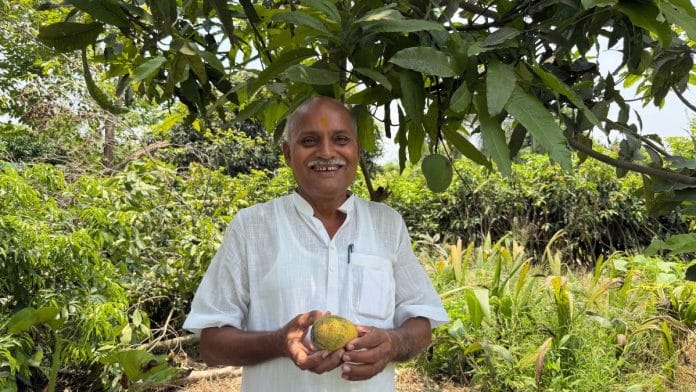


Muzaffarpur: Ram Kishore Singh has become an unlikely Mango Man after he developed two new varieties, Nagendra Bhog and Ramjasi. Both reportedly stay fresh for up to 12 days after harvest, and one of them is a giant weighing 800 gm—nearly four times the weight of an average mango and almost twice as heavy as the FIFA World Cup football. It has drawn the attention of experts from horticultural institutions.
One of the inventions, the Nagendra Bhog, is on track to be registered with the government under ‘farmer’s variety’.
Experts from horticultural institutions, including teams from Lucknow, are now examining the yellow-red mangoes at Singh’s nursery and documenting their characteristics.
Samples and observations are being studied as part of the process that could eventually pave the way for official recognition of the mangoes as farmer-developed varieties.
“My ancestors also used to do farming, so I thought I should do something unique. I started this work eight years ago, and it was just five years ago when the tree started growing the fruit,” said Singh while sitting in his nursery as people kept coming to congratulate him on his success.
Singh remains tight-lipped about the process behind the two varieties.
“There are so many varieties of mangoes, but I experimented on my own. It is my hard work, and I don’t want to share it with anyone,” he said.
Dressed in a white kurta-pyjama and a gamcha over his head, Singh cuts an unassuming figure in Rahua village. The horticulturist, who could not complete his graduation due to financial troubles, lives with his ageing mother and spends most of his days tending to the nursery. Visitors know him as the man to consult for anything plant-related; now they arrive to see the mangoes that have made him locally famous. Since he isn’t sharing his secret, he may not lose the monopoly once the new mangoes blow up in the market.
Singh has been engaged in horticulture since 1974, learning the craft from his father and grandfather. However, he began experimenting with mango varieties in his nursery only eight years ago. According to Singh, one of the major problems with conventional mango varieties is their short shelf life, with the fruits beginning to deteriorate within seven to eight days of ripening.
Farmer’s variety
The two varieties he has developed—Nagendra Bhog and Ramjasi—reportedly remain fresh for much longer than average mangoes, about two weeks, after harvest. The trees also grow only up to around 15 feet, requiring less space than wide traditional varieties, while each tree can yield between 100 and 150 kg of mangoes in a season.
Singh said he does not sell the fruits commercially. Instead, he propagates saplings of the two varieties and sells to those interested in growing them. Following the recent media attention, he has sold nearly 100 saplings, each priced at Rs 300. Despite years of experimentation, he said he is yet to earn any significant financial returns from his work.
Government institutions have collected samples of the two mango varieties for evaluation. The assessment will determine whether they qualify for recognition as a “farmer’s variety” under the provisions of the Protection of Plant Varieties and Farmers’ Rights (PPV&FR) Act.
“At present, these are being treated as farmer-developed varieties under evaluation. Once the institutes complete the verification process and approve them, they can be formally recognised as a farmer’s variety,” said Krishan Gopal, a horticulture official based in Muzaffarpur.
The Bihar government has encouraged research institutions to identify and document such farmer-led innovations so that they can be brought under the ambit of the PPV&FR framework. Experts from the Indian Council of Agricultural Research (ICAR) and other horticultural institutions have been working to identify unique crop varieties developed by farmers, and Singh’s mangoes have now become part of that process.
“Ram Kishore Singh’s Ramjasi has already been submitted for registration under the Protection of Plant Varieties and Farmers’ Rights Authority in New Delhi. It is exceptionally sweet and has a strong aroma. The second variety, Nagendra Bhog, requires another year of monitoring before the process can move forward,” said Dr Sanjay Singh, head of the ICAR.
This recognition, if granted, would place Singh among a small group of farmers whose innovations have received official acknowledgement for contributing to the conservation and development of indigenous crop diversity.
Also read: The truth behind India’s ‘Rs 2.5 lakh’ Japanese Miyazaki mango craze. It starts in Jabalpur
No money, only glory
For the last eight years, Singh has been working on these mango species while growing other plants in his nursery in Rahua village. He hasn’t sold a single mango from these two trees. The fruits of his labour get distributed to visitors and experts who come to monitor or see the new species.
“Many farmers have shown interest in buying plants. I am waiting for the plant to create space in the market so more and more farmers come to buy them,” said Singh while talking to a local farmer.
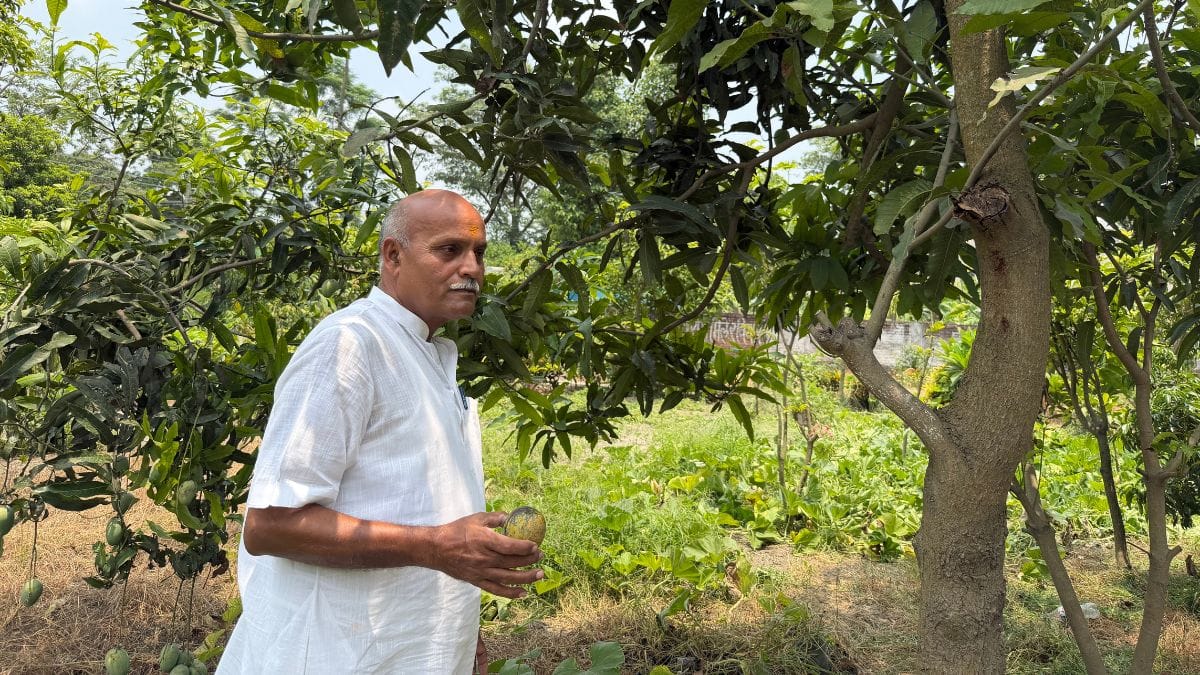
Singh has 20 types of mango trees in his one-acre nursery, which he runs all by himself. He sells chiku, anwla, bel and other vegetables and flower plants.
Farmers from nearby villages often turn to Singh for free advice on plant-related issues. He also helps buyers of his mango saplings plant and care for them.
“I tell them how much water the plants need and how to look after them through different seasons. Within three to four years, they start bearing fruit. It makes me happy because I have spent years helping people grow other plants, and now the varieties I developed are finding a place in farmers’ fields. It is a matter of pride for me,” Singh said.
Singh has named both of his mango trees after his parents. Nagendra Bhog is named after his late father, while Ramjasi is named after his mother, who is in her late 80s. Both varieties have earned praise from agricultural experts and farmers alike. Singh added that the popularity of mangoes has spread largely through word of mouth.
Fifty-year-old Rajeev Kumar first visited to taste the mangoes and see what set them apart. He took home three fruits and kept them for 10 days. Even after that period, the mangoes remained in good condition. They were sweet and had plenty of guda, meaning pulp.
“I bought five or six saplings and planted them in front of my house. It’s easier to take care of them there. If they grow well and the experiment succeeds, I’ll plant more on my farmland for commercial cultivation,” Kumar said.
Singh said that both the mango varieties are unique in their own way.
“A single Nagendra Bhog mango weighs between 700 and 800 grams, while Ramjasi mangoes are of a regular size, around 200 grams each. Both varieties have a long shelf life and excellent taste. The biggest thing I’ve earned from them is a name, not money,” said Singh, adding that he is happy his hard work is finally being recognised.
The ICAR has initiated the process of registering the Ramjasi mango variety. The necessary paperwork has already been filled and filed. If the institution begins commercial propagation of the variety, Singh will be entitled to 20 per cent of the profits, according to Dr Singh.
For the Mango Man, the greatest reward is not the prospect of future earnings, but the knowledge that an experiment born out of curiosity and inherited wisdom has earned him a place in conversations far beyond his village.
“Maybe the money will come later. Right now, people recognise my work, farmers are planting my varieties, and my parents’ names will live on through these trees. That alone makes me happy,” Singh said.
(Edited by Ratan Priya)