


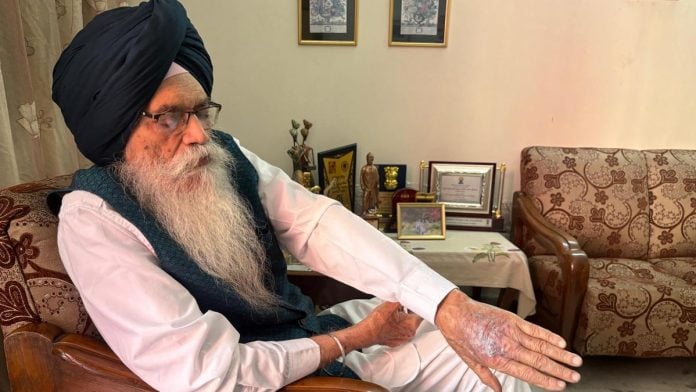
Chandigarh: As former Punjab DIG Inderjit Singh Sidhu applied antiseptic to his badly bruised hand at his spotless home in Chandigarh’s Sector 49, his son asked him how he hurt himself. “There were some pieces of wood that had to be picked up. One of them hit my hand,” Sidhu replied nonchalantly in Punjabi.
The 88-year-old retired IPS officer was awarded the Padma Shri this year, not for his policing but for his fight against garbage on the streets of India’s ‘City Beautiful’. But the man celebrated as Chandigarh’s “broom warrior” and an “unsung hero” is also a reminder of the city’s civic failures.
In the first spell of rain, under the punishing summer loo and in the biting winter, Sidhu sets out at 5 am with a broom and a large collapsible bag, when most residents of the IAS-IPS Society are still asleep. His unsteady legs, injured hands and frail body have done little to deter him.
“Without water, without food, I leave in the morning. I don’t return until my son comes and takes me home,” said Sidhu, who joined the Punjab Police in 1963 before being promoted to the IPS in 1981.
Sidhu was already known for this work in Chandigarh, but he was catapulted into the national limelight in July 2025 when a video shot by local advocate Gaurav Goel went viral. It showed the octogenarian walking with a limp and laboriously pulling a trash-laden cycle cart, stopping only to stoop and pick litter off the street. Industrialist Anand Mahindra shared the video on X and called him a “quiet warrior of the streets”.
This clip which was shared with me is about Shri Inder Jit Singh Sidhu of Chandigarh.
Apparently, every morning at 6 AM, in the quiet streets of Chandigarh’s sector 49, this 88-year-old retired police officer begins his day in service.
Armed with nothing but a cycle cart and… pic.twitter.com/pkDlptoY8f
— anand mahindra (@anandmahindra) July 22, 2025
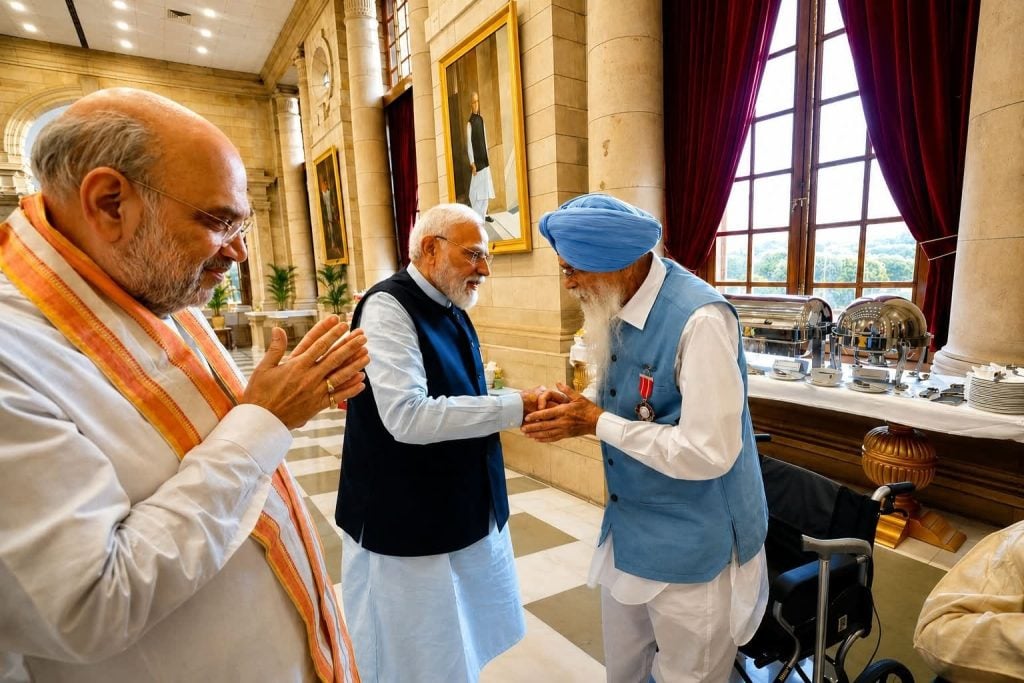
Since then, Sidhu has won the Padma Shri, the PTC Sewa Samman Award and received praise from across the political spectrum—from an appreciation letter by Home Minister Amit Shah to Punjab Congress chief Raja Warring joining him on a clean-up drive. Even PM Modi has praised him for making cleanliness “a way of life”.
Chandigarh ranked second in the 2025 Swachh Survekshan Super Swachh League for cities with populations of 3-10 lakh. But India’s first planned city has been losing its sheen, with its wide footpaths and green spaces increasingly giving way to congestion, encroachments and waste.
‘Pavan Guru, Pani Pita, Mata Dhart Mahat’ is a verse that many Sikhs recite every morning, much like a prayer. It teaches us to regard the wind as our Guru, water as our father and the earth as our mother. I began to understand that when we pollute the air, water and land, we are polluting what our faith teaches us to respect
– Inderjit Singh Sidhu
Sidhu has watched it happen over the decades and refuses to be a helpless spectator. The IAS-IPS Society is now known locally as ‘Inderjit Singh Sidhu’s Society’. Some neighbours call his project an obsession; others see it as a form of service everyone ought to perform. According to his son, Amoldeep Sidhu, residents now think twice before littering, knowing the retired IPS officer could appear at any hour to pick up the trash they’ve thrown.
“Everybody admires him. To clean your own city with your own hands is commendable, something that is beyond words,” said Harpreet Kaur Babla, BJP councillor from Ward No. 10 and former Mayor of Chandigarh. “Of course, the Municipal Corporation is responsible for the cleanliness and sanitation of the entire city, and its responsibility should be fixed. But he is going beyond what is expected of an individual citizen.”
Also Read: A Lucknow RJ is cleaning the Gomti River. Over 177 Sundays, 8 volunteers grew to 8,000
From police service to cleanliness seva
Inderjit Singh Sidhu was picking up trash well before he became a policeman. As a student at Government Ranbir College in Sangrur, he had an economics professor, Munshi Ram Verma, who would take students to parks and get them to clear the litter.
“The habit stayed with me through my years in the police force,” he said in a voice softened by age.
It didn’t hurt that Sidhu had grown up in a military family in Punjab’s Sangrur district, where discipline was part of everyday life. He recounted cleaning the areas around his tents during National Cadet Corps (NCC) camps, where this was part of the drill.
He was also a keen boxer in college, winning the College Colour Award and twice making it to the sports Roll of Honour for his achievements at the university level. After his BA, he went on to earn a master’s degree in economics from Mohindra College in Patiala.
In 1963, Sidhu applied for a job in the Punjab Police. Around 6,000 candidates competed for just four posts. He landed one of the two inspector jobs.
“The recruitment process involved a written examination and an interview. There were only two DSP and two Inspector positions in Punjab, so the competition was tough. I was around 25 when I applied,” he said.
One of his early postings was to Pangi Valley, near the China border. In 1966-67, he moved to Kolkata and served with an anti-Naxalite force. He also served in the Samba sector during the 1971 India-Pakistan war. By 1978, he was serving as a DSP in Punjab, which would soon be engulfed by years of militancy.
“I was promoted to the Indian Police Service in 1981. I served in Punjab, Haryana, Himachal Pradesh, New Delhi and Kolkata,” he added. In 1991, he received the Police Medal for Meritorious Service.
“This is part of a police officer’s life, but it takes a heavy toll on the family. It is very stressful. I would worry about whether my son would return home safely while I was on duty. Frequent transfers also made it difficult to raise children,” he said.
But after retirement, in 1996, he was not happy to sit still. The streets had to be cleared of the trash menace.
“One person alone cannot do much, but if everyone makes an effort, we can make a difference,” he said as he sipped tea in his living room. “We have been given air, water and land in abundance, free of cost, and it is our duty to take care of them. Every human being has an equal responsibility towards the environment, yet we fail to fulfil it,” he added.
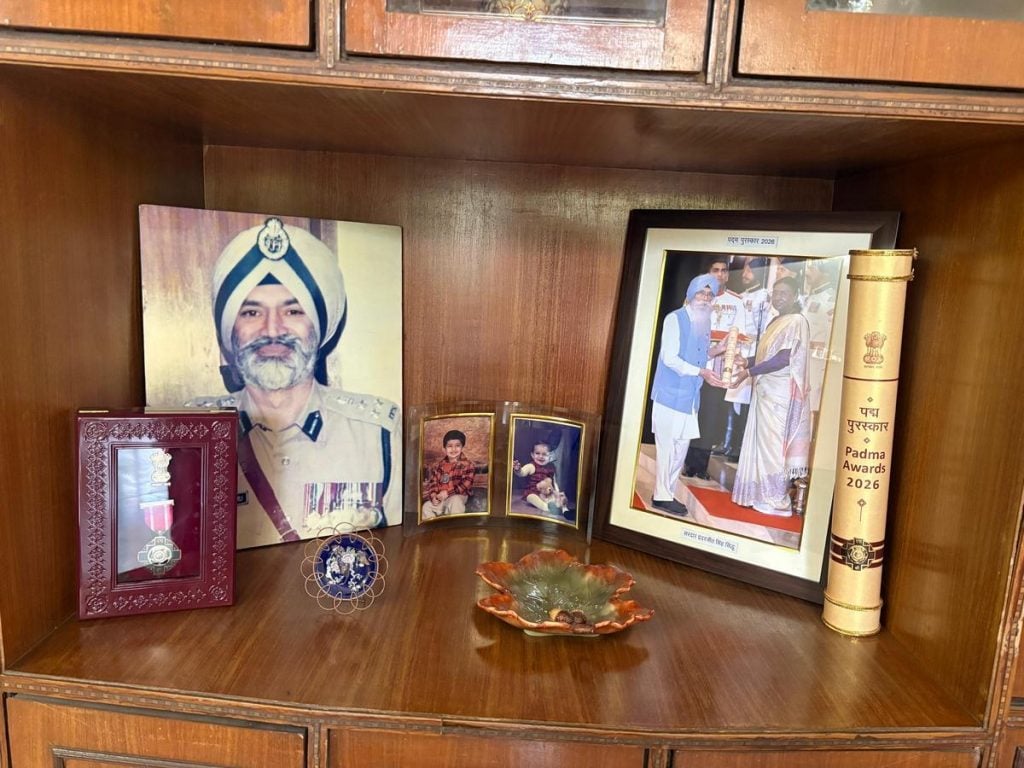
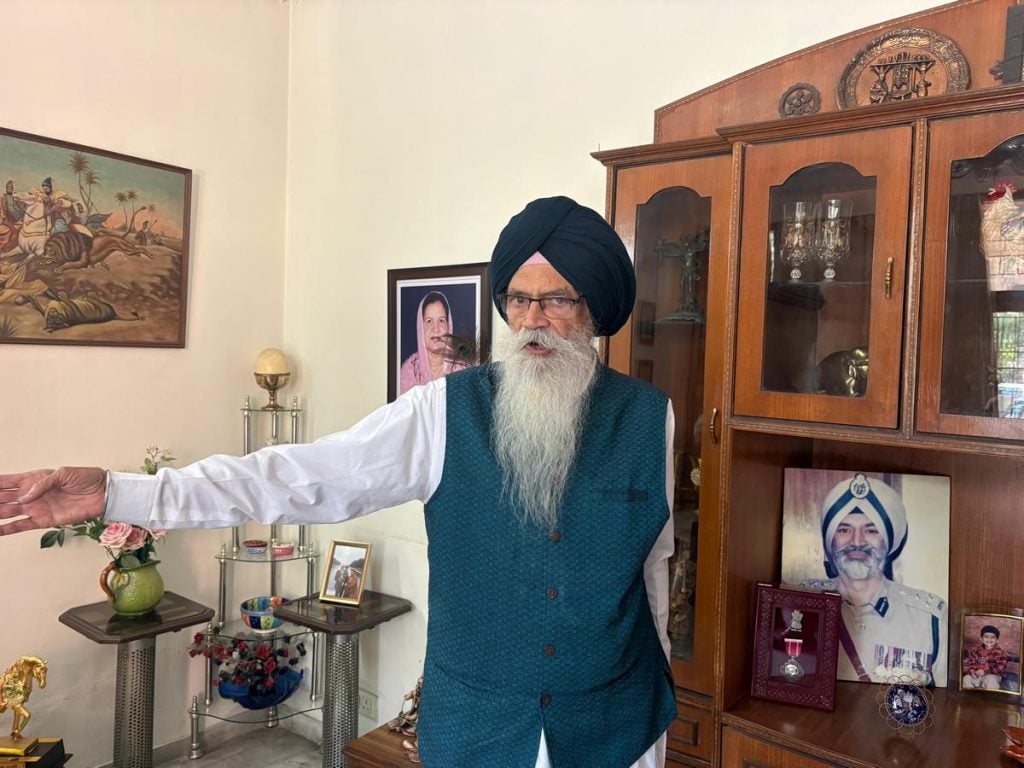
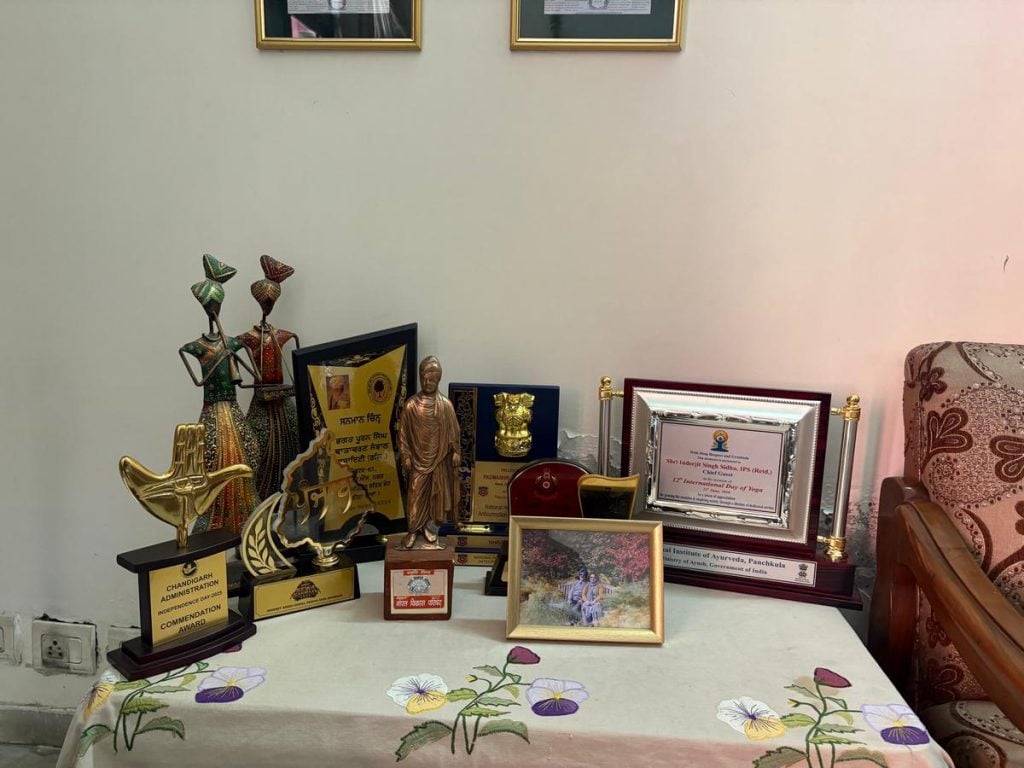
A photograph of his late wife hung on the wall in front of him. Nearby were the awards and medals he had collected over the years, along with a photograph of himself receiving the Padma Shri from President Droupadi Murmu.
No easy retirement
Sidhu has written letter after letter to the authorities, including the governor, about Chandigarh’s neglected public spaces and mounting waste. All are painstakingly handwritten and sent by post. So far, he hasn’t received a single reply.
On one occasion, he found a stretch of cycle track that had not been cleaned. When nobody responded to his request to clear it, he picked up a broom and did the job himself. He also asked the residents’ association for a rake, but was told it might be stolen because it cost Rs 20,000. And so he carried on with whatever tools he had.
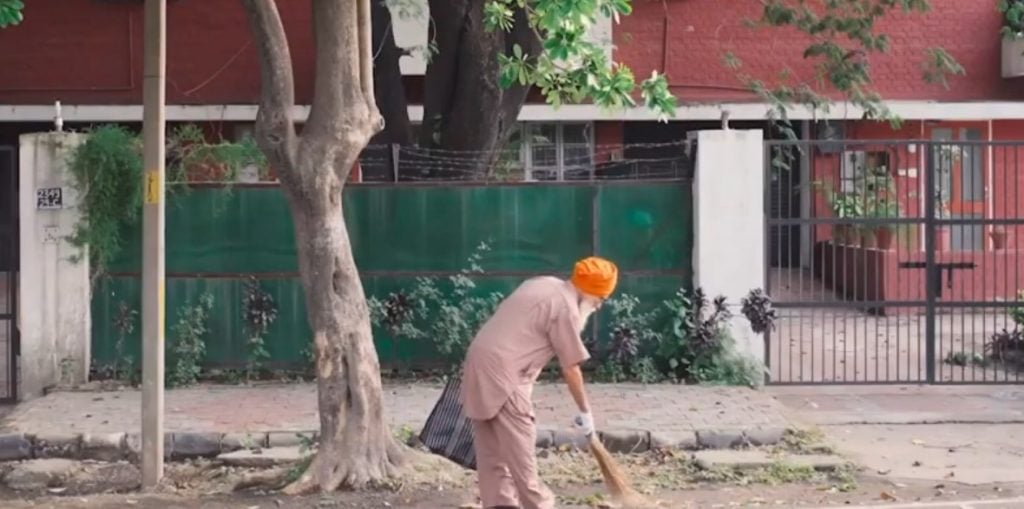
Sidhu collects the waste and leaves it at a spot where he hopes municipal workers will notice it and take it away. If they fail to do so, he follows up by calling the municipal corporation himself. But he is frustrated that even basic civic problems, such as abandoned material blocking footpaths, often remain unattended.
Cleanliness is next to godliness and Gurbani for Sidhu.
“Punjabi thought is deeply influenced by Gurbani. ‘Pavan Guru, Pani Pita, Mata Dhart Mahat’ is a verse that many Sikhs recite every morning, much like a prayer. It teaches us to regard the wind as our Guru, water as our father and the earth as our mother. I began to understand that when we pollute the air, water and land, we are polluting what our faith teaches us to respect,” he said.
I tried to stop him, and my mother also told him not to do it. We felt these problems would never be solved because people would continue behaving the same way. But I also felt that my father should spend his time doing something good for society. He has been doing this since childhood and continued doing it even during his service
– Amoldeep Sidhu, Inderjit Singh Sidhu’s son
For his family, watching a retired senior police officer walk around neighbourhood streets picking up garbage was initially difficult to accept.
“I tried to stop him, and my mother also told him not to do it. We felt these problems would never be solved because people would continue behaving the same way. But I also felt that my father should spend his time doing something good for society. He has been doing this since childhood and continued doing it even during his service,” Amoldeep said.
At the gurdwara, too, Sidhu would polish shoes, clean toilets and sweep the approach to the place of worship as part of seva.
“His work also challenges a social mindset in which cleaning is often seen as the responsibility of a particular section of society. For a retired senior police officer to pick up litter and clean public spaces himself goes against the status traditionally associated with his former position,” said Amoldeep.
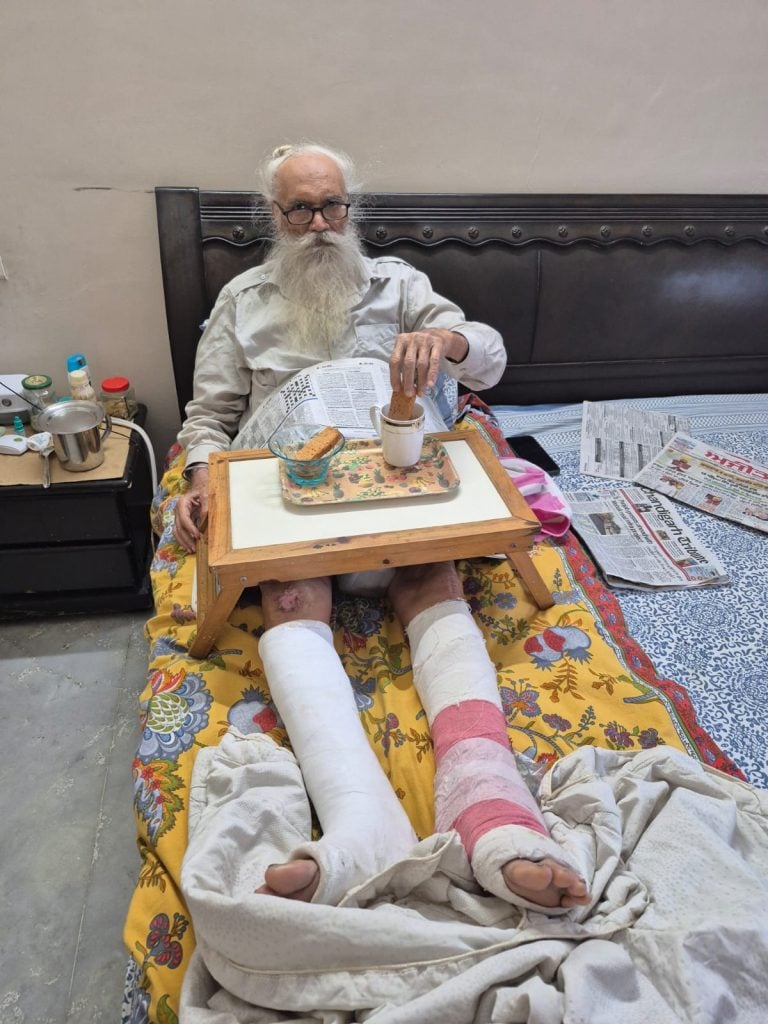
As he examined his father’s bruised hand, Amoldeep said such injuries were not uncommon, but they worried him. There had been more serious scares.
In March, while visiting his daughter in Mohali, Sidhu continued his cleaning rounds, much as he did in Chandigarh. One evening, while picking up litter along a busy road after dark, he was hit by a vehicle.
The accident injured both his legs, leaving one in a plaster cast. Amoldeep, who had been running a business in the US, returned to look after his father full-time and has been staying with him ever since.
He has since imposed a few rules for his father’s safety. Sidhu earlier walked more than 2 km on his cleaning rounds, but Amoldeep has restricted him to a 200-metre radius around their home.
His father’s influence, however, extends well beyond the neighbourhood. Amoldeep’s two children, who live in the US, have taken their grandfather’s example to heart.
“My son was so inspired by his grandfather that he began growing his hair at ten and started wearing a turban despite all the odds. He still does,” said Amoldeep. His daughter, now studying law at UC Berkeley, flew down for Sidhu’s Padma Shri ceremony.
“She was so inspired by his selfless service that she wants to work for non-profit organisations in the US,” he said.
Also Read: How Shahjahanpur brought down stubble-burning fires
The trouble with ‘hero worship’
When Dr Simrandeep Kaur Gill moved into the IAS-IPS Society three years ago, she was surprised to see an elderly man in gloves picking up garbage from the streets, sometimes even after dark. At first, she wondered why a retired IPS officer would do such work but now admires his determination.
“I find it very inspiring, especially at his age. It is easy for people to read a newspaper, comment on things or complain about how the government or its workers are not doing enough. But he believes that actions speak louder than words. He has taken the initiative and done the work himself, despite having held such a senior position. That is what makes his efforts so inspiring,” she said.
Gill said Sidhu would sometimes stop her to point out garbage and ask what should be done about it. But he is careful not to put pressure on others.
While I admire what Mr Sidhu is doing, we must remember that his efforts cannot replace the work of government departments. The horticulture and sanitation departments must follow a schedule and do their jobs
– Aditya Vikram, neighbour of Inderjit Singh Sidhu
“He tries to engage with people and encourage them to take initiative. But he also understands that everyone has their own commitments, so he does not want to take up their time. He tells them that if they feel strongly about something, they should take the initiative themselves,” she added.
Merely watching him in action has made some residents more conscious of their surroundings. One of them is Aditya Vikram, who moved into the neighbourhood about a year ago and runs Pushpanjali Trust, a non-profit working in mental health advocacy.
“Mr Sidhu picks up plastic, paper, fallen branches and other waste from the roads and public spaces around the society. When I moved here, I would see him quietly going about his work. He seemed like a very driven person, almost obsessed with what he was doing,” he said.
Vikram now helps tend to the society’s green spaces, including pruning trees and keeping the grass along the pavements in shape. He said Sidhu has noticed and often asks him for updates. According to him, other residents are no longer cavalier about littering or the society’s upkeep.
“He’s been able to motivate quite a few people in our society. Whether it’s getting a pothole repaired, or getting the lights fixed on the sidewalks outside,” said Vikram.
But Vikram is wary of people seeing Sidhu as a substitute for the authorities. Citizens can do their bit but government departments cannot be let off the hook.
“We are a nation somewhat devoid of heroes, and we quickly fall into the trap of hero worship. While I admire what Mr Sidhu is doing, we must remember that his efforts cannot replace the work of government departments. The horticulture and sanitation departments must follow a schedule and do their jobs,” said Vikram.
(Edited by Asavari Singh)