


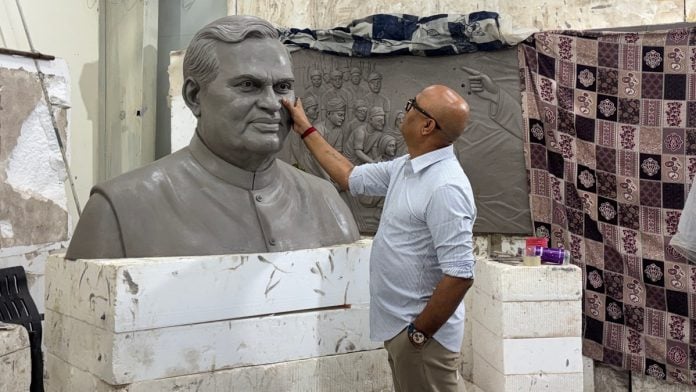
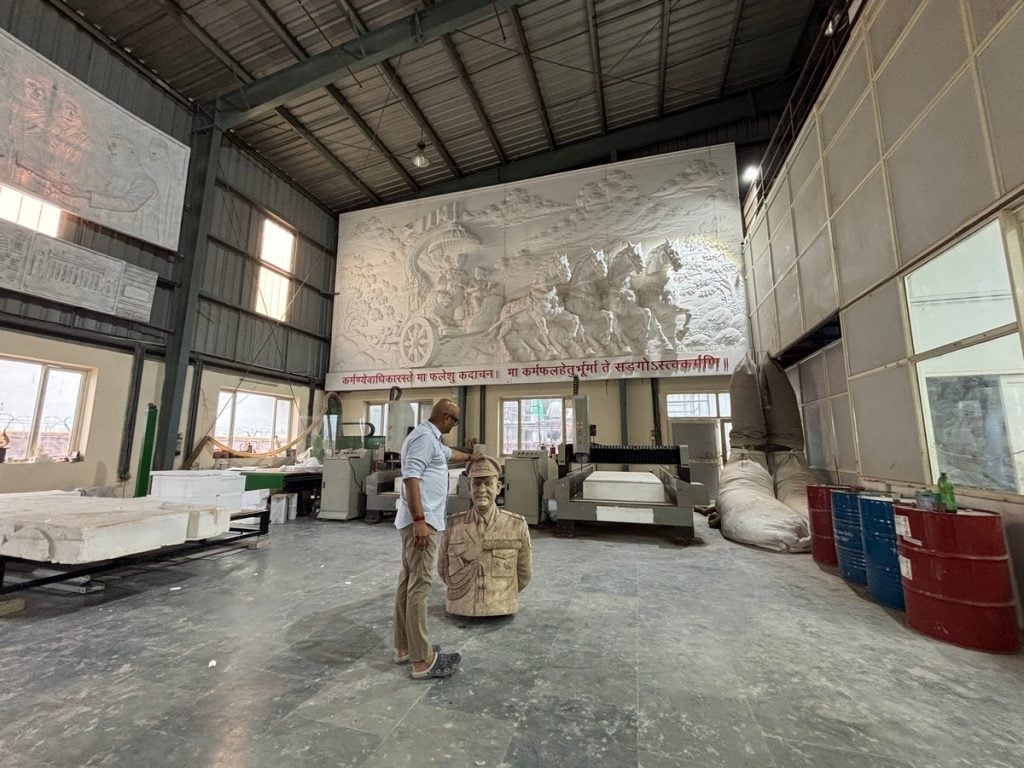
Manesar: Old Bollywood songs play on a colour-changing speaker as artisans work on a sculptural mural of BR Ambedkar and other unfinished pieces. One of them smooths Ambedkar’s clay coat, another works on figures of villagers on the other side. The mural takes up an entire wall. But that is modest by the standards of Naresh Kumar Kumawat’s workshop in Haryana’s Manesar.
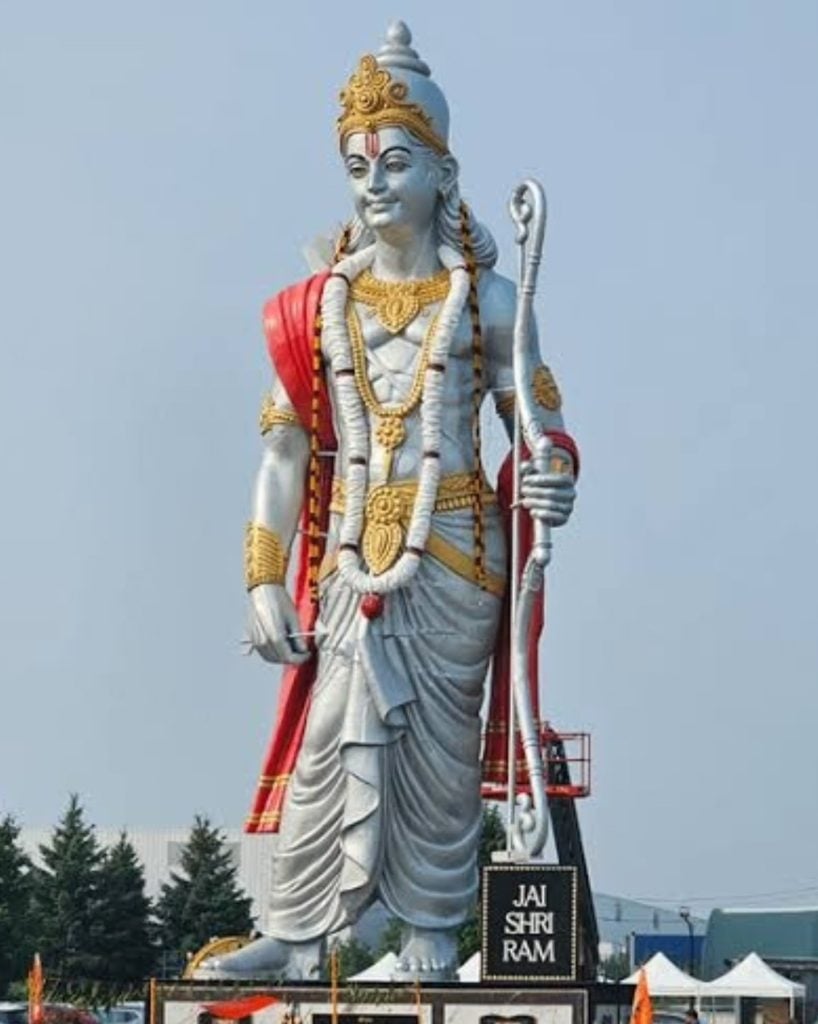
Kumawat is one of the Modi government’s go-to sculptors and has spent most of his career making gods and political icons larger than life at home and in over 40 countries—from the 369-foot Shiva ‘Statue of Belief’ in Rajasthan to a 51-foot Ram in Canada last year. Now an exhibition of his work, ‘The Mirror Men’, goes on show at the India Biennale at the Red Fort next month, and he says it’s like nothing he has done before.
“I have before worked with subjects that left little room for imagination and my own creativity. This is an exciting new endeavour for me,” said the 51-year-old sculptor, eagerly showing the blueprints of the installation.
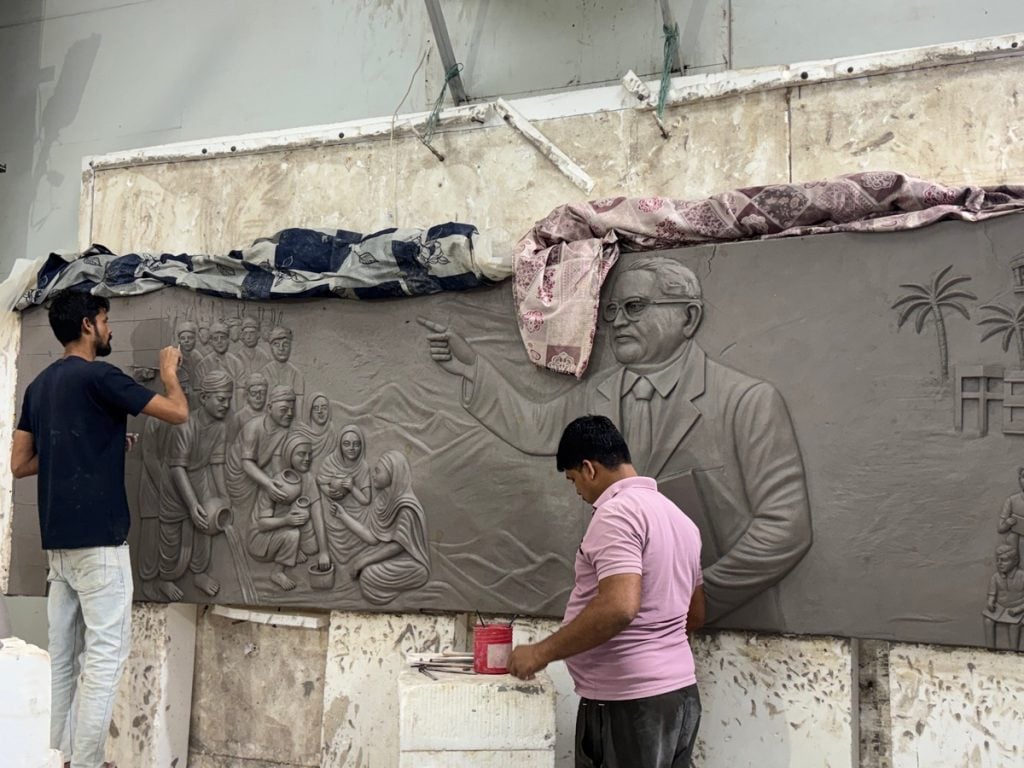
One part of the show is a celebration of his sculptures so far. The Culture Ministry’s website describes photographs, process documentation and realised works “tracing how portraiture, material and monumental scale shape civic and cultural remembrance.” The centrepiece, though, will be an “experimental” installation that’s more about self-expression than magnifying others.
But even then, there’s a place for Modi.
“I have a dream that the Prime Minister is standing at the centre of my installation while live Sufi music plays. This is a picture-perfect moment I have imagined,” he said.
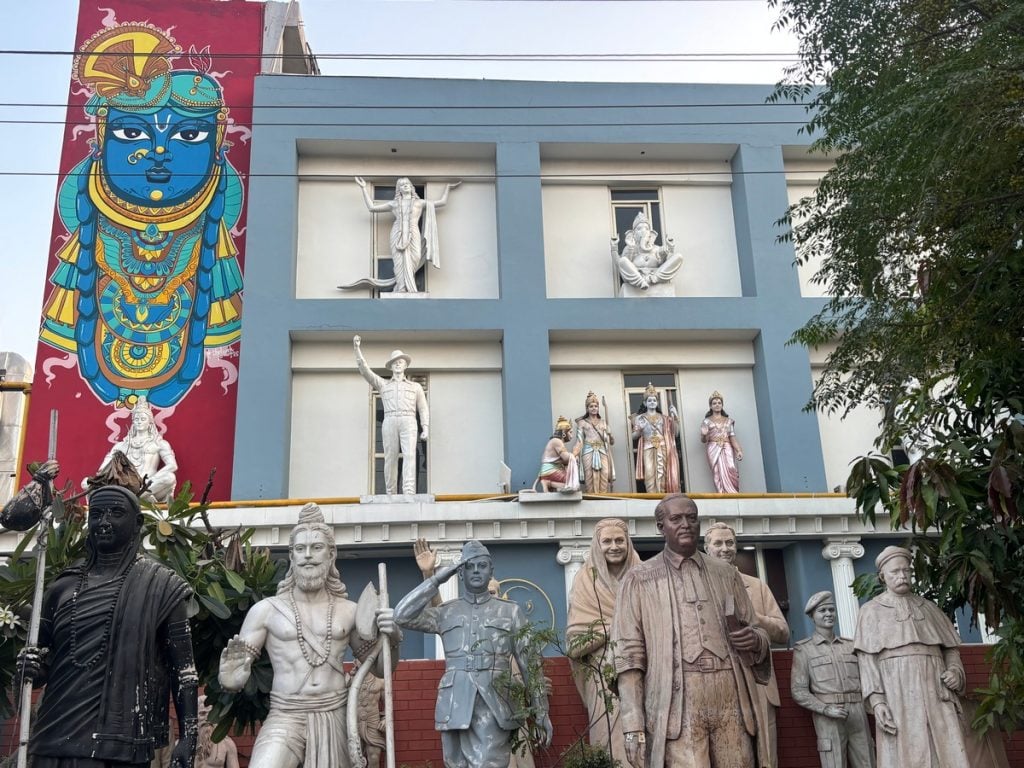
Over the last decade, Kumawat has been an integral part of the Modi government’s project of showcasing towering symbols of national identity through sculpture. He’s the man behind the grand 75-foot-long Samudra Manthan mural and the medallions of Sardar Patel and Ambedkar in the new Parliament building, as well as the bust of Deen Dayal Upadhyay that Modi unveiled at Vigyan Bhawan in 2016. His other standout work includes the 125-foot Statue of Social Justice depicting Ambedkar in Vijayawada and the 51-foot Statue of Strength depicting Parashuram in Arunachal Pradesh.
I have a dream that the Prime Minister is standing at the centre of my installation while live Sufi music plays. This is a picture-perfect moment I have imagined
-Naresh Kumar Kumawat
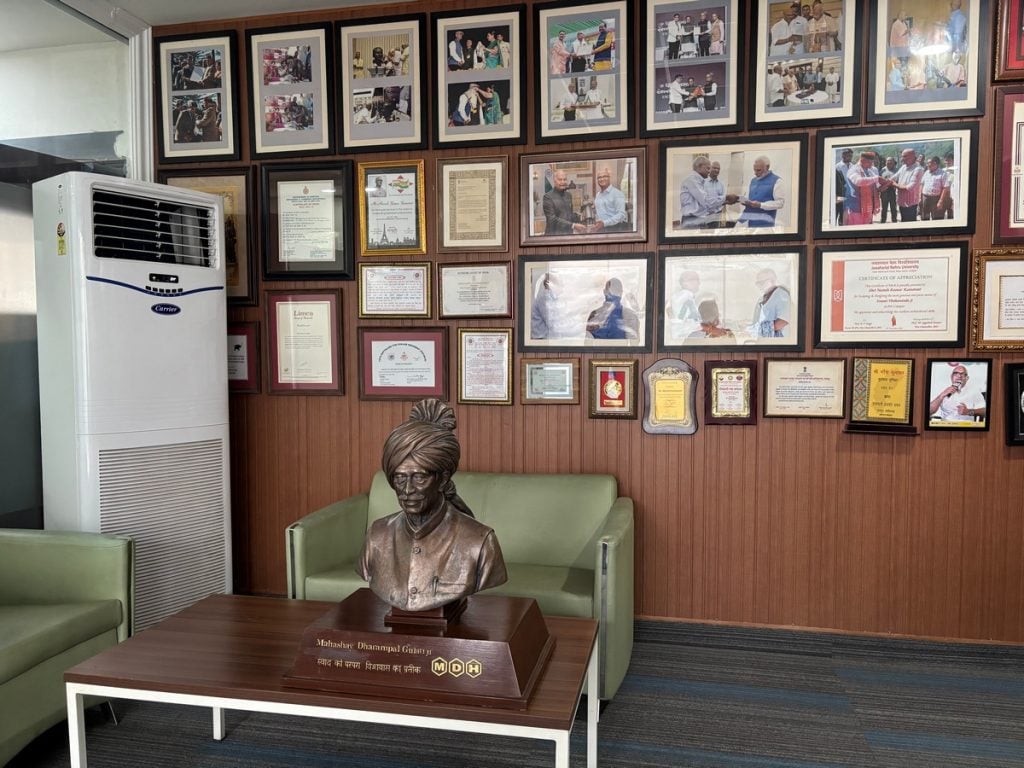
Modi himself is a fan. On Mann Ki Baat last year, he brought up the Ram in Canada and said people “were very excited about this event.” In the same broadcast, he spoke of a bronze bust of Maharishi Valmiki made by Kumawat’s studio and gifted by the Indian Council for Cultural Relations to Camporotondo in Italy. “Wherever you go in the world, you will definitely find the influence of Indian culture there,” Modi said. Kumawat has also sculpted portraits of Modi’s parents and was honoured at Rashtrapati Bhavan by former President Ram Nath Kovind.Kumawat has also sculpted portraits of Modi’s parents and was honoured at Rashtrapati Bhavan by former President Ram Nath Kovind.
For the sculptor, the satisfaction of making something monumental is not necessarily in the public recognition it brings.
“When you do such a big thing, you do it for your own pleasure, your own satisfaction,” he said.
But patronage at the highest levels is something that Kumawat has grown up seeing—except it came from the Birla family, the famous financiers of the Congress before Independence.
Also Read: Ram Sutar shaped independent India’s public spaces. He was the statue man
Tycoons and towering art
Scale has come to define every aspect of Kumawat’s career. He built what he describes as Asia’s biggest art foundry and works not just with artisans but with teams of engineers to realise his larger-than-life ideas. It might seem pre-ordained for someone from a third-generation family of sculptors. But there was a time when Kumawat was not entirely sure he wanted to become a sculptor at all.
Growing up in Rajasthan’s Pilani, he learned his craft from his father, the renowned sculptor Matu Ram Verma. But it was the family’s association with the Birlas that would eventually change the course of their lives.
In 1988, GD Birla’s son Basant Kumar Birla asked Matu Ram—who was also a teacher at a Birla school in Pilani—if he could make a 50-foot Shiva sculpture. Matu Ram said he could make one 100 feet tall. Then Birla asked whether he could go up to 200 feet. Matu Ram took up the challenge.
This was no task for the family workshop alone. Matu Ram consulted structural engineers and architects, prepared sketches and models, and presented the proposal at Birla House in Delhi before BK Birla, Sarla Birla and an architect. The presentation led to the making of the Shiv Murti near Palam Airport, one of the first towering statues in the country and a landmark in Delhi. In the end, it stood 85 feet tall.
For the young Kumawat, the project also offered an early glimpse of what art could make possible. He recounted BK Birla and Sarla Birla visiting their home to see a model of the sculpture.
No matter how big your work is, people may not connect, but if it is about art, then the biggest tycoon connects with you
-Naresh Kumar Kumawat
“For the house of an employee, such big tycoons coming to your house was a historical thing in itself. But this was art, which brought them to our house,” he said. “No matter how big your work is, people may not connect, but if it is about art, then the biggest tycoon connects with you.”
Yet by the time he finished Class 12 in the 1990s, Kumawat was toying with other options, such as becoming a doctor or engineer. It was Colonel VM Ratnakar, then director of the Birla Educational Trust, who encouraged him to stay with the family’s work.
“You have a career at home, why do you need to search outside?” Ratnakar told him. The advice struck a chord, and he threw himself into the family vocation under the tutelage of his father. The family had established its felicity with gigantic mythological figures, and there was no shortage of ambitious commissions from those who liked their deities looming.
One of Kumawat’s early assignments was a 121-foot Shri Sarveshwar Mahadev statue in Vadodara, completed in 2002. He later worked on a Hanuman statue at Chhatarpur Mandir, where he met businessman Ashok Kapoor, who gave him several projects.
Carving an identity
A few years into working with his father, Kumawat was eager to establish a brand and identity of his own. And so he approached Matu Ram for financial help in setting up shop independently. Rather than hand him money, his father offered him three things: his name, his car and his blessings. The car was something he could use immediately; the other two, his father said, would be more valuable in the long run. Kumawat concedes this has come to hold true.
If there is any small deficiency in any big statue, then that deficiency attracts you more than the attraction of the whole statue
-Naresh Kumar Kumawat
An opportunity to work in Sikkim eventually helped him establish himself financially. Then chief minister Pawan Kumar Chamling called Kumawat on his mobile phone, looking for Matu Ram. Ultimately, it was Kumawat who went to meet Chamling in Delhi and later travelled to Sikkim to present a proposal for sculptures, one of which was the 135-foot gilded statue of Guru Rinpoche in Samdruptse, completed in 2004.
By now, Kumawat had a studio, a wife and a restless curiosity about materials. He was modelling in clay and working in bronze, Panchdhatu (a traditional five-metal alloy) and stainless steel, depending on what a project demanded. But there was one thing that still eluded him, and it was the key to making bigger and more complex sculptures: metal casting. He wanted to start his own foundry.
Going big
With his new ambition taking shape in his mind, Kumawat watched video after video on YouTube of artisans demonstrating aluminium casting.
“I started learning metal casting with the help of YouTube. I used to stop a video 50 times and learn from it,” he recalled.
He began exploring the process around 2010 and set up his foundry at IMT Manesar in Gurugram the following year.
But having the facility did not mean he knew how to operate it. His first project was worth around Rs 40 lakh, and the foundry was not yet equipped to execute the metalwork. He began seeking out artisans, or karigars, in Shahdara and Mandoli in Delhi, some of whom, he said, tried to exploit his inexperience. But the searching was worth it.
“One day I got a good karigar who became my guru. He taught me how metal casting is done,” he said.
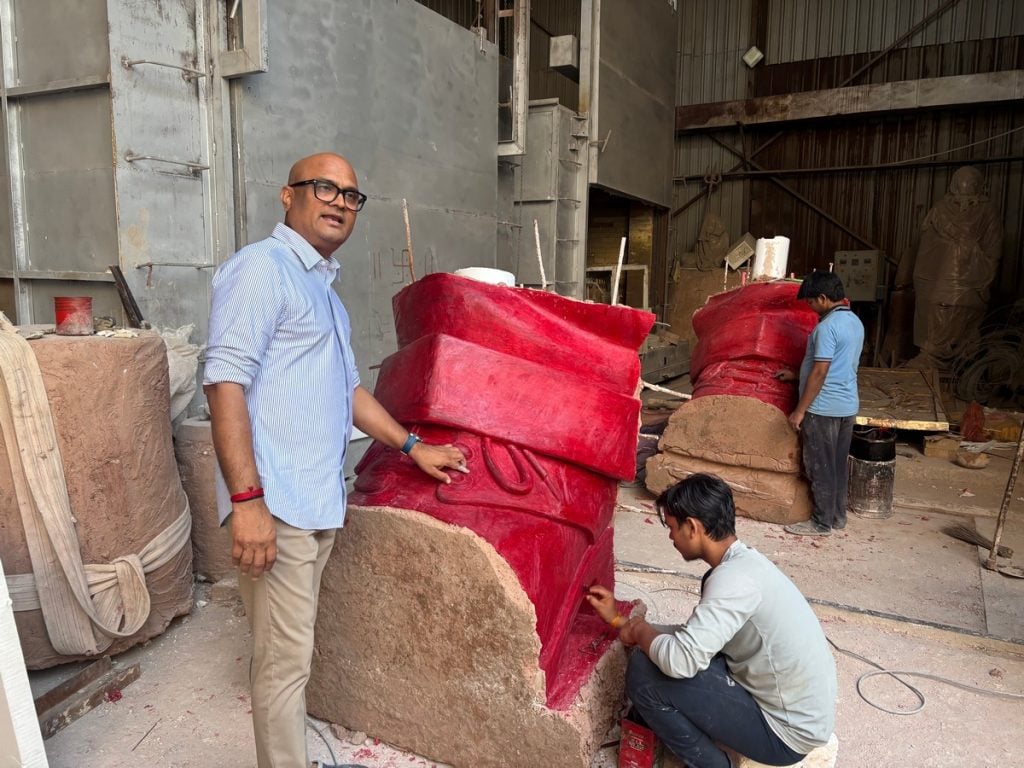
Learning the technicalities of casting, acquiring machinery and building a team took time. But over the next decade and a half, the foundry grew into the centre of his work. Kumawat says it can now cast single pieces up to 40 feet high, which can then be assembled on site into far taller statues. He employs around 270 people in all, including those working at the foundry, on project sites and on assignments outside India.
One of the biggest projects Kumawat’s studio took on in the foundry’s early days came from Miraj Group chairman Madan Paliwal: a 369-foot Shiva in Nathdwara, Rajasthan—now known as the Statue of Belief. The foundation stone was laid in 2012, but it took about a decade to execute. Paliwal wanted Shiva in a particular seated pose. Kumawat’s team had to work out how to build a figure that tall, keep its proportions right and make sure it would stand.
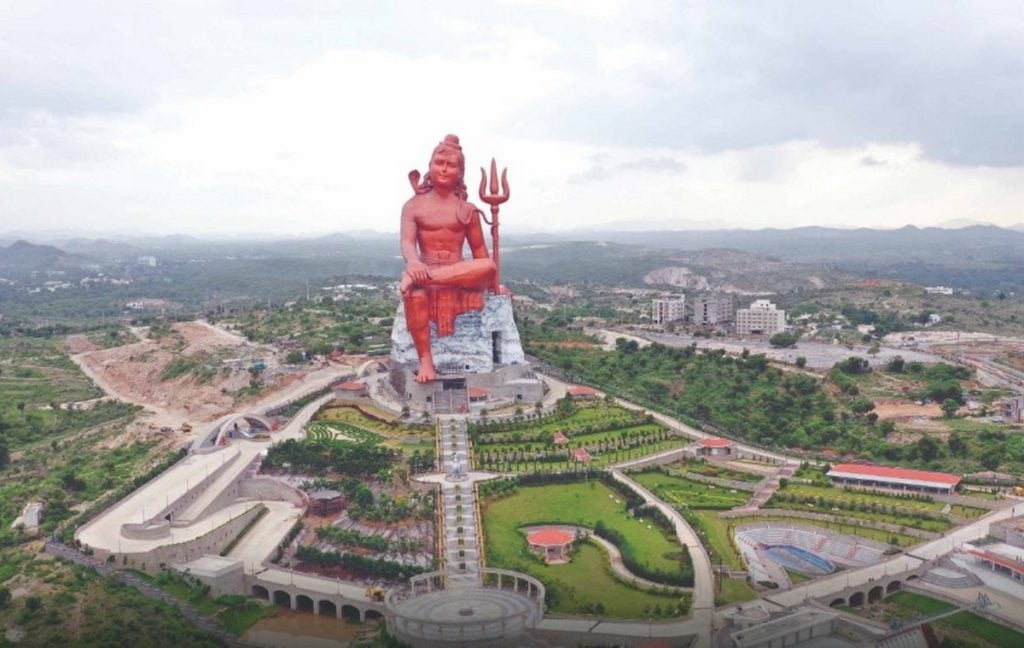
The sculpture was built in sections at the workshop, with the frame and individual components prepared before being transported to the site and assembled. Kumawat and his team travelled to the site regularly, sometimes climbing around 1,500 stairs before lifts were available. The working area covered nearly two lakh square feet.
With those dimensions, even a small error can become conspicuous. A figure’s proportions change depending on the height from which it is viewed, and a detail that looks right at ground level may not work when the sculpture is seen from far below.
“If there is any small deficiency in any big statue, then that deficiency attracts you more than the attraction of the whole statue,” he said. “If a black dot is applied on any white canvas, then that black dot attracts you more than that white canvas.”
The responsibility does not end when a statue is inaugurated, according to him. He recalls a 162-foot Hanuman statue in Nagpur, where rain caused the fresh colour on the chest to come off, exposing the white metal coating underneath. The team arranged a 100-tonne crane and a trolley to reach the affected section and repair it.
For Kumawat, leaving the defect unattended was not an option. The work carried his name and reputation, after all.
“I have to fix it not because my money will get stuck, but because years after the statue is made, nobody is going to ask who commissioned it. Everyone will ask who made it,” he said.
Sculptor in the corridors of power
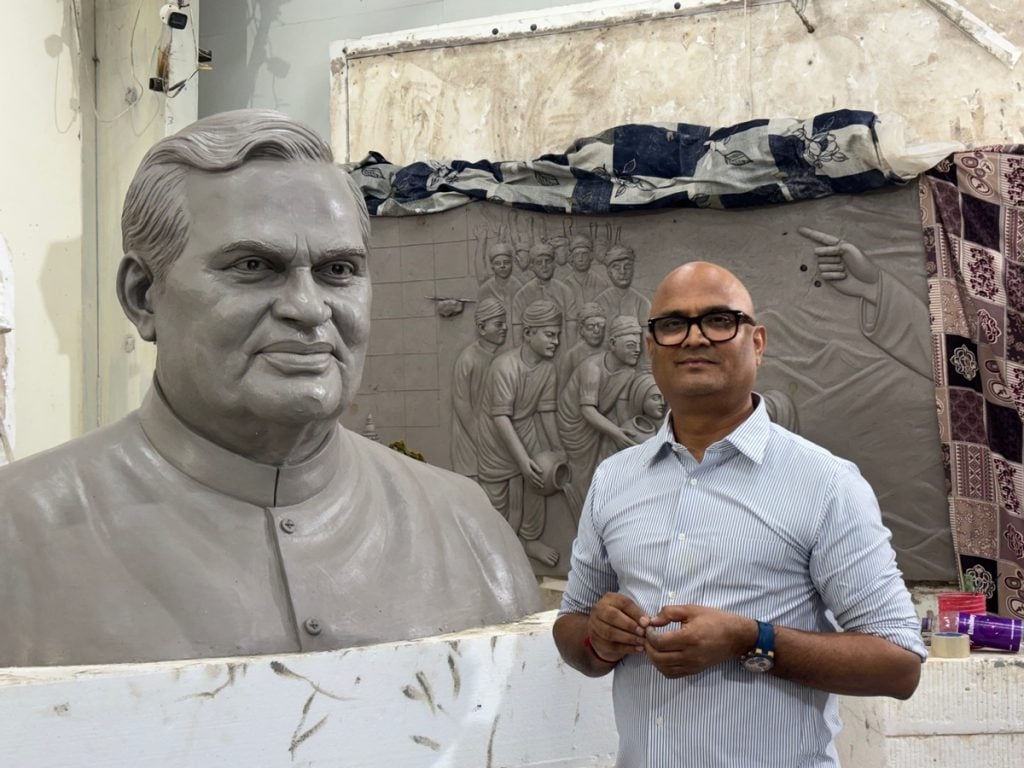
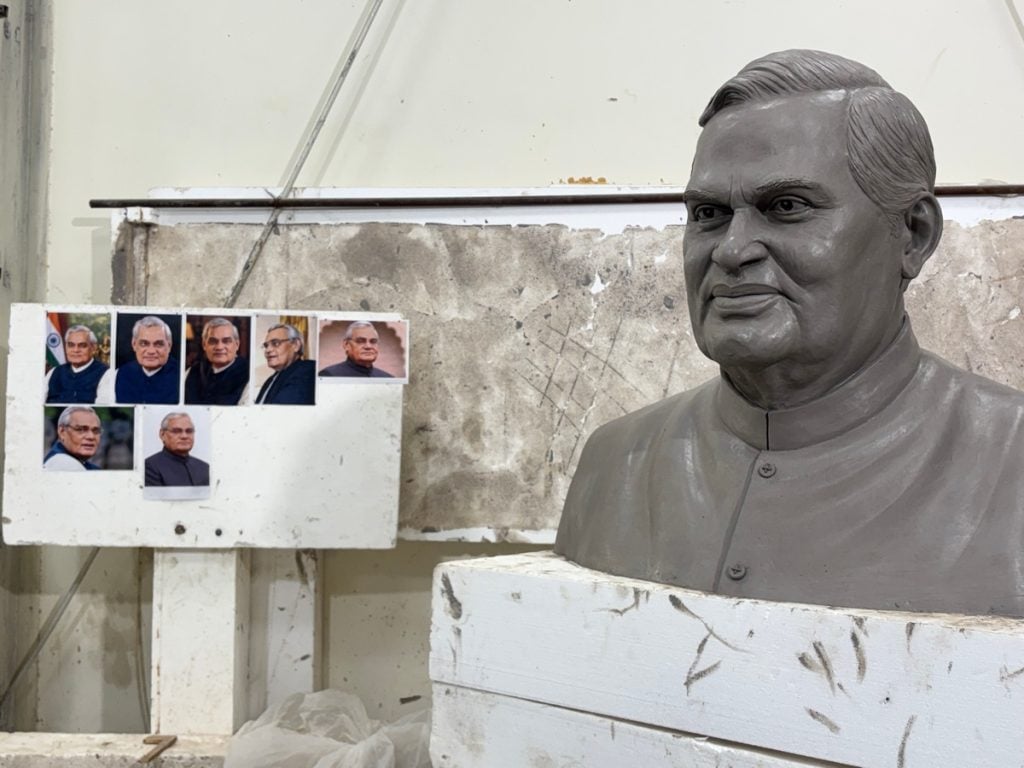
Kumawat’s stature as the Modi government’s preferred murtikar was built on a string of commissions that brought his work into prominent public spaces. There is no shortage of nationalist icons to his credit—from the Deen Dayal Upadhyay bust to the Ambedkar statue in the Supreme Court and statues of Atal Bihari Vajpayee and Syama Prasad Mookerjee in Lucknow.
His association with the PM also extended beyond official commissions. In an interview with NDTV last year, Kumawat spoke of how he made a sculpture of Modi’s mother Heeraben as a gift, after which he was asked to make one of Modi’s father as well.
“I met her once in Gandhinagar. Then I sculpted it on my own and I presented it to the Prime Minister and kept it in his room,” he said, adding that the PM had just one request for a change: to make the sari a little less long.
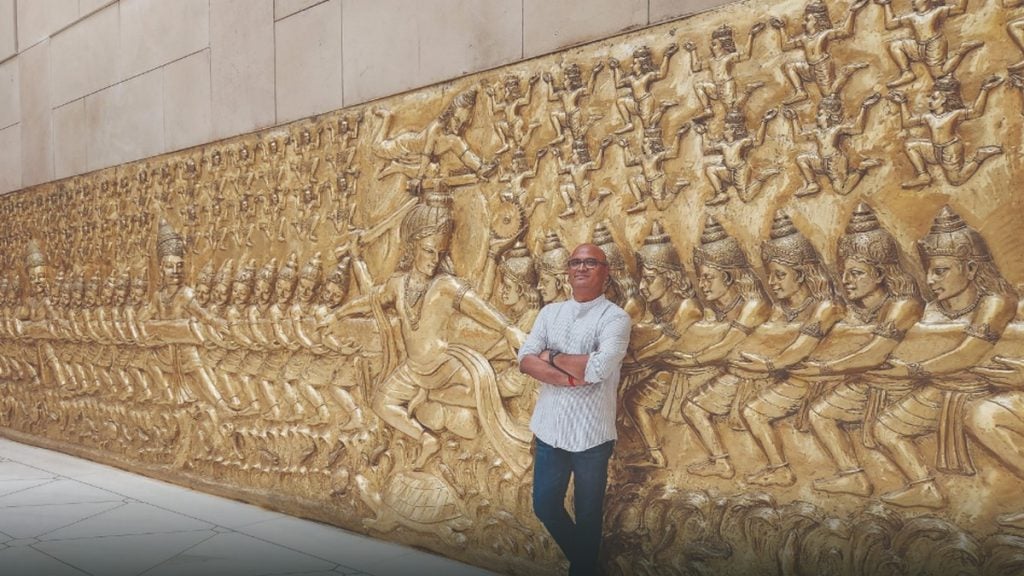
One of the opportunities he recounts fondly was the Samudra Manthan for the new Parliament building: a sweeping sculptural mural depicting the mythological churning of the ocean by gods and demons. Commissioned around 2022, it was among the large-scale artistic installations that became part of the new building.
Govind Mohan—then culture secretary and now home secretary—visited his studio, reviewed the work and gave him leeway to approach it artistically.
“He used to give full freedom as an artist, that you do the work according to you,” Kumawat said.
For the concept, though, he gave all credit to the top.
“It was our Prime Minister Narendra Modi’s vision to create a scene from Samudra Manthan… as a symbol of serving in a righteous manner from the sacred Parliament, which would turn into elixir for our country and countrymen,” he’d said at the time of the unveiling.
Kumawat’s commissions have also taken him beyond India many times as an artistic envoy of sorts. The latest was a bronze bust of Sardar Vallabhbhai Patel at the Consulate General of India in Atlanta, unveiled by External Affairs Minister S Jaishankar on 31 October.
“On #NationalUnityDay, an honour to unveil a bust of Sardar Vallabhbhai Patel… An enduring source of inspiration, reminding us of Sardar Patel’s vision, leadership and invaluable contribution to India’s unity & integrity,” Jaishankar posted on X.
On #NationalUnityDay, an honour to unveil a bust of Sardar Vallabhbhai Patel at @IndiainAtlanta
An enduring source of inspiration, reminding us of Sardar Patel’s vision, leadership and invaluable contribution to 🇮🇳’s unity & integrity. pic.twitter.com/FPHZ0iIPR1
— Dr. S. Jaishankar (@DrSJaishankar) October 31, 2026
Kumawat says he appreciates every project, including those that initially seem nearly impossible to pull off.
“There were a lot of projects. I mean, I enjoyed each and every project of mine, but there are projects when I was doing them, I always felt that how will this happen. But it happened,” he said.
Tech, team and human touch
Kumawat has come a long way from his days of squinting at YouTube, with a studio generously equipped with CNC machines, 3D printers and scanners. His team uses 3D models, cross-sections and structural analysis to work out what holds a sculpture up from the inside. Engineer Sarath Gupta, whom he credits with the structural drawings for the Statue of Belief, the Statue of Social Justice and the Statue of Strength, is as much a part of the process as any artisan.
But Kumawat is careful about what technology can and cannot do. For him, the engineering and the artistic work are connected, not interchangeable. He points to ancient sculptures such as the Nataraja, balanced on one leg, and the Dancing Girl of the Indus Valley Civilisation as examples of how much technical understanding went into traditional art.
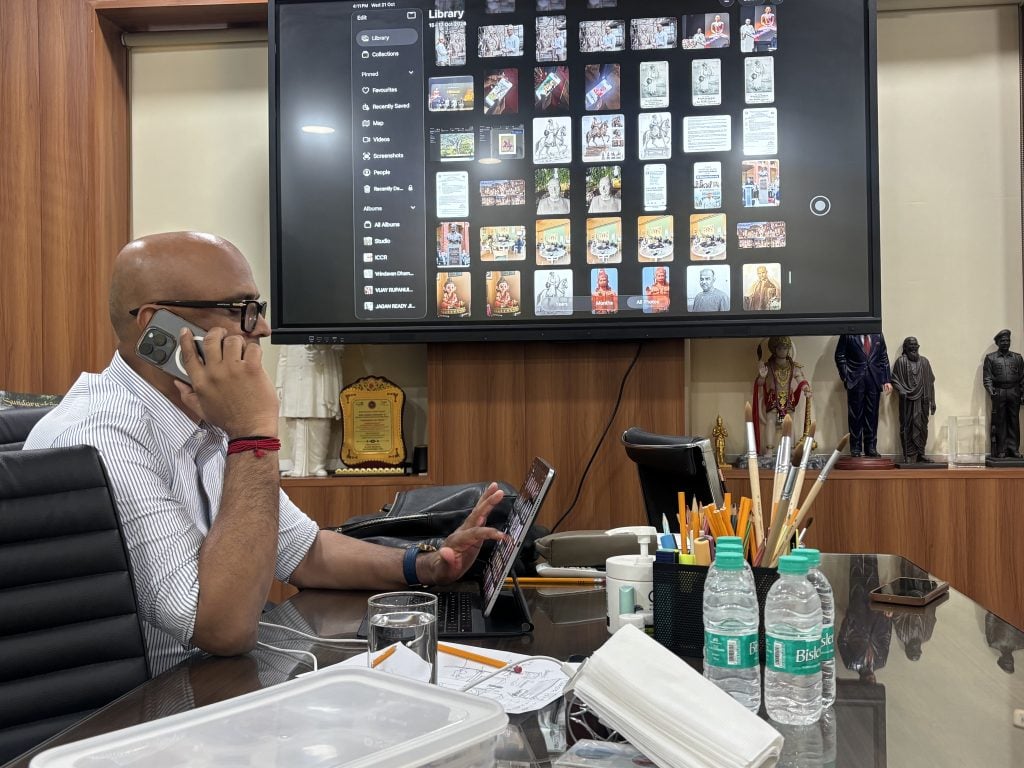
According to him, artificial intelligence and digital tools can help scan a subject, enlarge a model or work out the structure inside a sculpture, but the final work still needs the human touch.
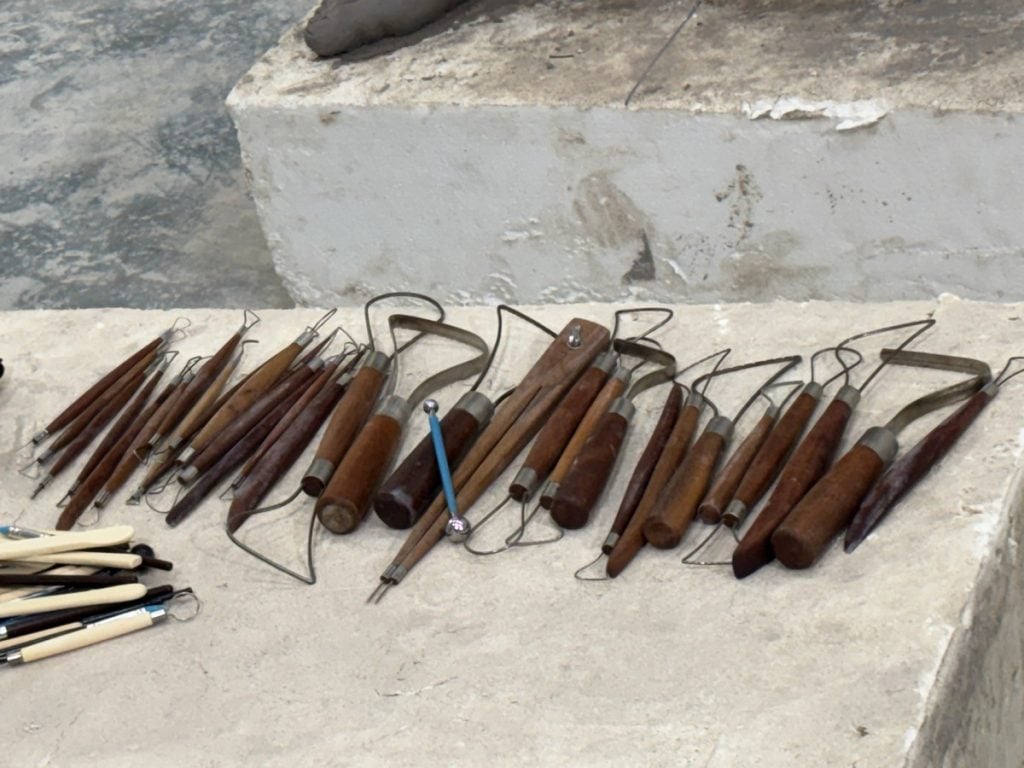
“All the work is still done by hands,” he said.
Kumawat is eager to share the credit with the people those hands belong to. He speaks of them as collaborators and compares his studio to a newspaper: the byline belongs to the reporter, but no publication is the work of one person alone.
“All my workers have an equivalent credit in all my work. Because they are there and I am there,” he said.
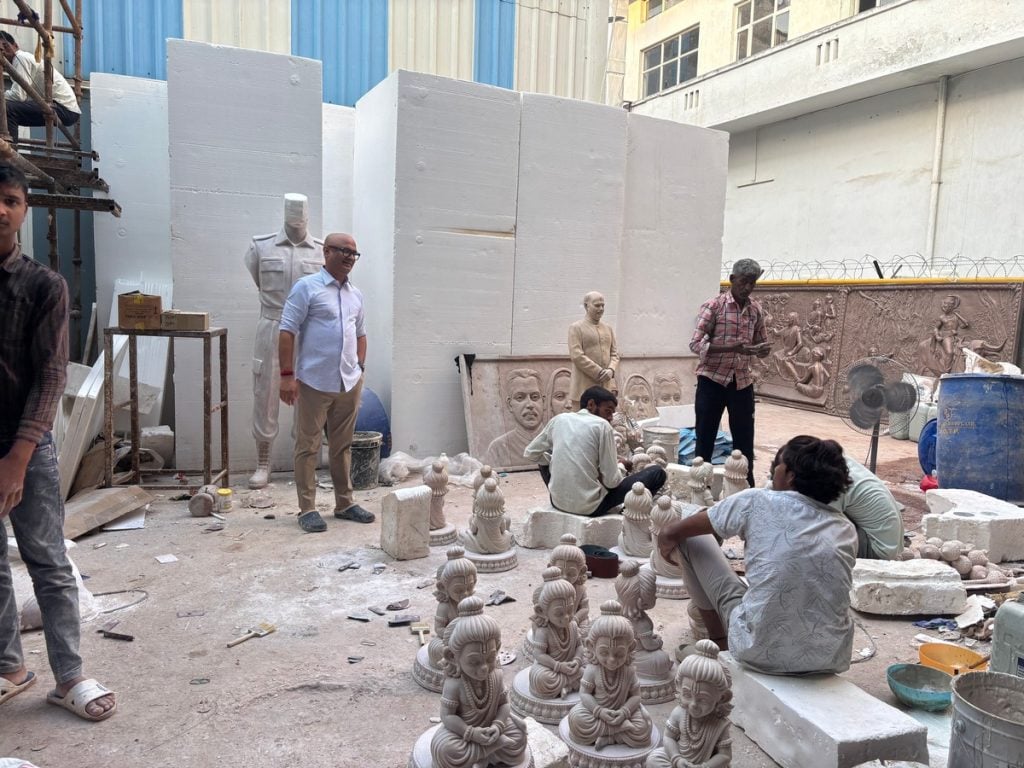
That’s not to say he isn’t a taskmaster. Kumawat exercises plenty of oversight over every aspect of work at Matu Ram Art Centres.
“You cannot depend totally on the workers. You cannot ask the workers to make a 100-ft statue and get it inaugurated,” he said.
At the same time, he’s invested in their comfort. There’s AC, music and safety gear for everyone.
“You have to have a team which works for you, with you,” he said.
Also Read: Meet Inderjit Singh Sidhu, the 88-year-old retired IPS officer sweeping Chandigarh’s streets
Through the looking glass
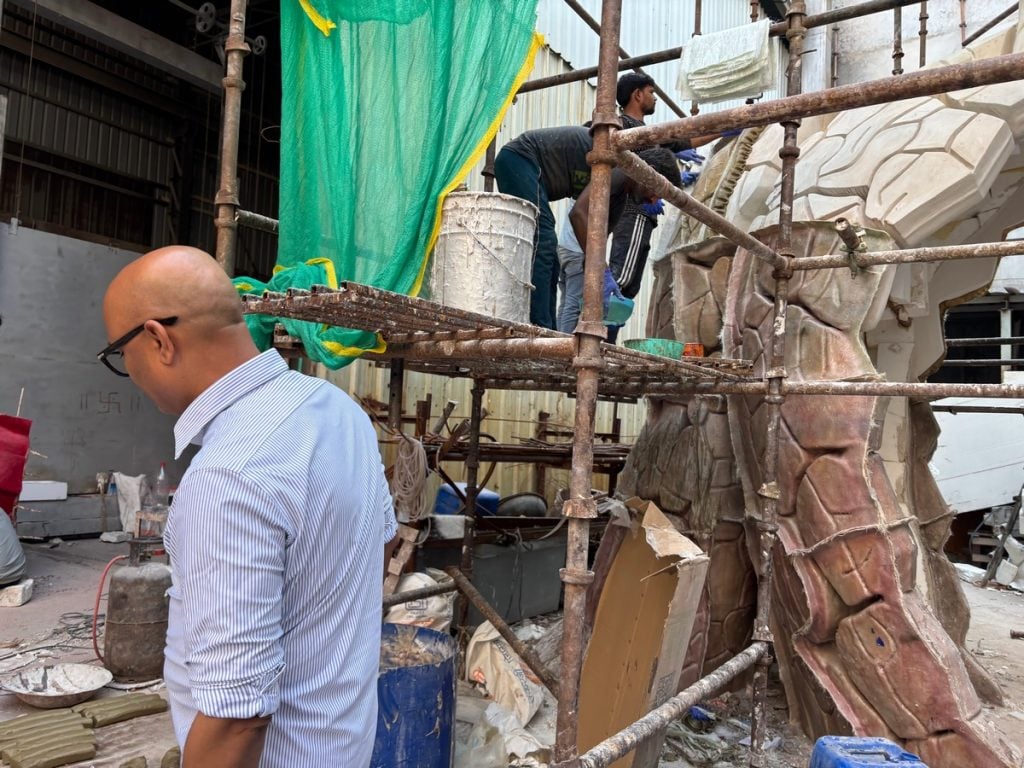
Under the open sky in the studio compound, ‘The Mirror Men’ is taking shape from its blueprints as workers on ladders go about their work. The installation will be on show at the India Biennale ’26, which runs from 4 December 2026 to 21 March 2027.
The approximately 22-foot installation, made of mirror-polished stainless steel and bronze, draws on the Upanishadic principle of “Tat Tvam Asi”, or “That Thou Art”. Its reflective human forms are designed to let visitors see themselves within the artwork, exploring self-realisation, human identity and the interconnectedness of existence.
The title, too, points to this exchange between the artwork and the person looking at it. Rather than remain an object to be observed, the sculpture makes the viewer part of the experience.
For Kumawat, the installation is also a departure from the commissioned subjects that have defined much of his career. A portrait, for instance, must retain the features that make its subject recognisable. ‘The Mirror Men’, by contrast, gives him greater room for interpretation. But he is as exacting about it as any sculpture of a deity or dignitary. The principle he goes by is that first and foremost, an artist must be satisfied with his own work.
“If I don’t like it, how will you like it?” he said.
(Edited by Asavari Singh)