



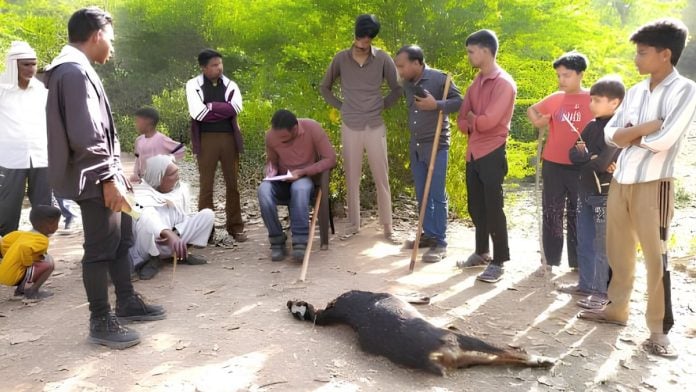
New Delhi: Where the urban sprawl of Delhi and Haryana meet, one of the city’s best-kept secrets lies — the sacred forest, Mangar Bani. Gurugram and Delhi activists fight to protect it, environmentalists praise it, but at its core, Mangar has survived because it takes a village to protect a forest.
But now, the villagers of Mangar want the government to look after their cows and goats too as they conserve the forest. The Mangar Bani forest is usually in the news and in the National Green Tribunal for encroachments and illegal constructions. The villagers’ own woes rarely get talked about when a massive 677-acre forest is at stake.
As stories of man-animal conflict become more frequent, Mangar has a unique problem. Over the past five to 10 years, the area has developed an ‘animal-animal’ conflict, and the custodians of the forest are stuck in between. Villagers estimate that every year nearly 30 to 40 cows and goats are eaten up by wild animals in the sacred forest, mostly leopards. This is just in one village, and there are at least a dozen villages surrounding the forest.
Sunil Harsana, an environmental activist, said that at first, his work in Mangar was about protecting the forest and the wildlife. But as complaints mount from the local community, he is doing all he can to help them too.
“Mangar might be one of the lungs of Delhi, but the local community also needs to benefit from the forest. People often ask me, if there are too many wild animals around here, whose side will you pick? I don’t know; we still need to figure these problems out,” Harsana told ThePrint.
It is a classic conundrum. When the forest is conserved better, the villagers are on the frontline of wild leopard attacks.
On paper, the government offers them a mechanism to claim compensation, but most livestock deaths in Mangar and the surrounding villages don’t even make it to the wildlife warden’s records. The Gurugram wildlife division recorded only one such livestock death from Mangar in 2020. In the past two to three years, the number has risen, but even then they still have a total of about 10 cases since 2020.
When they try to seek compensation, herders are left chasing vets and wildlife officials in the hope that some money might eventually reach them. Often in vain.
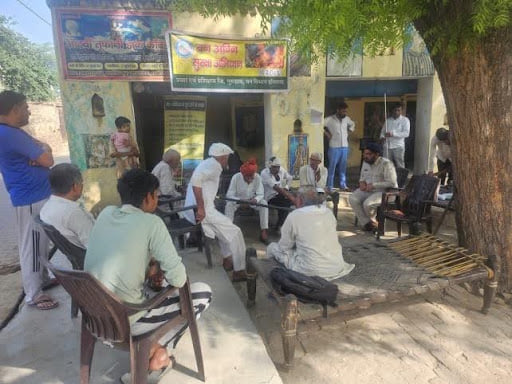
The night Chauri died
On the night of 2 March 2026, 25-year-old Sundar witnessed this absurd sequence of events firsthand.
While Sundar, his father, and his two dogs slept peacefully in their house at the edge of Mangar Bani, a leopard crept into the enclosure where the family kept their dozen goats. That night, the leopard chose three-year-old Chauri for its meal.
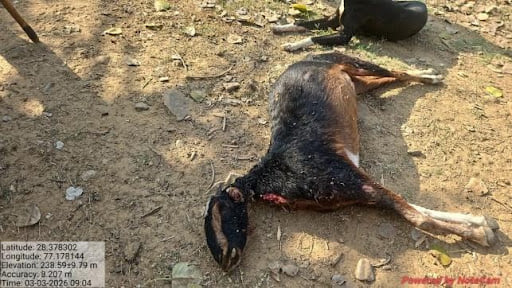
“The next morning, my dog Kaalu followed the scent and found Chauri about 200 metres from the house. We could see the teeth marks around her neck and we knew that the leopard had killed her,” Sundar told ThePrint.
Standing at the murder scene, a disheartened Sundar needed no proof that a leopard had killed his goat Chauri. But convincing the wildlife department and getting compensated was a whole other matter.
First, he wrote a complaint to the wildlife department. Then an inspection was done by a wildlife official. A diary entry followed, and then a government vet showed up at the scene with his gloves and tools to conduct an autopsy, photograph the scene, and establish the cause of death. The report had to then return to the wildlife department, followed by Aadhaar and PAN details, bank documents, and the signature of a village sarpanch.
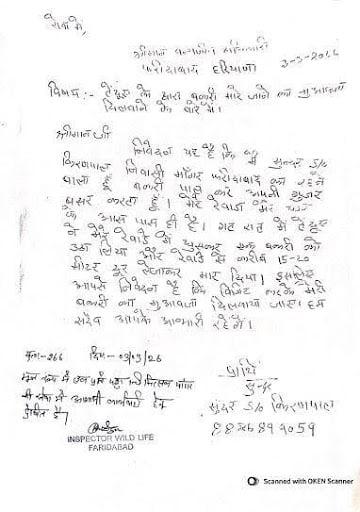
It has now been over six months since Chauri’s death, but Sundar is yet to receive compensation. However, he is one of the lucky ones who have made it to the final step of the compensation process.
“We have conducted studies in Mangar, especially among the communities that are still dependent on livestock farming, and we found that cows and goats are the most vulnerable to leopard attacks,” said Harsana, who grew up in Mangar.
Harsana is the first person people call when their cows or goats get murdered by a wild animal. He guides them through the compensation process, because without his help, many don’t even try following up on the government’s cumbersome procedure.
At first glance, the problem might look like just a few dead goats and cows, but across Mangar and the villages near the Aravallis, livestock losses have grown more common in the past five to six years. Many of the families still depend on livestock for their livelihood, and the death of a cow or a goat is no small loss.
The return of a forest
Mangar Bani used to be home to a pastoral community which depended on the forests for their livelihood. Many of the locals were Gujjars who had settled there to avoid conflict with agricultural communities. They would leave their cattle and goats in the forests during the day, bring them back in the evenings, and they were used to the wild animals that would often take their due. But with time, Mangar changed.
In the 1970s, the army used the forest as a training range. They would fire from the Tuglakabad base and the bombs would land among the trees. Then came the mining. The road that leads up to the village, now surrounded by lush green on both sides, was once flanked by the temporary settlements of hundreds of workers employed in the mines. In 2002, when the mining finally stopped, some of the communities slowly returned to livestock farming.
Sundar’s family was one of them. Around the early 2010s, Sundar and his father had nearly 100 goats. Today, they have barely a dozen. Over the years they began keeping fewer goats but in the recent past, quite a few of them have been eaten up by wild animals. If the deaths occur deeper inside forests, then they have no legal right to compensation either.
Much of his livestock-related income comes from selling baby goats when they are about three to six months old. But even that fetches hardly about Rs 8,000 to Rs 9,000 for a five- to six-month-old goat. Keeping the livestock safe has now also become a hassle. Ever since the death of Chauri, Sundar now guides his goats up a staircase and keeps them on his terrace in the evenings.
“These leopards have been brought back by the government. We don’t know who, but still. Keeping animals makes no sense anymore,” he said.
Harsana said he knows the villagers need someone to blame, but as he opens up a map on his laptop, he points to the interconnectedness of the forests in India. Right from Rajasthan’s Sariska, Sawai Madhopur, to Tughlaquabad, the Harchandpur hill, Manesar, there are pockets of forests separated by merely a few kilometers of human settlements.
“Between 2008 and 2013, the tiger population rose in Sariska. As leopards moved the forest’s fringe, they ventured out and found their way back to Mangar,” explained Harsana.
The leopards have not been “brought there”; they have simply travelled the green corridors and returned to a forest where they once lived. But even as livestock deaths rose over the years, most villagers didn’t bother following up for compensation.
“Sometimes the wildlife office takes a while to respond to complaints. Sometimes the vet is busy. Sometimes the wildlife officer asks for a letter from the gram panchayat who refuses to provide it because there is no proof of land ownership,” Harsana said that the process can choke up at many points.
Even when compensation is received, it is hardly significant. The price of a goat today is anywhere between Rs 10,000 and Rs 20,000. But the compensation for an adult goat’s death is Rs 3,500. Harsana said that the village is situated so far from the wildlife warden’s office that even if the applicant has to make a couple of trips to complete the documentation, he ends up spending much of the compensation on the commute itself.
Having a good relationship with the local vet helps in the process. If he comes in time and does the autopsy, the villager is more likely to receive compensation. After all, they can’t keep a rotting carcass in their house as evidence for the vet.
Bureaucratic delays
When the Wildlife Division in Gurugram heard that the number of livestock deaths in Mangar has risen in the past year, most officers were surprised. Their folders don’t match the numbers.
Divisional Forest Officer Ramkumar Jangra said that Sundar’s case is at the last stage. The orders have been filed, and only the money is left to be paid out. But the department is lacking the funds. In fact, there isn’t even a separate budget for compensation — the amount is paid out from the department’s “miscellaneous” expenses.
“Obviously we don’t want anyone to suffer because of wild animals. That is why we give such schemes related to compensation, or even vaccinations. We even do awareness drives. But the compensation process is slow because we have to send an officer to verify the death,” Jangra told ThePrint.
The department has also sent several proposals to revise the compensation amount, but approvals are still pending. The last time the compensation amount was updated was in 2014. The wildlife division proposes to raise the compensation for a cow’s death from Rs 12,000 to Rs 20,000, for a calf’s death from Rs 6000 to Rs 10,000 and for a goat’s death from Rs 3,500 to Rs 7,000.
“We conducted surveys to understand the current market rates for livestock and in most cases we are nearly doubling the earlier compensation. We have done everything from our side, the approval can come anyday,” Jangra said.
The department even offers schemes where villagers can buy life insurance for their livestock.
Sundar admitted that he has indeed insured some of his goats.
“But the leopard always seems to know which ones are insured. He never takes any of them,” Sundar laughed.
Harsana said he is going to conduct more surveys in Mangar to better understand and document the man-animal conflict; several cases remain in limbo.
Sundar’s compensation too is stuck between the goodwill of officials and bureaucratic delays. His goat might be dead, but the paperwork Chauri left behind is still alive.
Also read: MCD’s unsafe buildings list for Delhi. Declared dangerous, still in use
Coexistence despite the crisis
Despite the rising number of livestock deaths, the older villagers in Mangar don’t have an enmity with the leopard itself. When the leopard kills livestock in the forest, they understand that it is an unspoken ‘tax’ which they offer the forest. It is only when the leopard comes into their homes that they complain and demand help.
Jeetan, now in his 60s, has been taking care of cows all his life. He said that the reappearance of the leopard is not all bad. It has reduced the number of livestock thefts from the forests and it has, in some sense, brought him closer to his cattle.
“Earlier, many of us used to leave our animals in the forest for days and weeks. Now we are more careful. We spend the entire day with our cows. When a cow dies, we hold ourselves accountable too. We ask each other ‘why were you not more careful?’” Jeetan told ThePrint.
Nearly three years ago, one of Jeetan’s Sahiwal cows, a breed high in demand in India for its milk production, was killed in his courtyard.
“She was pregnant. If the leopard had waited just a few more months, I could have sold her for more than a lakh,” said Jeetan, who had to instead settle for Rs 12,000 compensation that came six months later.
For him too, the process of compensation was tedious. For two days the body of his pregnant cow lay in his courtyard. He had covered her up to make sure the dogs didn’t get to her. Luckily it was January and the cold made sure the body didn’t decay too fast or smell too bad. The vet came only two days later.
When the application for compensation was finally made, Jeetan’s son travelled all the way to Gurugram to deliver it in person. It took six months, but a wildlife official eventually returned to Jeetan with a cheque.
Over the years, Jeetan has lost over 20 cows to Mangar. Most of them died in the forest, and he did not have a legal compensation claim. But even then, he has nothing against the returnee leopards.
The first generation of leopards that returned appeared as if they were brought from some zoo. Jeetan said they were friendlier and less bloodthirsty, but that meant they would not run away when they saw humans. He says that, in some sense, they were more dangerous because they preyed unafraid.
Jeetan used to run into one of them quite often. She had a scar on an eye through which he recognised her. Jeetan and other villagers would stare at her, and she would appear blind.
The new generation of leopards are more bloodthirsty but also wilder and more afraid of the humans. For the villagers this is a silver living, atleast the new leopards are a little more afraid of them. But despite it all, Jeetan is happy to welcome the leopards back to Mangar.
“We are just careful not to venture into the forest at night. After all, especially at night, the forest is their kingdom,” he said.
(Edited by Ratan Priya)