


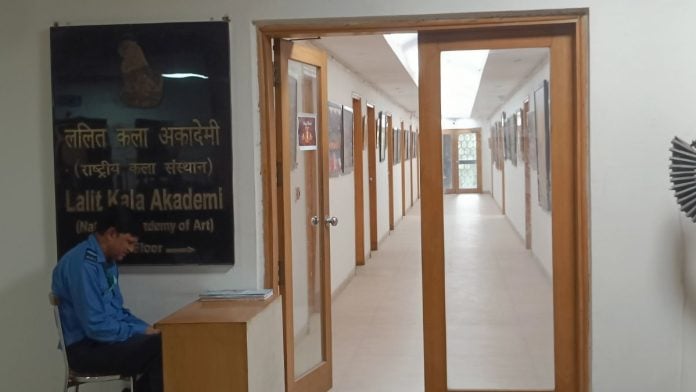
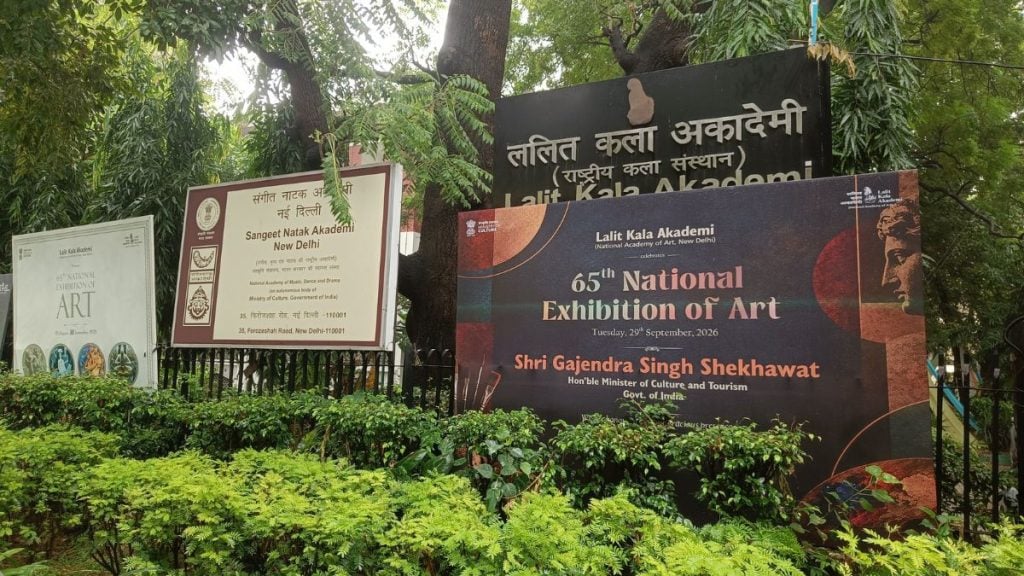
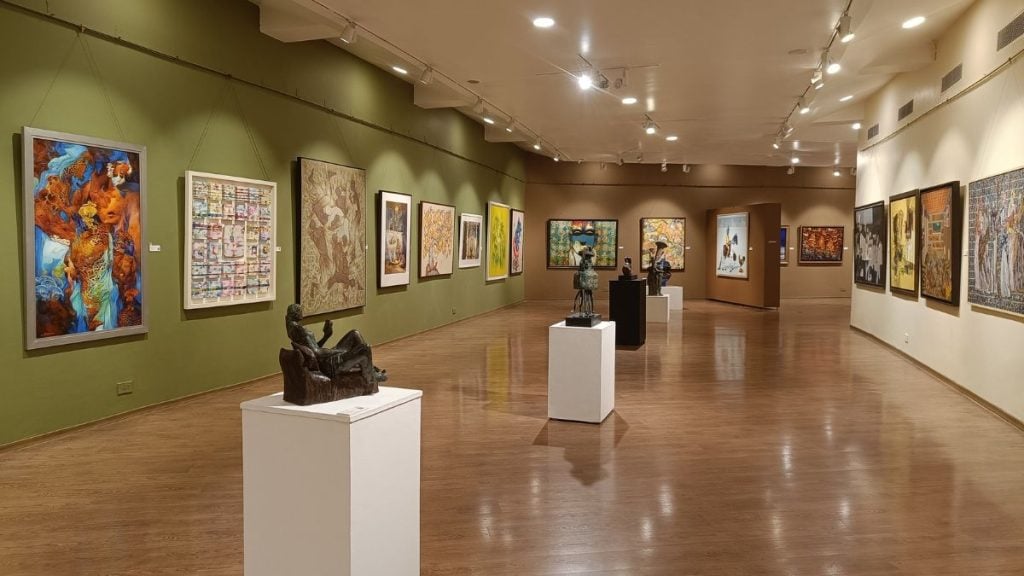
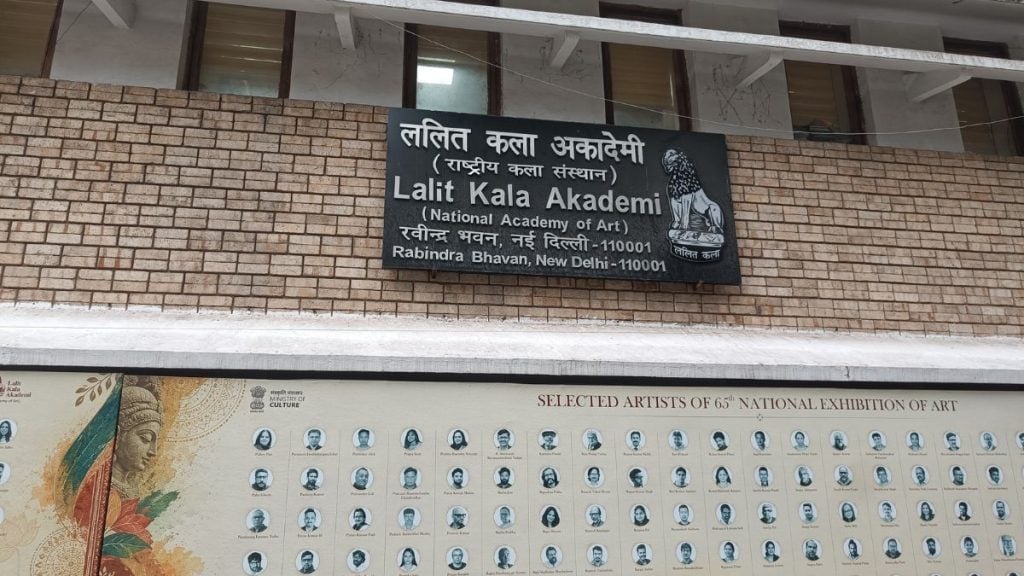
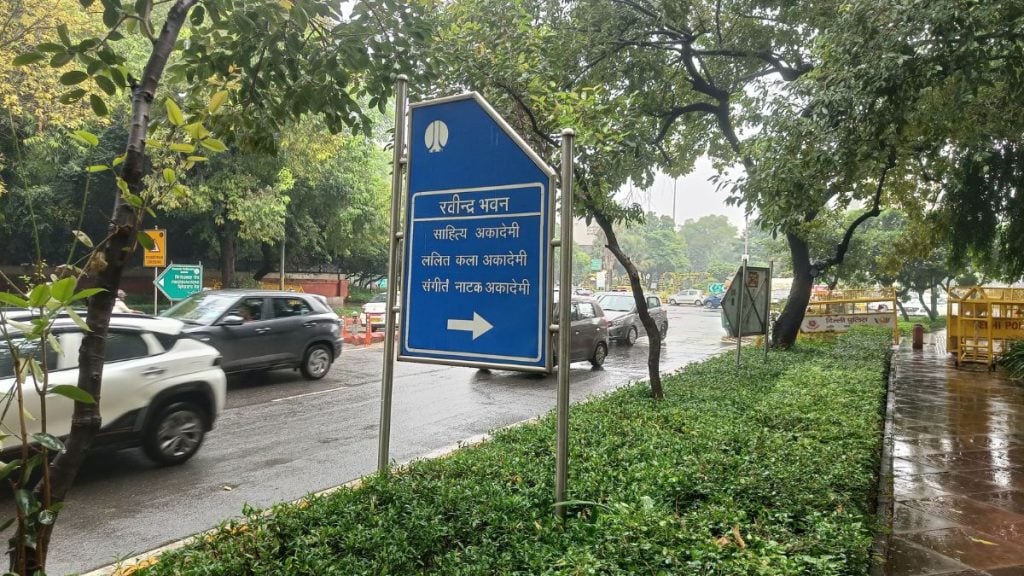
New Delhi: Union Culture Minister Gajendra Singh Shekhawat was there. So were the Culture Ministry secretary, senior officials and a gallery packed with artists. It was Lalit Kala Akademi’s flagship National Exhibition of Art, one of the biggest annual celebrations of contemporary art that opened at New Delhi’s Rabindra Bhawan in September. Yet one person was conspicuously missing — the institution’s chairperson.
It was no accident. For the second consecutive year, the Lalit Kala Akademi’s marquee exhibition unfolded without a chairperson at its helm. The Lalit Kala Akademi has been without a chairperson for more than seven months now, leaving one of India’s premier visual arts institutions without a full-time head at a time private galleries in India are mushrooming.
A senior Akademi official who has worked at the institution for more than a decade described a body struggling to function despite continuing to stage national exhibitions and award ceremonies.
“We are a headless body. Imagine a national institution with such a large mandate to serve and support Indian art functioning without a chairperson. The Akademi was already facing allegations of financial irregularities, staff crunch and several court cases. Nobody seems interested in overhauling this prestigious institution,” the official said.
The vacant chairperson’s post, however, is only the most visible symptom of a much deeper malaise at one of India’s principal bodies for visual arts — where successive leadership disputes, ministry interventions, allegations of financial irregularities and chronic staff shortages have left governance in limbo.
The General Council’s term expired in May 2023; the chairperson’s ended in March this year. A Delhi High Court petition now seeks the constitution of the council and appointment of a new chairperson.
The crisis did not emerge overnight.
Lalit Kala Akademi’s crisis runs deeper than a prolonged leadership vacuum. For nearly four decades, it has lurched from one controversy to another — allegations of financial irregularities, factionalism, staff shortages, court battles and repeated confrontations between its leadership and the Ministry of Culture.
Under the Modi government, these institutional weaknesses have persisted, even as its programming has pivoted toward cultural nationalism and collaborations with RSS-linked organisations such as Sanskar Bharati. With its governing bodies defunct, more than half its sanctioned posts vacant and its chairperson’s position unfilled, the Lalit Kala Akademi risks becoming less a national platform for artistic expression and more a battleground for bureaucratic control and ideological influence.
Chairperson curtailed, ministry in control
When V Nagdas, painter, Sanskar Bharti member, and former professor at Khairagarh’s Indira Kala Sangeet Vishwavidalaya took charge of the Lalit Kala Akademi in March 2023, his tenure soon turned into a prolonged tussle with the Ministry of Culture, in spite of an ideological alignment. The friction was a turf war.
The trouble began with disagreements over how the Lalit Kala Akademi should be run. Nagdas wanted to bring in external consultants to handle editorial, curatorial and coordination work, and open new centres in Ahmedabad, Shimla and Dharwad. For a decade, he has also been planning to organise an art triennale in Delhi to no avail.
The ministry, however, repeatedly objected to administrative decisions being taken without its approval—most consequentially, the appointment of 29 consultants across the Delhi headquarters and regional centres.
The appointments triggered a dispute over the institution’s autonomy and the ministry’s control over its expenditure.
In February 2024, the ministry terminated the services of 24 contractual employees — 10 at the headquarters and 14 at regional centres.
There were other issues too. The then-vice-chairman of Lalit Kala Akademi, Nand Thakur, had also written to the ministry about Nagdas’s proposed meeting to select new General Council members. He alleged that the meeting was being organised without proper nods and that he had not been invited.
The proposed Ayodhya art camp became another point of friction. Nagdas had sought to organise an exhibition in which 108 artists would depict the human face and philosophy of the Hindu god Ram ahead of the Ram temple consecration in January 2024. It did not happen.
The dispute was also playing out over the institution’s public events. The ministry was unhappy with the arrangements for the National Exhibition of Art and its annual awards ceremony in August 2023, particularly the President’s absence from the award ceremony. Nagdas’s supporters maintained that the President and the then Culture Minister, G Kishan Reddy, had been invited. The event was instead officiated by Nagdas in the presence of officials from other autonomous bodies under the ministry.
“It had become a question of who controlled the Akademi, its chairman or the ministry,” said an official.
The ministry’s intervention followed soon. On 8 January 2024, it issued an order directing Nagdas not to take administrative decisions — including appointments, recruitment, transfers, disciplinary action and financial decisions — without consulting it. The order cited his failure to respond to an earlier complaint and alleged non-compliance with the ministry’s administrative directions.
“…you are hereby directed not to take any administrative actions including appointment, recruitment, transfer, disciplinary actions and financial decisions without the concurrence of the Ministry of Culture,” read the order.
Nagdas’s supporters argued that he had acted within his powers.
“Nagdas believed that the Lalit Kala Akademi, being an autonomous cultural institution, should have sufficient independence to make administrative decisions,” said an official at the institute. “The Ministry, however, objected to decisions being taken without its concurrence.”
The outcome of all this unseemly tug-of-war was an institution where the chairman’s position remained, but much of the authority associated with it had shifted elsewhere.
A month later, on 13 February, the ministry ordered the termination of the 24 contractual employees. Many were considered close to Nagdas and did not follow the proper recruitment process, sources claim.
Nagdas remained chairperson until his three-year term ended in March 2026, but sources said his presence at the Akademi’s day-to-day functioning diminished after the ministry’s order. He was also absent from the 64th National Exhibition of Art.
“The government appointed Nagdas with a thought that he will follow his masters but he tried to do things without consultation with the culture ministry,” said the source.
The vacuum after Nagdas
Nagdas’s departure did not resolve Lalit Kala Akademi’s governance crisis. The chairperson’s post remained vacant, while the General Council—the body through which artists and representatives from across the country participate in the Akademi’s functioning—had already been without a valid term for nearly three years.
In April, petitioner Susheel Kumar Agrawal approached the Delhi High Court seeking directions to constitute the General Council and appoint a chairperson. The court’s 7 April order noted that the council’s term had expired on 25 May 2023 and the chairperson’s on 13 March 2026. The petitioner argued that there was no governing body to run the Akademi’s affairs. The court issued notice to the Union government and sought instructions.
ThePrint has reached out to Vivek Agrawal, secretary at the culture ministry and Rajeev Kumar, secretary of the Lalit Kala Akademi for an interview. They did not respond.
A ministry source said the government was being cautious about appointing the next chairperson.
“This time the government is very careful in choosing the person for this post. Earlier the decision went wrong,” the source said. “Till then, the administration decision will be taken through the deputed person from the culture ministry.”
A crisis that predates Nagdas
The current leadership vacuum is part of a longer history of administrative breakdown. Since the late 1980s, Lalit Kala Akademi has repeatedly faced allegations of financial misuse, disputes over its governing bodies, staff shortages, and interventions by the Ministry of Culture.
Established in 1954, the Lalit Kala Akademi was set up to promote and nurture visual arts in India. Its network of regional centres in Chennai, Kolkata, Lucknow, Bhubaneswar, Shimla and Garhi in Delhi was meant to extend its work beyond the capital and engage with artists across the country practising different traditions.
The first major government review of its functioning came in 1988, when a committee headed by former bureaucrat PN Haksar examined the national Akademis following complaints of misuse of funds. The committee recommended restructuring its General Council, Executive Board and electoral system.
The concerns eventually culminated in the Lalit Kala Akademi (Taking Over of Management) Act, 1997 which empowered the Centre to assume management of the institution for a limited period, citing serious difficulties in its functioning.
The institutional crisis resurfaced in the following years. By 2013, the Lalit Kala Akademi’s General Council and Executive Board had become non-functional, partly because of court cases. Its administrative functioning was also clouded by disputes involving senior officials.
A major flashpoint came in December 2011, when then chairperson Ashok Vajpeyi terminated the services of the Akademi’s secretary Sudhakar Sharma citing dereliction of duty and financial irregularities.
Some officials remember Vajpeyi’s 2008-2011 tenure as a period of greater artistic ambition. In January 2009, the National Exhibition of Contemporary Art was held in Goa for the first time, taking the institute’s flagship exhibition beyond Delhi. That year, the institution also announced a panel to examine fake artworks in the Indian art market. In 2011, India participated in the Venice Biennale with its own pavilion for the first time.
But the institution’s administrative troubles continued. In August 2012, then chairperson Balan Nambiar wrote to the Culture Minister, blaming Sharma for the Akademi’s deterioration.
“He is shrewd, he has an evil mind; he is an expert in manipulations and he has the most heinous destructive capacity in him,” Nambiar wrote of Sharma.
Nambiar also alleged that the institution’s internal administration had allowed staff to stagnate without meaningful action against inefficiency.
“The administrative system of the Akademi also contributed to the same. Hardly any possible punishment or transfer of staff for inefficiency. Staff get stagnated. The whole setup has to be revised,” Nambiar told ThePrint.
The institution’s art collection was dragged into the dispute as well. Nambiar said he had encountered resistance from Sharma while trying to pursue projects and had raised concerns about the maintenance of the collection. A committee that examined the artworks in 2004 had reportedly found prestigious paintings, including works by MF Husain, Somnath Hore and J Swaminathan, missing.
Ministry takeover and another reset
In April 2015, the Culture Ministry once again took direct control of the Lalit Kala Akademi’s management, appointing its Additional Secretary KK Mittal as administrator. The government cited allegations of administrative and financial irregularities, the non-functioning of the General Council and Executive Board, and the suspension of the institution’s principal executive officer facing a departmental inquiry.
“Over the past few years, Ministry of Culture had been receiving complaints regarding alleged administrative and financial irregularities in Lalit Kala Akademi which is one of the Ministry’s autonomous organizations. The Akademi’s General Council and Executive Board are also non-functional since 2013 due to certain court cases,” the Culture Ministry said in a press note.
The intervention effectively placed an autonomous institution under the direct management of the ministry. But even after the government took control, controversies continued.
“With the new government coming to power which is so involved in pushing culture, there was a hope that cultural institutions were revamped. But things did not change,” said an official at the Lalit Kala Akademi.
In 2017, the ministry’s inquiry committee flagged allegations relating to the institution’s functioning and the reported disappearance of artworks by MF Husain. The case was referred to the CBI, and then-secretary Sudhakar Sharma was suspended pending an inquiry.
In 2018, the government handed back the administration to the Lalit Kala Akademi and appointed sculptor Uttam Pacharne as its chairman. Its General Council, Executive Board and Finance Committee were subsequently constituted for the last time after several years of dysfunction.
Pacharne’s tenure, which ended in 2022, included the revival of artist camps and the organisation of national events such as Kala Mela. In August 2018, he also issued a suspension order against an employee over a pending sexual harassment complaint. Pacharne, a longtime member of Sanskar Bharati, died in 2023.
Also Read: ASI’s ghost campus in Noida—grand new Rs 289-cr facility, 15 students, no faculty
Public money, empty posts
Lalit Kala Akademi’s administrative instability has also been reflected in audits and staffing figures. A Comptroller and Auditor General (CAG) review covering 2016-17 to 2021-22 flagged alleged lapses in payments, appointments, hiring of outside agencies, and foreign travel.
One of the audit’s major observations concerned grants: the institute had not received utilisation certificates for Rs 25.68 crore released to various institutions between 1997-98 and 2021-22. The CAG also questioned vehicle hiring worth Rs 54.76 lakh without limited or open tender procedures. Other observations involved legal counsel, laptop purchases and distribution, alleged undue favours to contractors and the appointment of an assistant programme officer.
The Lalit Kala Akademi’s then secretary-in-charge, Ramakrishna Vedala, rejected the allegations, calling the audit observations wrong and fabricated. He maintained that the appointments and expenditure were in accordance with the rules.
The concerns also echoed in the 351st report of the Parliamentary Standing Committee on Transport, Tourism and Culture, presented in July 2023.
The committee flagged financial irregularities, administrative mismanagement, inadequate manpower and a lack of specialised expertise across national Akademis. It recommended a clearer separation of purchasing, provisioning, financing and policymaking functions to prevent financial misconduct.
Lalit Kala Akademi rejected the findings and called the report ‘wrong and fabricated’.
Then came the staff crunch. Against 170 sanctioned posts, only 71 were filled, leaving 99 vacancies—around 58.2 per cent of its sanctioned strength. A Lok Sabha reply in July 2023 had also put the vacancies at around 100.
“The shortage of manpower has added to the institutional challenges confronting the Akademi. There are no serious efforts to hire people,” said an official.
The key vacant positions include Chairman, Vice-Chairman, regional secretaries, assistant editor (Hindi and English). Even secretary Rajeev Kumar is on deputation; he also serves as a director at the Ministry of Culture.
The parliamentary committee urged the government to fill vacancies within a fixed timeframe and strengthen internal governance. It also called for a clearer separation of purchasing, provisioning, financing and policymaking functions to reduce the risk of financial misconduct.
“Lalit Kala Akademi’s crisis is not an isolated episode of bureaucratic infighting. It is a recurring institutional failure. The same questions have returned: who runs the Akademi, how is public money spent, and why has an institution with a national mandate struggled to build a functioning administrative structure,” said a former chairperson, requesting anonymity.
For artist Ram Onkar, Lalit Kala Akademi’s troubles have come at a cost to its credibility, drawing artists to private galleries.
“Several chairpersons and officials have faced allegations of serious financial irregularities, yet no stringent action has ever been taken against any of them,” he told ThePrint. “The government ought to have strengthened this institution. Decades have passed, but its systems remain flawed.”
The ideological turn
Alongside the governance crisis, Lalit Kala Akademi’s programming has become a point of contention among artists who see a growing emphasis on cultural nationalism and collaborations with organisations linked to the RSS over the past decade.
One of the most visible examples is its association with Sanskar Bharati, the RSS’s cultural affiliate, with which the Lalit Kala Akademi has organised several programmes.
In 2022, the two collaborated on the Dilli Kala Mahotsav, themed around Bhartiya Sanskriti. A year later, the exhibition was organised around Samvatsara ke Nayak Ram, featuring nearly 100 interpretations of Ram by Sanskar Bharati artists.
The trend is not entirely new. In 2015, soon after the Modi government came to power, the Akademi hosted Cultural Continuity – From Rigveda to Robotics, an exhibition conceptualised by the Institute of Scientific Research on Vedas (I-SERVE), which seeks to establish scientific evidence for events described in Indian epics.
More recently, the Akademi’s programming has increasingly featured themes such as Viksit Bharat, Swachh Bharat and India’s civilisational heritage.
“For nearly six decades left and Congress-minded people ruled cultural institutions. It’s our time and there is nothing wrong with it. We are promoting Indian art, collaborating on projects on themes of Nationalism,” said a senior functionary of Sanskar Bharti.
Some artists see the shift as an attempt to enlist art in the promotion of government ideology.
“In the last decade, we have seen artists forced to paint on government schemes. During the Congress era, these things did not exist. The government has a strong machinery to promote their schemes and thoughts, why do they need artists to promote?” said a Lalit Kala Akademi National Award winner artist.
Ashwini Kumar Prithviwasi, founder and director of the Delhi College of Art said that institutions themselves are not inherently flawed, rather, it is the individuals in positions of authority who are at fault.
“The actions of such flawed officials damage the institution’s reputation,” he said, claiming corruption has permeated deep within these institutions.
Also Read: Delhi’s archaeology department is running on empty. 13 vacancies, no deputy director
An institution without a mentor
For artists outside Delhi, the chairperson’s absence is more than a vacancy at the top. It leaves regional art communities without a functioning national forum to raise concerns, seek support and shape Lalit Kala Akademi’s priorities.
An artist, who recently won a Lalit Kala National award, said the chairperson was crucial to constituting the Governing Council, whose members represent different parts of the country.
“The GC members raised the issues of their respective states and asked for the funds to support art in their states. But without a chairman, all these things are in limbo,” the artist said. “The government should appoint a chairman at the earliest so that states will not suffer. Such a national level institute can’t be headless for long.”
(Edited by Stela Dey)