








Srinagar: In Aasma’s home, the Turkish drama Diriliş: Ertuğrul plays on an endless loop, even when no one is watching. It’s become part of the furniture, a constant hum in the background – its swords, horses, and themes blending into the everyday noise of Kashmiri life.
What began as a binge-watch during the 2019 internet ban, when the Turkish saga and its two sequels spread via USB drives, has since become a cultural anchor for families in Kashmir across class and age.
For 30-year-old Aasma, a doctor at a government hospital in Srinagar, the nearly 800-episode saga gave Kashmiris a sense of resonance.
“For the first time, we saw something we could truly relate to,” Aasma said.
Kashmiris, she explained, have rarely recognised themselves in either Indian or Pakistani cultural portrayals on screen. Their sensibilities, she said, align more naturally with the Middle Eastern world, particularly Iran and Turkey.
“We aren’t modern yet. Even our youth is old school. In our households, there is a sense of men being superior and women are under their shadows, something which was also shown in Ertuğrul,” she said.
Ertuğrul, a show about the Ottoman Empire founder Osman I, landed with unusual force in a region looking for mirrors in two directions and finding none. As the series gained popularity, it slipped from screens into life. Its codes – modest costumes, honour-based storytelling, clan structures, aesthetics of craft – began appearing in how many Kashmiris dressed, imagined, decorated their homes and eventually, in how they built businesses. A cultural swell followed: Turkish-themed restaurants, decor lifted straight off the sets, menus attempting Ottoman dishes and even Ertuğrul-inspired clothing enveloped Srinagar.
But waves of culture don’t settle evenly. The Valley embraced the fantasy with enthusiasm but negotiated its terms carefully. Several restaurants tried to go all-in on Turkish cuisine and faltered. While Kashmiris are happy to eat under Ottoman-style arches, take pictures on medieval-inspired takhts (seats), and listen to Turkish music as ambience, the food met a more cautious response. Kashmir’s culinary life remains anchored in Wazwan, and for many diners, comparatively milder Turkish dishes like Adana kebabs and doner kebabs could not replace familiar flavours.
“Without Wazwan, our meals are incomplete. Chinese cuisine is also extremely popular here, so these two options need to be on every menu. That’s why only-Turkish restaurants have struggled to survive,” said food influencer Mohsin, who runs the popular Instagram page Kashmir Eatz. The few that survived did so by blending Ertuğrul’s world with Kashmir’s own. This selective embrace lays bare the texture of the Turkish moment in Kashmir: a search for cultural affinity, moderated by palate and practicality.
But Mohsin, who has been running his page since 2017, is excited to see young entrepreneurs experimenting and taking risks.
“It’s painful when those risks don’t work out, but perhaps in the coming years, as Kashmiri youth gain more exposure, other cuisines will also find wider acceptance and popularity,” he added.
Restaurants that understood this blend – offering Turkish dishes alongside Kashmiri favourites – found customers. Those that went ‘pure Turkish’ quickly realised the Valley’s palate was not ready for a full transition.
The Turkish wave arrives
When Asma Khan Lone launched The Terrace in 2024, she matched the Turkish decor with the real thing – an actual Turkish chef. The restaurant in Srinagar marketed three draws: authentic Ottoman dishes, a panoramic high-rise view, and Gokhan Kesen, an eighth-generation Ottoman cuisine chef.
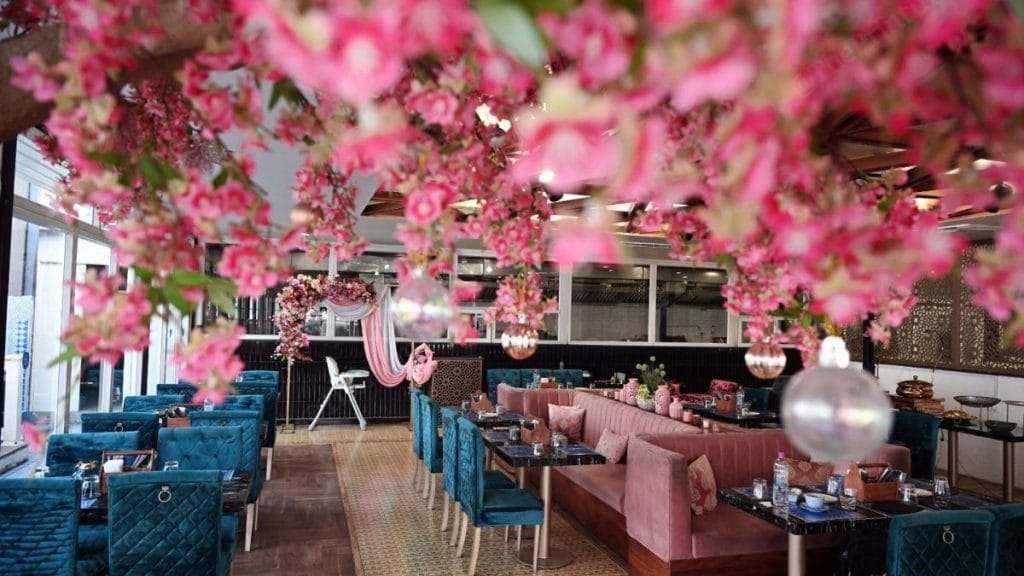
The response was immediate. Diners came for the food, the stories behind each dish and, increasingly, for a photograph with the chef who quickly became a local celebrity.
“They look like us, their culture is so similar to ours,” said Chef Gokhan, who has consulted on Turkish menus across India and cooked for the likes of Karan Johar, Shikhar Dhawan and Suresh Raina. The four months he spent in Kashmir, he said, felt like home.
Having watched other Turkish-only ventures struggle, Lone ensured a hybrid menu – Wazwan, Chinese and café staples alongside Turkish dishes like adana kebab, shish tawook, Ottoman lamb chops and Turkish pide.
The strategy worked. Demand for Turkish dishes exceeded expectations so dramatically that the kitchen ran out of food within two days of opening.
“People travelled nearly 100 km just to dine at our restaurant,” Suhail Gull, the marketing head at The Terrace, said.

For a month, the restaurant operated in two shifts – a rarity in Srinagar – simply to manage prep.
“We opened at 11 am, and by 1 or 2 pm, all our Turkish dishes were sold out… We’re not exaggerating,” Gull said. About 50 per cent of the diners come specifically for Turkish cuisine, he added.
For many, the rooftop restaurant became the closest physical extension of the Ertuğrul universe. Gull believes this connection runs deeper: few places, he said, Kashmiris feel culturally linked to.
He points to the restaurant’s Middle Eastern tiles resembling papier-mache patterns, the shared motifs in Kashmiri and Ottoman art, even the rabab’s Turkish origins. “No Pakistani drama has enjoyed the level of popularity Ertuğrul does,” he said.

He sees parallels in food too. Both traditions, Gull said, “celebrate hospitality, communal eating, and elaborate preparation methods passed down through specialised culinary guilds.”
Nevertheless, he admits he initially found Turkish dishes “a bit undercooked,” but the flavours grew on him.
Today, beyti kebabs are his favourite.
Also Read: Kashmiris are dodging internet shutdown to watch Turkish ‘Game of Thrones’ to beat the blues
Fantasy sold, food didn’t
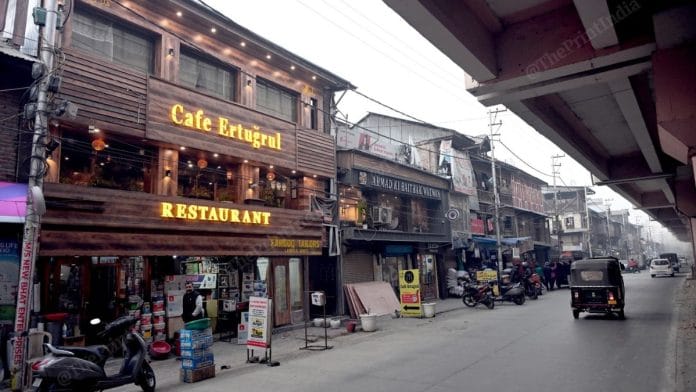
Just 10 minutes from The Terrace, stands Café Ertuğrul – the perfect example of a Turkish aesthetic that succeeded, and Turkish cuisine that didn’t. The café’s medieval-set decor, takht seating, posters and woodwork immediately transport diners into the show. But once the food arrives, the illusion breaks: it is pizza, pasta, biryani and mocktails. This pivot from Turkish food was a deliberate choice.
“We started the restaurant with a Turkish menu. It had all the kebabs and lamb chops but the food wasn’t selling,” owner Tafheem bin Tariq said.
Crowds thronged the restaurant but largely for the decor and to click photos with it. The food simply didn’t land.
“In the end, it’s business. We swapped the food with the regular café food… and it just became the perfect balance,” he said.

Lessons from a failed experiment
Not every Turkish-themed experiment survived the post-Ertuğrul wave. The Valley’s newer ventures – The Terrace, The Persian Grill, Café Ertuğrul– have all taken lessons from one of the earliest and most ambitious attempts: Kardeşler – The Kashmir Café.
Located in downtown Srinagar, Kardeşler leaned fully into the Ertuğrul universe – an Ottoman-style throne, character portraits lining the walls, and a menu spanning Middle Eastern, Turkish, and Mughlai dishes. But the concept proved difficult to sustain.
The café saw big losses and, within two years, it shut down.
Junaid Kichloo, a customer at Café Ertuğrul, remembers visiting Kardeşler and believes the problem lay elsewhere.
“More than the food, it was the location that was the problem. Nobody prefers to go downtown for having food otherwise, it was a good spot,” he said.
Kichloo, who owns an apparel shop in Srinagar and travels frequently to the Middle East, was drawn to Turkish cuisine after becoming hooked on the show. His first trip to Turkey came in 2022, and he has since visited four to five times. He’s fond of Adana kebabs and the mezze platters – but he knows he’s in the minority.
“So when I am in Kashmir, I am always keeping track of Turkish restaurants and cafés. I am personally very fond of Turkish food, but people like me probably make up a very niche market, one that isn’t necessarily profitable for restaurant owners,” he said.

Same, same or different?
For many restaurateurs in Kashmir, the explanation is simple: Turkish food, they say, is simply too mild for local tastes. Chef Gokhan of The Terrace disagrees.
“I can bet you my life’s savings, Kashmiri food is more close to Turkish food as compared to the flavours of Delhi, Mumbai or Bengaluru,” he said.
While travelling across India for work, Gokhan prefers Turkish food, soups and salads. In Kashmir, however, he gravitates towards local staples like Wazwan and Harissa. “The flavours of Wazwan are not extreme. It has subtle flavours, just like how our food does. Therefore, I was confident that Turkish food will do wonders here,” he explained.
Food experts, however, urge caution against reading this familiarity as a direct lineage.
Both Kashmiri and Ottoman cuisines evolved within a Persianate and Central Asian cultural sphere that once linked large parts of West, Central and South Asia through trade, migration and royal courts.
Food writer Vernika Awal traces this evolution further back. Kashmir, she noted, was once a predominantly Hindu region, where Kashmiri Pandit food shaped everyday cooking – guided by climate, seasonality and religious practice, and marked more by balance and subtlety than richness. The idea of Wazwan came later, shaped by Persian influence and then the Mughals.
“Even things people assume are ‘typically Kashmiri’, like eating from one shared plate, weren’t originally part of the culture. Along with this came ingredients like dry fruits and saffron, brought in through migration and trade,” she said.
For Awal, the sense of familiarity many Kashmiris feel with Turkish food is because of shared culinary principles.
“Both Kashmiri and Turkish cuisines really respect meat,” she said. “Whether it’s a Kashmiri rista or a Turkish kofte, the focus is on texture, the right amount of fat and careful handling. Spices are there to support, not overpower a dish.”

Turkish fashion makes an entry
If the culinary transition proved tricky, the fashion influence did not. Ertuğrul’s layered woollen cloaks, silhouettes, leather accessories, and ornate embroidery slid almost effortlessly into Kashmir’s existing aesthetic vocabulary. The Valley’s own traditional clothing – shaped by Persian, Central Asian and Middle Eastern histories – made the forms appear familiar rather than foreign.
Local boutiques and online sellers soon began stocking ‘Ertuğrul-inspired’ jackets, waistcoats and jewellery. In markets like Lal Chowk and Bund, caps inspired by the show’s headgear emerged as alternatives to the traditional Kashmiri Karakuli cap.
Social media accelerated the trend. Kashmiri influencers and fans recreated character looks, especially those of Halime Sultan and Ertuğrul Ghazi, circulating the aesthetic into weddings, celebrations and daily wear.
Designer Shehla Arif is among the local designers who have helped shape this moment. Her work, which has also found buyers in the Gulf and Middle East, mirrors the cross-regional sensibility that many Kashmiris say the show helped them rediscover – cultural influences they had long mistaken as Pakistani.
Also Read: Ertugrul series, propaganda, money — security agencies flag growing Turkey sway in Kashmir
Back home, Aasma pulls out her phone and scrolls through photos from a recent wedding. In the pictures, she is wearing a black-and-gold cape-style outfit from Arif’s label.
“I hadn’t even realised it was Turkish-inspired until people at the wedding came up to me and said, ‘This reminds us of Ertuğrul,’” she said.
For Aasma, that recognition is the point. “This is just one example of how Turkish culture has blended into our own. We can spot it and relate to it everywhere now. And, it is validation.”
(Edited by Stela Dey)
Well you don’t have to be a kashmir to like Ertuğrul- or search for ones roots. I am from south and many of us liked and didn’t want to stop watching-watched it 2-3 times all those episodes. Not on Netflix any more.
It’s just the history- old times- people lived and the story behind it- is captivating
We are all mixed races, somewhere some time back then are histories crossed paths
Kashmiri cuisine is familiar but yet not same as turkish one, especially flavors-
.. that’s why it didn’t work lol
Middle Eastern flavors are too mild for the palate of the people of the subcontinent
Minor correction: Diriliş: Ertuğrul is about the father of Osman I.
And largely fictitious. There are like just a couple odd pages about the dude in actual documented history – a historical fiction writer’s playground in the purest sense.
And the show is riddled with problematic messaging about uniting the qoum / ummah, rising up against the threat of the depraved kuffar, and sniffing out internal traitors. Its song in Arabic cheers the revival of (political) Islam dominating the world and the spirit of fighting in the path of Allah, seeking immortality in this world and rewards in jannah (I watched it so you don’t have to).
Kashmiri muslims would be better word. Kashmiri Pandits don’t give a f about any turkish propaganda
Wrote an article under ground report after taking views from 3 people. 🙏🙏
The public health doc seems like a friend of author & rest are just extended acquaintance.