


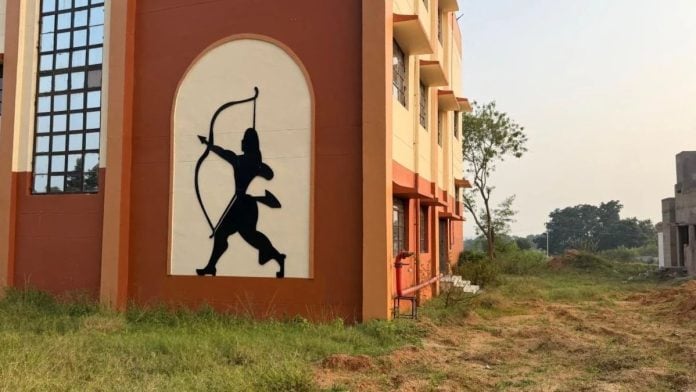
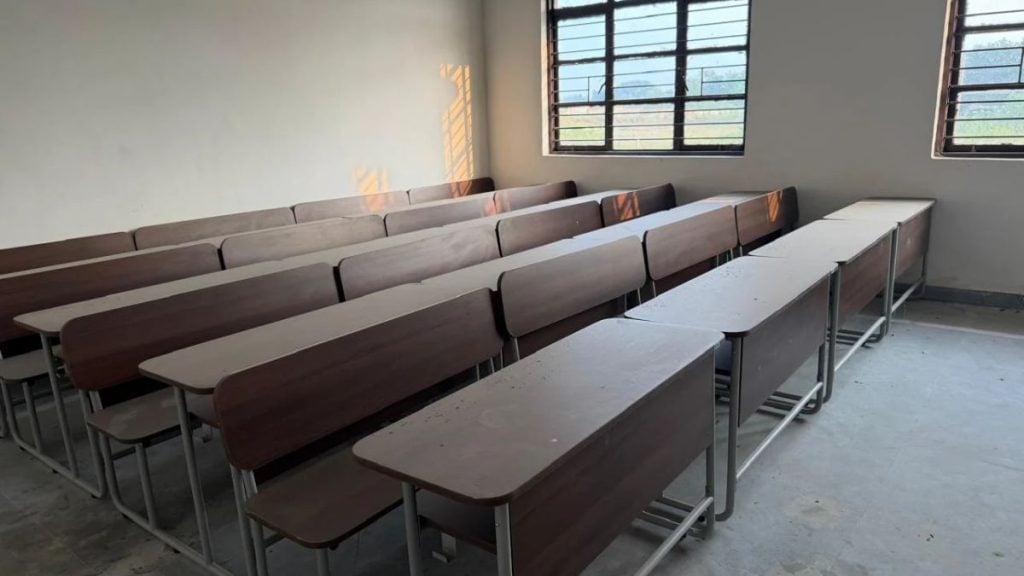
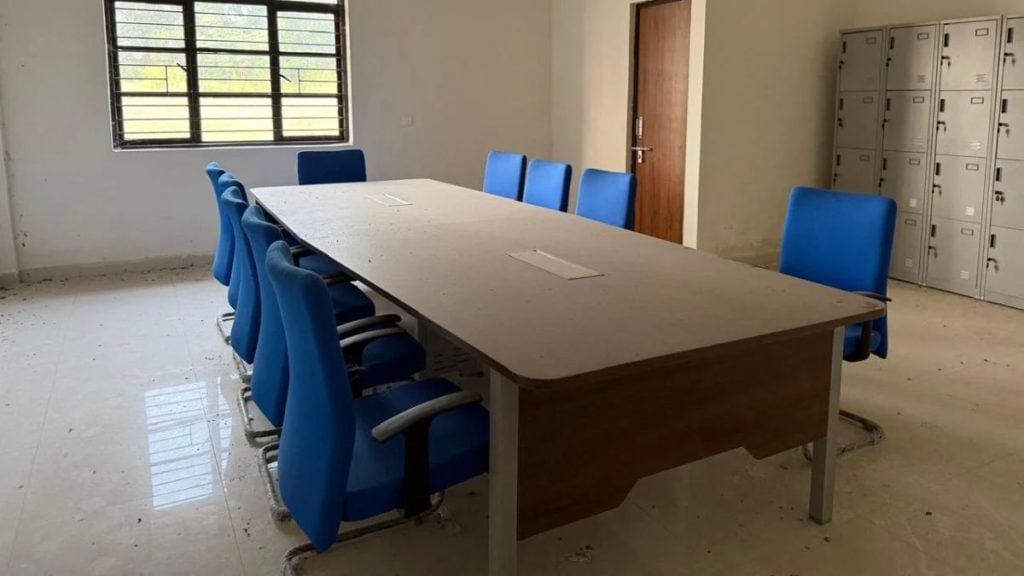
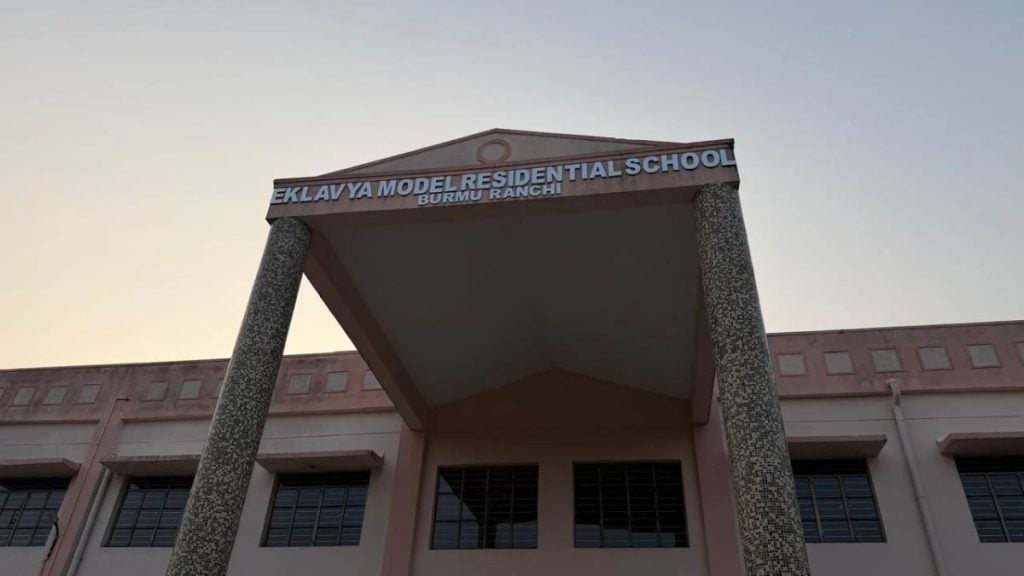
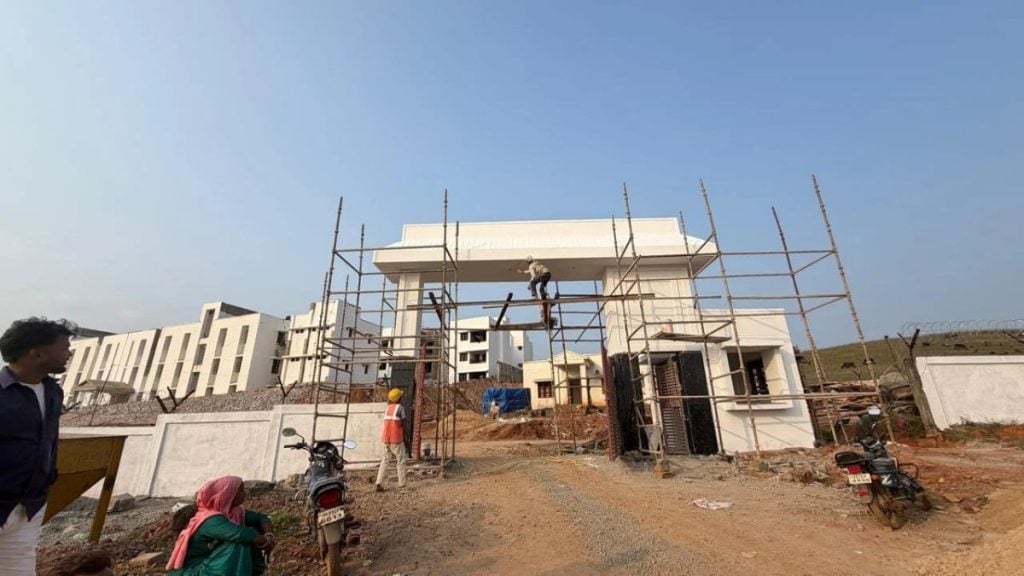
Ranchi: The Eklavya Model Residential School in Ranchi’s Chanho block looks ready for its first batch of students. Spread across 15 acres, the campus has spacious classrooms, hostels, and laboratories. But there are two glaring absences: students and teachers.
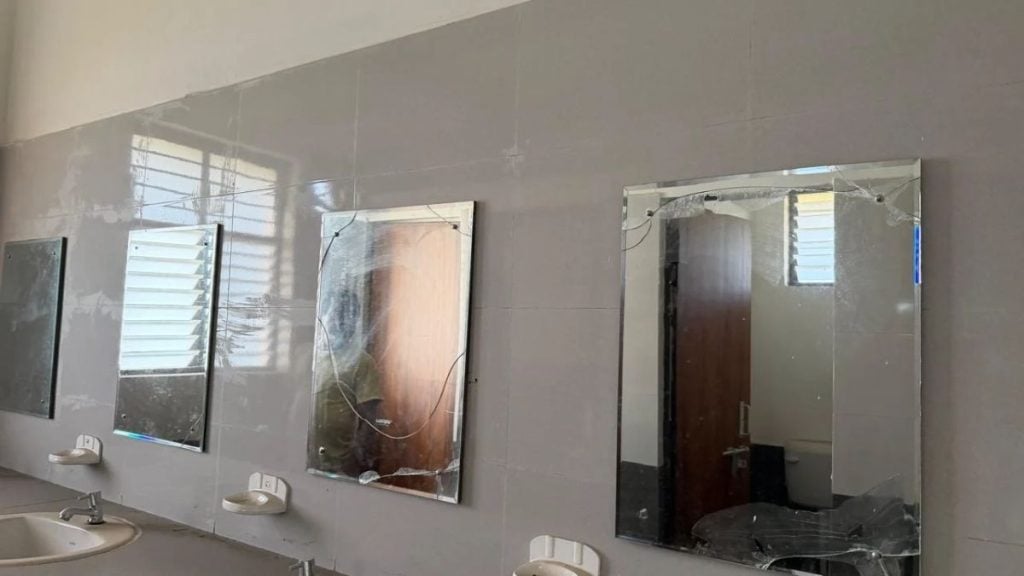
Nearly a year after Prime Minister Narendra Modi inaugurated the campus, not a single student has set foot in its classrooms. Dust has settled on the benches, windowpanes lie broken and mirrors in the washroom have cracked. The flowers brought in for the inauguration have withered inside the building. Despite its state-of-the-art promise, the school is yet to get water and electricity connections.
Satyam Ojha, who joined as the principal just two months ago, is scrambling to get work done.
“I am getting admissions done and have been asking the district administration for teachers. We will be starting school soon,” he said.
The delay has left students who have secured admission waiting for their first lesson, and families in tribal villages wondering when the school will open.
The Chanho campus lays bare a persistent problem plaguing India’s push to expand residential education for Scheduled Tribe children: building schools is only the first step towards making education accessible. The Eklavya Model Residential Schools were launched in 1997-98 to provide quality education to Scheduled Tribe children in remote areas. The programme expanded in 2018-19, with the government seeking to establish schools in every block where tribal population exceeded 50 per cent.
Each school is designed to accommodate 480 students from Classes VI to XII, with facilities intended to be comparable to those at Jawahar Navodaya Vidyalayas.
But across the EMRS network, non-functional campuses, staffing shortages, construction delays, and Centre-state administrative disputes are failing this ambitious education initiative for India’s tribal children. In Jharkhand, 91 schools have been sanctioned but only 51 were functional as of January 2026, with 8,380 students enrolled across the network by March.
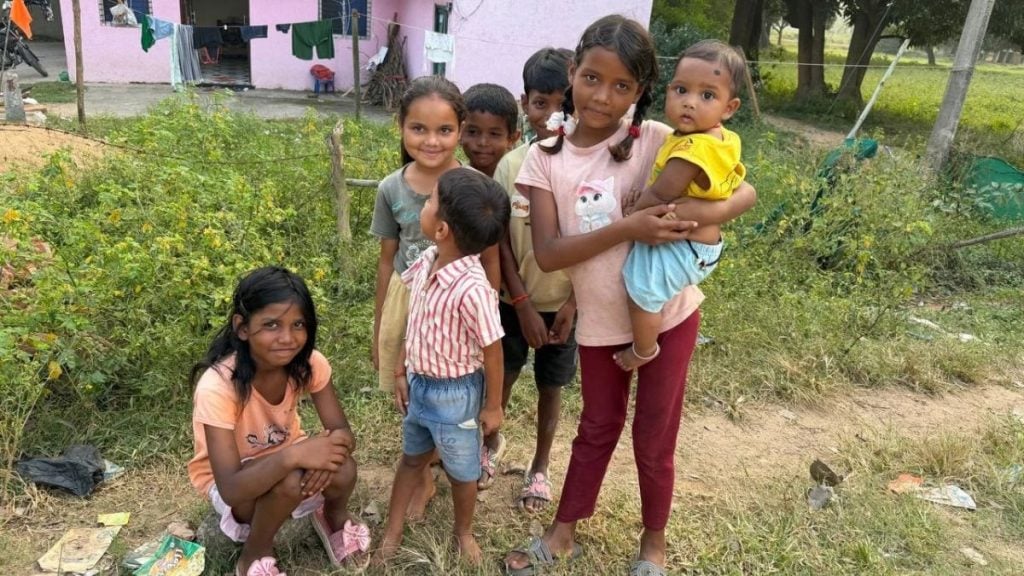
The state’s welfare department has reported enrolment across the functioning network, while newly built campuses remain at different stages of construction and operational readiness.
Tribal Welfare Commissioner Kuldeep Chaudhary said the biggest challenge to get the school doors open is staff.
“The recruitment of teaching and non-teaching staff is under process by the National Education Society for Tribal Students (NESTS). We have hired staff and guest teachers on an ad-hoc basis till the completion of the recruitment process,” he said.
For tribal children, these bureaucratic delays can determine whether they get access to a well-resourced residential school that prepares them for higher education and careers that have long remained out of reach or remain dependent on the limited educational opportunities available in their remote villages.
Twelve-year-old Anushka Kumari has already secured a seat at the Chanho school. She is still waiting to begin classes.
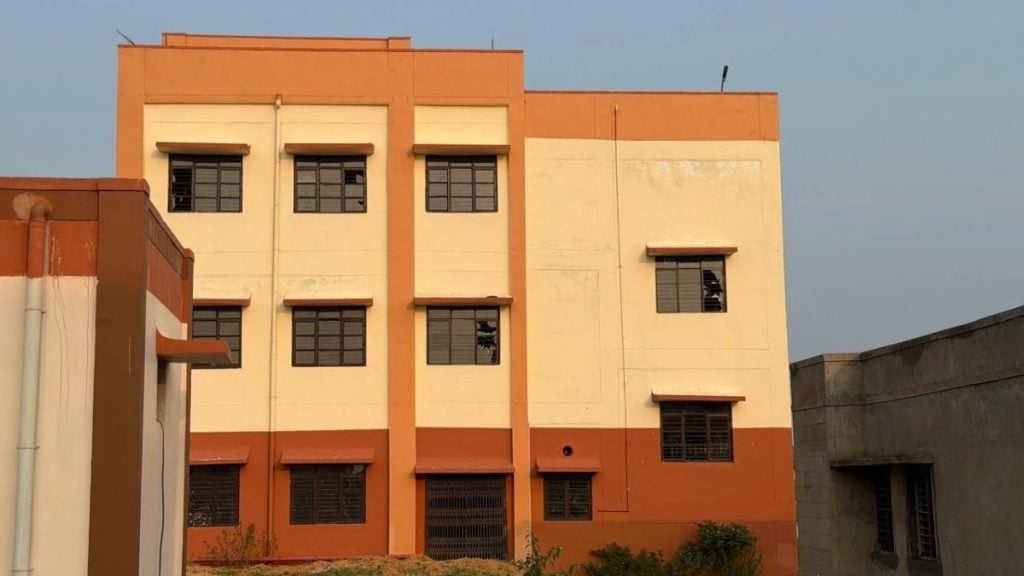
A campus waiting to open
Anushka took the entrance examination for admission to an Eklavya school in February. When the results were declared in March, her name did not figure in the final selection list. She continued studying at a private school in Bijupada, near her village.
A month ago, as the school began trying to fill its seats, students on the waiting list were called. Anushka’s name was included. She now has a place at the residential school, but no classroom to attend.
Ojha, who joined in September, said admissions were being conducted for 60 students across two schools — 30 seats at Chanho and another 30 at a nearby Eklavya school that is still under construction. Until the second campus is ready, students from both schools are expected to study at Chanho.
So far, 36 students have been admitted in both schools.
“We aim to complete 60,” he said.
The school cannot begin classes until its basic services are in place. Ojha said applications had been submitted for water and electricity connections, and funds for water were released only last month.
“Hopefully, once the issues are resolved, the school will start functioning,” he said.
The wait has become an exercise in uncertainty for students who have secured admission. The building stands ready, but the infrastructure that makes a school functional — and the people who make it a place of learning — remain absent.
The campus sits on elevated, rocky ground, surrounded by fields. The approach road is uneven, with stretches of mud and stone. Villages lie at some distance, their houses scattered beyond the fields. During the day, when residents leave for agricultural work, the hamlets are quiet.
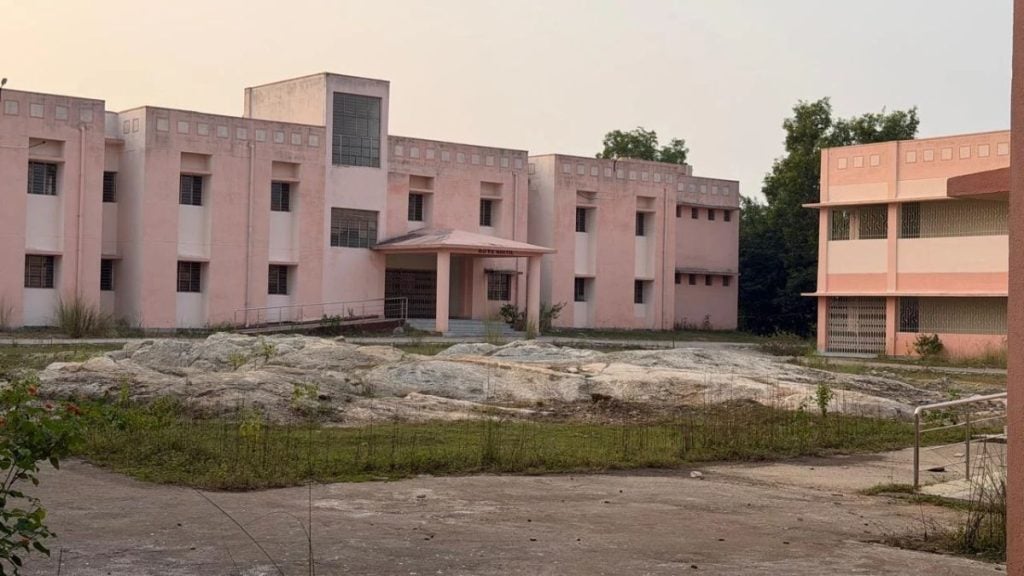
For families living nearby, the school is both a promise and a reminder of what has yet to be delivered.
Sunila Kumari, who belongs to the General category, said she had heard about the school but knew that admission was restricted to tribal students only. She had hoped that its opening might also bring employment opportunities for residents.
“They have built such a big building, but it’s still not functional yet,” she said, while walking across a field. “We thought that once it’s functional there will be cleaning jobs or others but we have been just waiting.”
For Scheduled Tribe children in the villages, the stakes are higher. The school is meant to provide access to an education that their families may otherwise struggle to afford.
Thirteen-year-old Sunila Oraon visits the campus every week with her siblings. She did not take the entrance examination but hopes to study there. Each time, she only encounters the school’s security guard, Varun.
“Varun always says, ‘The admission is in process. Principal sir will be able to tell when the school starts’,” Oraon recounted the guard as saying. His response is the same for others who can see the school but cannot enter it yet.
A government-school teacher from the same block, Neeraj, has been helping some of them. Six children in the area had not taken the entrance examination but wanted to study at the school. He has written to the principal seeking an opportunity for them.
“The villagers gave their land, their children also deserve the chance to study in a good school. I have helped build this school. If the scheme has come this far then we should be able to take advantage of it,” he said.
The staffing gap
Across the state’s Eklavya network, the shortage of teachers and personnel is a key obstacle to making schools functional and sustaining those that are already running.
The National Education Society for Tribal Students (NESTS), an autonomous body under the Union Ministry of Tribal Affairs responsible for overseeing the network, says recruitment is under way to address staffing shortages.
“We understand the shortage of manpower but the final stage of recruitment is almost done and we have 7,267 teachers ready to send to Ekalvya Schools all over after final training. We have expanded since 2023. At that time the requirement was not much,” said Vipin Kumar, Joint Commissioner of NESTS.
The Centre says its 2023 recruitment drive has already resulted in 150 appointments. In a July 2025 reply to Parliament, the Ministry of Tribal Affairs said 147 teaching staff recruited through the national drive had been posted in Jharkhand.
The number of teachers posted through the central recruitment drive, however, is not the same as the total number working in Jharkhand’s schools. The state’s staffing needs are also shaped by the pace at which new campuses become functional and the number of classes they run.
Based on figures supplied by state societies as of 15 July 2023, 76 per cent of teaching posts and 51 per cent of non-teaching posts in Jharkhand’s Eklavya schools were vacant.
Under central norms, a fully staffed Eklavya school with 480 students and classes up to Class XII has 31 teaching posts and 21 non-teaching posts. If all 91 sanctioned schools in Jharkhand reach full capacity, the state will need over 2,800 staff members across the network.
State officials say the process of filling vacancies is not always straightforward. Although schools can engage guest teachers, the appointments require district-level approval and can take time.
“There is provision, but hiring guest teachers comes under the district collector, and that becomes an issue sometimes as it takes time and the school suffers,” said a principal at an Eklavya school in Dumka.
Officials also point to gaps in school leadership. In some schools, a single teacher has been left in charge of an institution, despite lacking experience.
“They have received training, but it seems to have been done in a hurry. In many schools, ad hoc staff are present, so sometimes friction arises between teachers,” a state welfare department official said.
Who is responsible?
The difficulties spill over from just recruitment issues. Construction delays and the division of responsibilities between the Centre and state have also slowed the expansion of the network.
At least two Eklavya campuses — in Burmu and Chanho — where construction had begun in 2022 and 2023, respectively, still remain incomplete.
NESTS says construction is undertaken by public-sector undertakings, with delays often arising from local conditions.
“PSUs undertake the construction, so delays happen for various reasons. Sometimes there are land issues, sometimes forest clearances, and sometimes electricity and water are also a challenge,” said Kumar. “We are reaching remote areas where even roads have not reached.”
The state government, meanwhile, says its role is largely to provide land and coordinate with district administrations to resolve local disputes. The planning and construction of schools, it says, are handled by NESTS and the agencies it engages.
The lack of a regional NESTS office, Chaudhary says, makes coordination more difficult.
“One thing that can be done is the establishment of a regional or zonal office for improvement of the overall functioning of the schools as well as better coordination between the Central and State Government(s),” he said.
The consequences are visible in schools that are close to opening, too. In Dumka, a principal has been tasked with getting a school ready to function within a month. Students are available, but teachers are not. Although guest teachers can be hired, the process requires the district administration’s involvement.
“We approach the deputy commissioner for teacher recruitment and submit our applications, but the process sometimes takes time, delaying the school’s functioning,” the principal said.
Also Read: Kavita Mahto ran 1.6 km barefoot in a saree for a job. Now, her viral fame is a problem
What a functioning school can offer
A residential school gave Pandu Handa a shot at an education his family could not afford. But even at a functioning Eklavya campus, the promise of better schooling comes with its own gaps.
The 18-year-old is a Class XII student at EMRS Bhognadih in Sahibganj, and joined the school in Class VI in 2021. Coming from a poor family, he said, the prospect of a residential school with teachers, food and basic facilities had been a significant opportunity.
Over time, however, he noticed shortcomings.
“Drinking water facilities aren’t there and the school’s infrastructure also needs improvement,” he said. “Sports equipment could also be better.”
The school’s principal, Ranjeet Mishra, said he had repeatedly written to the district welfare department seeking improvements to the infrastructure.
“We can only teach and make the system at the school better. The infrastructure issue is there and we have reached out to the welfare department for the betterment but there is no response,” he said.
Here, too, responsibility is disputed. NESTS says maintenance and upkeep fall under state departments, while state officials say the schools are part of a centrally administered scheme.
Despite these gaps, Handa said the school had expanded his options. A friend from the school had moved to Ranchi to prepare for JEE and NEET. Handa chose not to pursue engineering, but said the education he received had helped him think beyond the immediate circumstances of his village.
Students from EMRS schools across the country have gone on to pursue engineering and medical education, including at IITs and government medical colleges.
In Jharkhand, six students from Eklavya schools cleared JEE Mains in 2024-25, according to Ministry of Tribal Affairs data. None qualified for JEE Advanced or NEET that year. In 2026, Susar Hembram, a Class X student at EMRS Salgadih, interacted with Prime Minister Narendra Modi’s flagship show Pariksha Pe Charcha.
For students such as Handa, the school has opened possibilities that were once distant. For children like Anushka in Chanho, the same promise remains out of reach.
For families in the surrounding villages, the wait for the school to open has been a long journey.
“The scheme is supposed to uplift them. The school has reached the villages. Desks, chairs, fans, labs — everything is there, including a principal,” said Neeraj, a teacher. “But students like Anushka are still waiting to start their first lesson.”
(Edited by Stela Dey)