



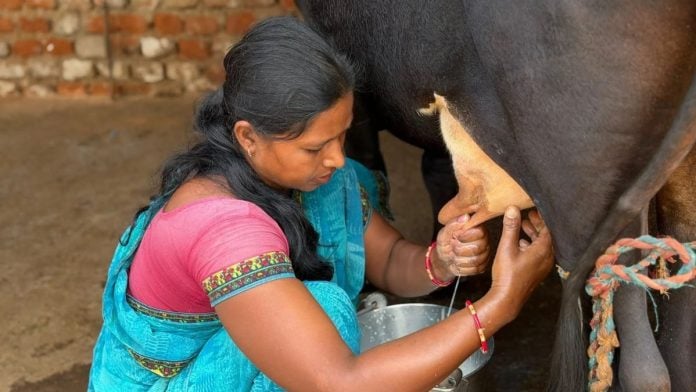
Ramgarh, Jharkhand: Two weeks ago, Kavita Mahto was a daily wage worker trying to outrun poverty. Then a video of her running 1.6 km barefoot in a saree made her an online sensation. Now, she is sprinting against a different clock, one ticking towards a Home Guard recruitment test she hopes will change her life.
The fame has acquired an audience the 30-year-old widow never sought. Now, politicians want to meet her, journalists want to interview her, and strangers have begun invoking her name online. But the one thing she wants from all this attention remains uncertain — a job.
“I got to know about the Home Guard recruitment only a few months ago. I saw it as a chance to get out of the daily-wage work I do,” she said. “When I ran in a saree, I never thought the video would go viral.”
Mahto’s extraordinary effort has made her visible to thousands, even as the circumstances that drove her to make the sprint remain largely unchanged. Across India, viral videos of blue-collar workers, labourers, farmers, and people living on the margins have turned private struggles into public spectacles, attracting praise, political attention, and promises of assistance. But virality does not ensure a job and certainly does not put food on the table.
She has already begun to feel the pressure. Having lost her husband and brother-in-law to illness within a month of each other in 2023, Mahto has spent the last three years helping keep her family afloat and her children in school through whatever daily-wage work she can find — from brick kilns and construction sites to agricultural fields. For Mahto, the immediate worry is that the people cheering her on will be disappointed if the job passes her by.
A Home Guard job would offer a more dependable income than the patchwork of earnings on which the household and her children survive. Yet preparing for the test has meant giving up some of that income, before she even knows whether she will be selected.
Mahto could not afford coaching and had little chance to train. When she learnt that a running trial was being held free of cost, she decided to give it a shot — barefoot and in a blue saree.
Mahto cleared the running trial for the Home Guard recruitment in 9 minutes and 40 seconds, 20 seconds inside the qualifying limit.
The run, however, was only the first hurdle.
Around 16,000 applicants have reportedly applied for just 284 Home Guard posts in Ramgarh. For Mahto’s Dumri block, only 22 seats are available—11 for men and 11 for women.
The competition is steep, and clearing the running trial does not guarantee selection. She still has to clear the remaining tests, including the long jump, high jump and written examination, while managing a household that depends on her income.
For the next steps, Mahto has joined an academy that trains Home Guard aspirants. It has just been a week since she joined and Ankit Singh, who runs the centre, offered her free training along with gear, and even fixed her phone.
“She has good running stamina and an athletic build, but still needs practice in the jumps. With the recruitment test approaching, she has little time to prepare for the other events,” Singh said.
Mahto’s many roles
Mahto’s day is a relay of roles. She wakes up at 3 am everyday, feeds her cows and goats, cleans the house, gets her two children ready for school and leaves for work between 4 and 4:30 am.
She has a regular job sweeping the Panchayat Bhawan, earning Rs 1,000 a month and gets a Rs 1,000 widow’s pension monthly. The rest is piecework.
She does not stand at a labour chowk waiting to be hired. In Soso village, most of her jobs come through recommendations but that has never meant steady income.
At construction sites and brick kilns, her workday ends around 5 pm, and the journey home takes another two hours. Her daily wage can reach Rs 200, but the work is never guaranteed.
That meagre income has to stretch across elderly in-laws and two children, aged 13 and 10, who attend a private school that costs Rs 4,000 a month. When Mahto cannot manage, her brothers help pay the fees.
For the last two weeks, though, the routine has changed.
After the chores, she no longer heads out to find work. She drinks two glasses of water and hops on a motorcycle, ridden by a relative, to her training centre 16 km away. The coaching may be free, but the commute eats into her working hours, and so into her earnings.
She reaches the centre in her saree, changes into a t-shirt, shorts and sneakers, and begins a grueling 3-hour workout.
Around 200 women are preparing for the Home Guard recruitment at the stadium, and Mahto’s flagging energy has not gone unnoticed.
“She seems so sad and tired. She isn’t getting enough sleep,” one woman tells another on the track.
The attention follows her even here. A YouTuber from Gumla, nearly 150km away, has arrived at the stadium asking to interview her.
“Just want to take some of your clips. You are very inspiring,” the YouTuber said, before asking her to demonstrate her running and a few stretches.
Mahto is still getting used to the demands of being recognised. In her initial interviews, she seemed excited about going viral. But as influencers, reporters and politicians continued to arrive, the attention began to compete with the very routine she needed to maintain to have a chance at the job.
She wants to say no, but struggles to turn people away.
“I don’t know how to say no to them. Some people even stay at our home,” she said. “People from Patna and Lucknow have also come,” she said.
A house that outlived its promise
On Saturday morning, Mahto arrives for training but cannot get her children ready for school because her household chores have taken too long. She changes back into her saree and heads home, a trainee no longer, a mother again.
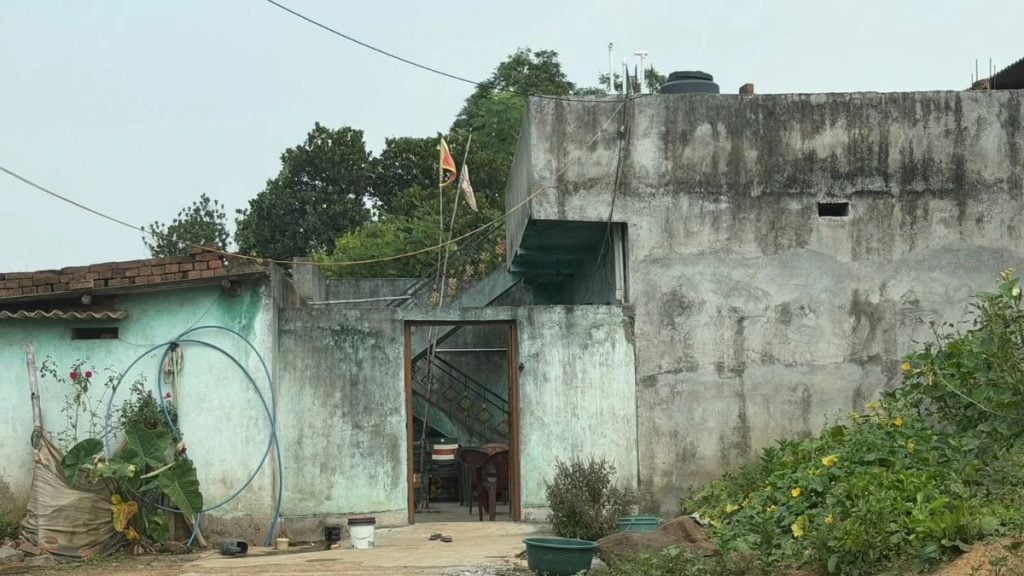
Their house is sturdier and larger than many in Soso. Her husband built it when he was earning well, and it was meant to hold the future she imagined when she married at 13, in 2009.
Today it stands as the ruins of that dream. The house opens into a large courtyard, but the space is dimly lit. The kitchen has no raised platform: the cooking gas and a chulha sit on the floor, with utensils scattered on the ground.
On her way back, at a fruit stall, she buys half a kilo of apples and some bananas. She pulls out her wallet and counts ten Rs 10 coins to pay the shopkeeper.
“Here, all 100 rupees,” she said. “We broke the piggy bank. That’s why I have so much change.”

Even as she pays for the fruit, she is thinking about the possibility that the YouTuber she met at the stadium might turn up at her home. If he does, she will have to put aside her pending chores to attend to him, too.
“The first thing I do after coming home is milk the cow. Only I can do that,” Mahto said, telling her older daughter to make tea.
But even the smallest tasks do not always go as planned.
“There is no sugar,” her daughter informed her.
“I just bought some three days ago,” she replied, surprised. She then asks her to go to the shop and buy some more.
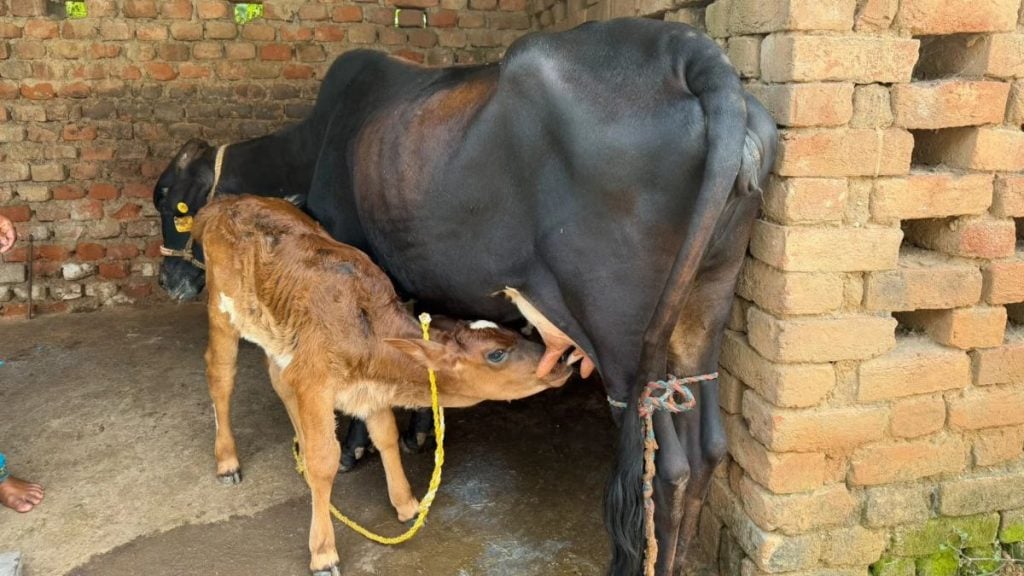
Mahto herself walks out to milk the cow, which is tied beside a calf inside an unfinished brick enclosure. The walls are exposed red brick, with gaps between the bricks and no plaster. The floor is wet, with water and spilled milk collecting around the animals’ feet.
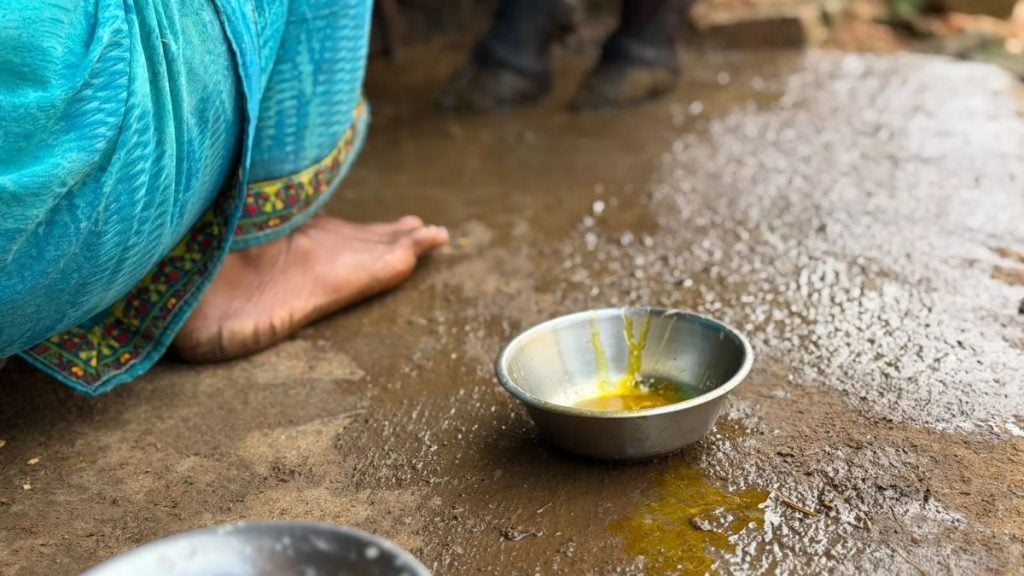
She crouches beside the cow, her turquoise-blue saree gathered around her legs, and begins milking into a metal vessel. Her dry heels have deep cracks, the skin roughened by years of walking barefoot and working on hard surfaces.
It is another ordinary chore in a day with little room for rest. Before the viral video brought strangers to her doorstep, such tasks were part of the routine she managed alongside daily-wage work. Now visitors keep arriving, asking questions and seeking her time.
The milking is barely done when the visitors arrive. A group of local politicians turns up at the house, asking her to get ready.
“What are you doing? Leave everything you have to come with us,” one of them said.
This has become a daily ritual now, and Mahto is still getting used to it. Whenever someone visits, she puts everything aside to tend to them, including her meals.
“I can’t say no to them. They are village people. This is how they talk,” said Mahto.
Mahto has not had any food yet, not even the tea. The meeting means travelling 15 km away, and she knows that another evening will be lost.
Also Read: IIIT Ranchi student’s suicide has opened a can of worms — protests over hostel, food, wifi
The price of being seen
The visitors rarely come empty-handed. The gifts arriving at Mahto’s home have included T-shirts, trousers, sarees and even muscle-building protein supplements. Many visitors also pose for photographs with her, and a single picture with her can draw thousands of likes on their social media pages. For Mahto, the attention has a different kind of cost.
More than 10 fake social media accounts have appeared in her name, she said, with some users posing as her sister or brother and asking people for money. Her trainers have since set up an Instagram account on her behalf, where she repeatedly asks people not to give money to anyone in her name. She fears that people who are sharing her story may also exploit it.
“Now people are using my name to ask others for money. I want to make it very clear that I don’t want help from anyone. If someone really wants to help me, get me a job,” Mahto said.
Help has been promised, but little has been delivered. She says she has received hardly any financial assistance. The training gear helps with her preparation but does nothing to ease the pressure on her family.
“So many people promised to help, but nothing came of it. The brothers at the training academy helped me get my mobile phone repaired and gave me shoes, a T-shirt and shorts. I want to make it clear that I am not asking anyone for money or help,” she said.
The gap between what people believe is reaching her and what actually arrives worries her most. She fears her in-laws and villagers will assume she has received substantial help and ask where it went.
“People are creating fake accounts and asking for money on my behalf. My in-laws and villagers will think I am getting that money. After a few months, my in-laws will ask about that money. My life is already difficult. I don’t want to make it more difficult,” Mahto said.
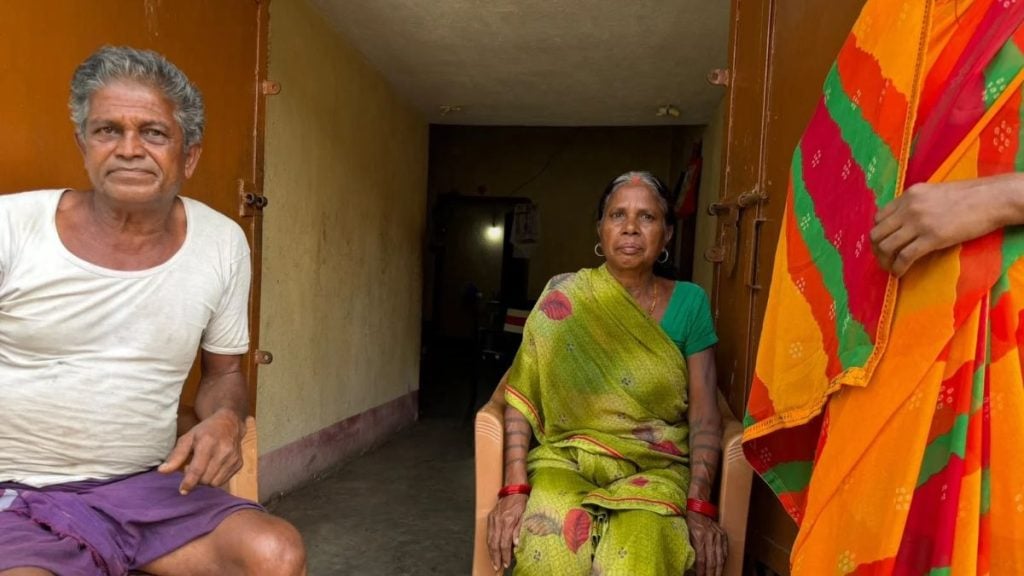
A family’s hope
Phulko Devi has lost both her sons. The person she now leans on is the daughter-in-law who has stopped earning to train.
“If she doesn’t go to the fields, what will we eat? My husband works in the fields, but we don’t have enough land to feed ourselves. We get only six months’ worth of grain from our land. Kavita goes out and earns money. That’s how we live,” said 65-year-old Phulko Devi, Mahto’s mother-in-law.
Her sons were once the family’s earners. One was a supervisor at a private company in Gujarat; the other was a security guard in Hyderabad.
Mahto has studied up to Class 12, but education has not spared her the struggle to make ends meet. Her father-in-law, still working the fields, is 70.
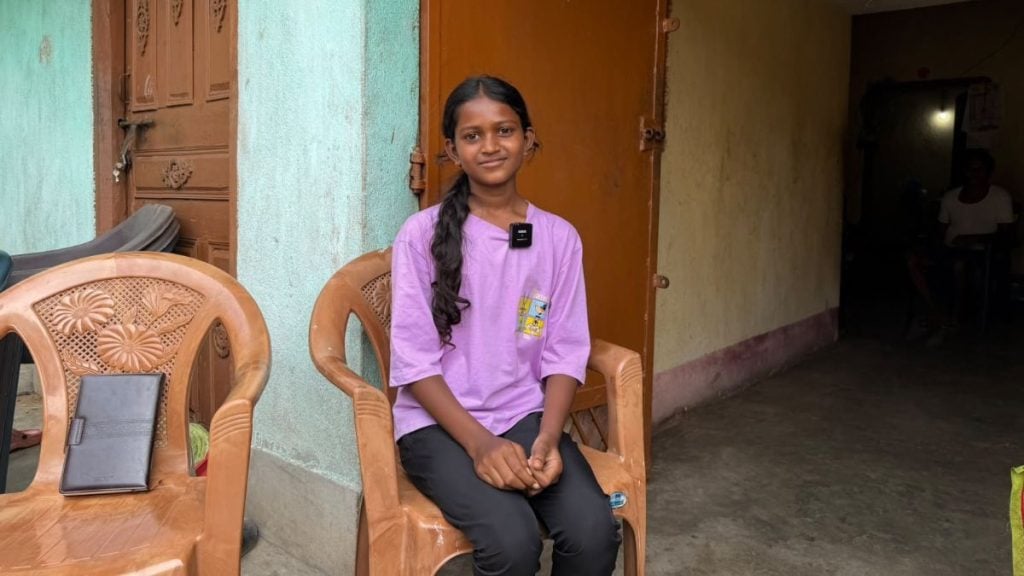
Mahto’s daughter, Arushi Kumari, sees her mother as a role model and is waiting to see whether she gets the job. Kumari dreams of becoming a doctor. She does not yet know how she will get there, but says her mother’s selection would be the first step towards a more secure future.
“My mother is very hardworking. She thinks about everyone. Her dream of getting a job is not for herself, but for us. I am not ashamed of what she does, but I want her to get a better job. She is educated. She deserves a chance,” Kumari said.
At the house, few local leaders are waiting. The Giridih MP wants to meet her, they say. Mahto has not eaten, chores need attention, and the day’s work remains unfinished.
“Change your saree. Sansad ji wants to meet you,” one of them tells her.
“I won’t change my saree. Why should I change just to meet him? He should know that I live like this,” Mahto said, washing her face.
(Edited by Stela Dey)