



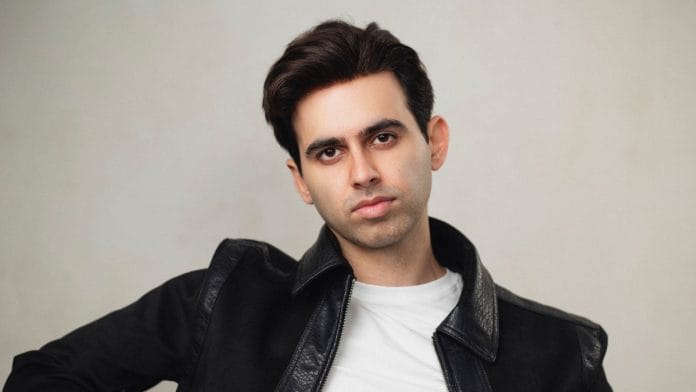
New Delhi: The life of Delhi’s rich is dotted with stops at the Gymkhana Club, Delhi Golf Club, Sainik Farms, Jor Bagh, Vasant Valley School pick-ups and Khan Market pit stops.
No one knows it better than Jaibir Nihal Singh, a 28-year old content creator who is making fun of this lifestyle. After all, he knows this universe only too intimately. He is one of them. He has easily carved an insider-outsider role for himself.
In one of Jaibir Nihal Singh’s popular reels on his Instagram account, heyjns, the satire begins with a family legacy.
“It’s pretty cool to have a road named after your family in Delhi,” he says, before turning that inheritance into content about the life he grew up around: Elite schools, farmhouses, college counsellors that can cost more than some degrees, business class flights abroad, family businesses, members’ clubs and the performance of money.
The road is Gurumukh Nihal Singh Marg in South Delhi. Sardar Gurmukh Nihal Singh was Delhi’s second chief minister, later Rajasthan’s first governor, and Singh’s great-grandfather. Singh, 28, grew up in South Delhi: Defence Colony first, then the family moved to the farmhouse belt near Chhatarpur. He went to Vasant Valley School and later studied film at Pepperdine University in Malibu, US.
The reel works because that world is not as private as it once was.
For Singh, the bubble itself is not new. What has changed is how much of it can now be seen.
“The rich before social media had a secret life,” Singh said.
He does not mean that wealth was hidden. Singh spoke of a grandfather who imported cars, including a stretch limousine, and holidayed in Monaco in the 1980s. There was also, he said, a family connection to the British royals. Before social media, these details stayed within homes, albums and drawing-room memory.
“The rich were always performing wealth, but no one was seeing it as much as they are today,” Singh said.
That visibility has created room for satire about the very rich.
It is also coming at a time when India’s socialist-era discomfort with wealth and wealth-creators has ebbed. There isn’t the same anger against the rich that Luigi Mangione in America personifies today. Indian attitudes are more relaxed. The rich share some of the same Indian chaosphere as the rest of the masses, after all. That helps ease class tensions.
Luxury in India is now on Instagram: In wedding reels, airport cabins, watch videos, restaurant openings, handbag explainers and the casual way people talk about Birkins, private members’ clubs and “old money” aesthetics. The very rich are getting richer, and the signs of that richness are becoming easier for everyone else to see. They are not living in impenetrable exclusive bubbles anymore. And there is both an aspirational curiosity and low-key resentment among the middle classes about the rich today.

The interest is older than social media, even if the people at its centre have changed. “The rich have always been the subject of fascination,” said Amita Baviskar, Professor of Environmental Studies and Sociology and Anthropology at Ashoka University. “Think about the lives of maharajas and how people used to exclaim and wonder about them. Now these are the new maharajas: Industrialist families, Bollywood,” she said.
But the appeal also lies in the distance between their lives and everyone else’s. “The rich are different in terms of their lifestyle; they seemingly inhabit a distant, glamorous world. Yet, in their pursuit of familial happiness and social standing, they are like us. They evoke awe, curiosity, but also a degree of empathy. Social media allows us to satisfy all of these in some small measure.”
According to Knight Frank’s Wealth Report 2026, the number of Indians with a net worth exceeding $30 million grew 63 per cent between 2021 and 2026, rising from just over 12,000 to nearly 20,000. Globally, consultancy Bain and Italian luxury trade association, Altagamma, have estimated luxury spending at €1.44 trillion in 2025, even as luxury brands try to hold on to their highest-spending clients.
This is the moment Singh’s heyjns belongs to. It is satire about a class that is fluent in global luxury codes, and more willing to laugh at itself when the line feels familiar enough.
Also read: New British boarding schools are here. The latest accessory for India’s rich
Lifting the curtain
Jaibir Nihal Singh’s account now has about 2,80,000 followers on Instagram. Many of the followers and fans are people like him, the upper crust. They find it funny, relatable and not critical. He is just lifting the curtain a bit and showing a pattern, not castigating them. His reels do not sound like someone taking shots from the outside.
Singh is not looking at rich Delhi from a distance. He knows the references, the shortcuts, the anxieties, and the things people laugh at only when the joke is close enough to home.
“I say the stuff that people know is true, but it’s very uncomfortable to say,” Singh told ThePrint.
Explaining why the rich are willing to laugh along, Baviskar said, “You recognise the characters, the situations, the attitudes. You’re speaking to your audience from a place of inside. We are this community that can identify with these particular characters and situations and events.”
That shared recognition can make the humour function almost as a symbol of belonging.
Singh is also the founder of TraqCheck, an AI-led background verification company. But heyjns comes from another part of his life: Film school, a long-running interest in comedy and storytelling, and the world he grew up watching closely.
In one reel, he speaks of being asked if he is an influencer at the gym. “No,” he says in the video, “I’m just chronically online and dangerously rich.” Later, after lighting “a 50,000 rupee candle” on a “balcony with heated floors” and “drinking sparkling water from Norway,” he wonders if the vlog is relatable “for anyone outside of South Delhi.”
He opened the script of another reel to explain how one of these bits is built. In the video, he drinks coffee instead of chai because “chai is so middle class”, points to a bathroom with “more marble than the Taj Mahal”, and then says the real work of art is not the mausoleum, but “the man in the mirror”.
It is not subtle. But that is the point. “You have to exaggerate it enough so people understand it is satire,” Singh said.
heyjns is not outside the bubble. It shows rich India from within: Insulated, visible, self-aware, absurd, aspirational, and now funny enough to become content.
The Delhi bubble
The first crack in Singh’s bubble came early.
He was about 12 years old, playing video games at a friend’s house on Aurangzeb Road in Lutyens’ Delhi, when the boys began talking about a school assignment. Most of them were not taking it seriously. One friend was.
“My parents don’t have the kind of money that most of your parents have, so I have to finish this assignment on time,” Singh recalled him saying.
The moment stayed with him. It was the first time, he said, that he understood that even within the same friend group at the same elite school, “not everyone had the same cushion behind them.”
By 16 or 17, money began to decide who could be part of the plan. Some friends could go out drinking every weekend and then eat afterwards at House of Ming at the Taj Mansingh Hotel, or China Kitchen or TK’s at the Hyatt Regency, a five-star hotel in South Delhi. Others could not.
No one necessarily said it out loud. Sometimes, it showed up as a skipped dinner, a missed holiday, or a quiet no.
In some circles, Singh said, groups began to form around the people who could keep up. Plans were made for the restaurants, hotels and holidays some could afford, and others slowly fell away.
His own group tried to do it differently.
“We always went to a place where everyone could come,” he said. “If one couldn’t go, there’s no point.”
That is also why he notices when the opposite happens.
In the world his reels inhabit, money can make adjustment unnecessary. If a plan is too expensive, the plan does not change. The people do.
Also read: India’s poor little rich people have it so bad. Money just can’t buy them freedom
Who looks outside the window?
Delhi’s rich people are not unaware of their privilege or the squalor that encircles it. That just brings an element of fragility to their lifestyles. Adopting a tunnel-vision helps a little.
The same tunnel-vision can also shape how Delhi’s rich move through the city itself. Their lives may be situated in polluted, trash-filled, traffic clogged Delhi, but often it is lived in a narrow sliver of it: Home, work, hotel, club, another friend’s home, then back again.
Delhi’s rich, Singh said, can remain “very insulated even while living in the middle of the city.”
Their cars are chauffeured. Their attention is on their phones. Outside, there is still traffic, heat, construction, poverty, a city that works very differently from their lives. But inside the car that takes them through, it can all become background.
“Who looks outside the window?” Singh asked wryly.
That insulation is not the same for everyone, he noted. The ultra-rich are sometimes forced to “look out” because they attract attention. A house, a wedding, a watch, a holiday, any of these can become news. When you are that rich, there is also some pressure to be seen giving back, he said.
Insulated, by choice
The quieter bubble often belongs to the rich who are not famous enough for anyone to watch closely.
Work can puncture it. Singh said people who run companies or go into offices still meet colleagues from different backgrounds. When he is in Delhi, he spends eight or nine hours a day in the TraqCheck office, around people whose lives are not like his.
It is not that the office removes privilege. But it does make the world outside the bubble harder to miss.
“If you’re not working, for example you’re a housewife, the traditional sort of Delhi housewife, you’re not really interacting with anyone outside the bubble,” Singh said.
That, he said, is where the distance comes from. The bubble can be harder to break when life is organised only around home, friends, family and the same social circuit.
The bubble is where his satire lives. Money does not remove the country. But it can make that country easier to ignore.
From secret lives to social media
There are others like him.
Singh points to The Gstaad Guy as one reference point because the account showed how far such humour could travel.
The anonymous creator began making videos while working at Apple, building characters from the way the global rich spoke, complained and moved through places such as Gstaad, Monaco, London and luxury boutiques. His Instagram profile now has 2 million followers, and he has been profiled by Forbes and Business of Fashion.
The luxury world has also pulled him in. Loro Piana, an Italian luxury house known for cashmere and fine fabrics, collaborated with The Gstaad Guy on a limited-edition product. The joke had travelled far enough for the gatekeepers of luxury to let it in.
For Singh, the interesting part was the audience. The people being described were also sharing the videos, recognising themselves in them, and in some cases buying what came out of them.
The jab can become flattering too. “The rich love it,” Singh said, when the line is made in a way that “strokes their ego”.
In a reel about the “right schools in India”, Singh lays bare some of the codes by which India’s elite identify each other. “They casually mention Doon, Mayo, Vasant Valley, Shri Ram or Welham, and everyone in the room immediately knows their background,” he started. He goes on to point out “that specific accent that’s distinctly Indian but internationally polished,” and inside jokes about teachers, school trips and “that one class-eight punishment story that has now become scripture.”
The school group chat, in his telling, is “still the most active one on their phone.”
Most of the comments on that reel were of fond recognition from people that had gone to those school. @doctor.agni wrote, “As a Shriram alumnus, I couldn’t agree more.” @ishitakhannaofficial commented, “As a Welhamite, I can attest this is 100% accurate.” Another user, @beryminali, wrote, “Jaibir meeting my big WhatsApp group Welhamites tomorrow. Will share this surely with them.”
For those who get it
Singh is clear about who he is speaking to. “Make content for the top one percent to consume. The rest will follow,” he said.
That does not mean the reels are only watched by the very rich. The person who knows the reference from the inside shares it because it feels accurate. The person outside the circle watches because the world is now visible, but still out of reach.
It also matters that “the rich” are not one flat category. Singh pointed out that India’s one per cent is still about 12 million people. The top 0.1 per cent is about 1.2 million—a layer where “even Rs 100 crore is not an extraordinary number.”
His comedy often sits in those tensions: Rich vs very rich, old money vs new money, rich but anxious about looking less rich, north-vs-south rich, young-vs-old rich, big city-vs-small town rich.
His “Lifecycle of a Rich Kid” reels show this perfectly. The Delhi child enters school at “Vasant Valley, Shri Ram, Sanskriti, Modern Barakhamba”. The Bombay child is sent to “Dhirubhai Ambani, Bombay Scottish, Jamnabai, Cathedral” to maximise their chances of “becoming friends with a nepo kid”. The Delhi birthday is at a “Chhatarpur or West End Greens farmhouse”, with “a live pasta counter and 300 uncles discussing property”. The Bombay one is at a “Juhu bungalow” or “South Bombay club”, where “old-money South Bombay parents judge parents from the suburbs for being a bit too loud.” At 18, the Delhi rich kid will “fly business class to college” because, as Singh puts it, “in Delhi, flying your child economy means the family business is going through something.”
The point is not to humiliate the people being described. Singh knows the joke can go wrong if the tone is off. A line like “chai is so middle class” works only if the viewer understands the character. Without the exaggeration, it could sound like contempt.
“When you make a joke about class, it can go south very easily,” Singh said.
He treads that line carefully.
He does not present this as self-censorship. He talks about it as a craft.
The point can still be made without losing the audience.
Assumptions and alter-egos
He is just as careful when he talks about himself. Singh knows that a founder from his background can easily be dismissed as “someone backed by papa ka paisa”. He said that is untrue in his case.
TraqCheck was not started with family money. He and his co-founder put in Rs 2 lakh each, and his share came from money he had saved while working at a café as a student in the US.
He does not deny his privilege, but he resists the assumption that privilege explains all his success.
This is also why heyjns should not be read as a diary. “heyjns is more of an alter ego and a character than who I am,” Singh said.
Those who have known Singh since childhood see the same gap between the persona and the person. “Honestly, I think it’s extremely exaggerated because he’s very low-key in person,” said Ananya Anand Sahni, 28, who works in strategic advisory and consulting. She has known Singh since they were at Vasant Valley School.
She went on to say, “He’s in touch with reality, which is why his peers respect him.”
The real person peeks through sometimes. In one unusually earnest reel titled, “the story about how I made my first million by 26 in India”, Singh goes back to himself as an 18-year-old “in LA film school, making Dubsmashes in my dorm room.” He goes on to say that “during the pandemic, a friend and I started the company. HR tech, because boring businesses make the most money.”

He admits to “begging over a hundred companies until one gave us a chance”, because “only losers give up”. The reel ends with him looking back at that younger self: “I wonder what that 18-year-old film student would think if he saw what he’s built today. I think he’d be proud.”
Also read: Will India grow old before it grows rich? Economists sound a warning
Rooms & references
The access question returns when Singh talks about elite culture.
One of his early heyjns reels was a day-in-the-life of a startup founder in Delhi. In it, he said he prayed for a membership at Annabel’s, the London private members’ club.
“Annabel’s is the world’s most prestigious members’ club,” Singh said in it.
He knew most viewers would not get the reference. That was part of why it worked.
“99.99 per cent of people won’t even know what Annabel’s is,” he said. “But maybe five hundred people in Delhi would know.”
Those five hundred people were enough. They shared it with friends who knew the reference, and with people who did not. The line was not only about Annabel’s. It was about the pleasure of knowing what Annabel’s meant.
Status in this world is by references. The right club, the right restaurant, the right holiday, the right school, the right bag at the right time. Singh’s satire works because it understands how much meaning can sit inside one name.
Private club culture is not new to India. Mumbai still has its old colonial-era clubs. Delhi (as of now) has the Gymkhana. The Quorum is a newer version of that world. It is contemporary, private, expensive, and for people who want their meetings, meals, drinks and social life under one roof.
Singh’s family is among The Quorum’s early backers. The private members’ club now has locations in Delhi, Mumbai and Hyderabad. He described it as taking “private members’ club culture from Europe and England, where it stems from, and taking it to India”.
The connection seems clear. In The Quorum, exclusivity becomes a space: A club, a table, a room, a network. In heyjns, exclusivity becomes material: A reference, a line, a character, a reel.
“Your network is your net worth,” Singh said dryly.
The line could have been from one of his videos, but he also meant it literally. In London, he said, he was trying to get a table at Crisp, a restaurant where reservations were not available for months. Through heyjns, he was able to reach the people behind it and get a table the same day.
Money could pay for the meal. Money alone could not get him in the room.

A different kind of access
Singh recalled Nikhil Kamath, co-founder of stockbroking firm Zerodha, coming to a party at his father’s house in Goa. That setting came from the older world of access: Family, friends, a private home, the right circle of people.
When Singh’s father mentioned TraqCheck, Kamath recognised the name because he had seen Singh’s videos.
“So that’s also access,” Singh said.
Singh described TraqCheck as a “30 million dollar company.” In April, the company raised $8 million, about Rs 70 crore, in Series A funding. It now has more than 250 enterprise clients, nearly 100 team members, and offices in London and Delhi.
The old network hadn’t disappeared. Kamath was in the house because of it. But heyjns had given Singh another kind network.
For many creators, this is where validation begins to drive the work.
He admitted that validation mattered “from a vanity point of view”, but said he did not take it too seriously.
The comments under his reels show both sides of that audience. One user, @tushar__exee, called a reel his “daily dose of motivation :)”. @luxurynomad9777 commented with laughing emojis followed by “old money in South Delhi.” There was also an aspirational joke by @rajeshkumarmagic: “new life goal unlocked: play golf with the commissioner”.
And then, there is this other comment. Cutting through the whole old money-new money schtick, @real.canyou commented: “kabhi old money bhi new money tha (Old money was also new money once).”
(Edited by Theres Sudeep)
Money but no class and lots of insecurity.