


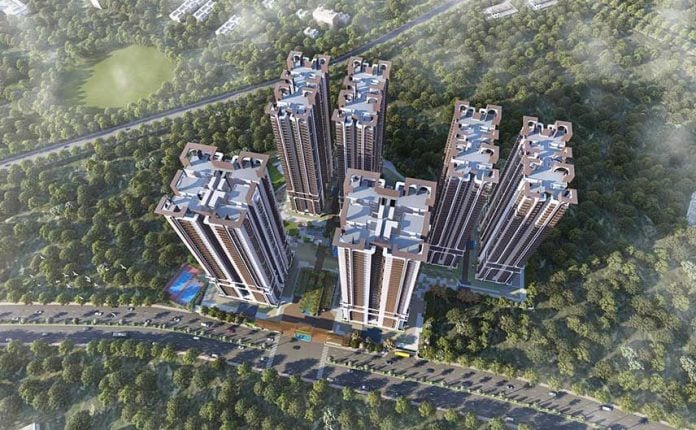
Hyderabad: From the sixteenth-floor balcony of a newly minted glass tower in Kokapet, Hyderabad’s western skyline looks like a city mid-sprint. Cranes still swing against the Deccan sunset, and billboards along the 158-km-long Outer Ring Road (ORR) promise “sky-villas” with private plunge pools and concierge decks.
Look closer after 8 pm, however, and a quieter story emerges. Across stretches of Neopolis, Narsingi, and Tellapur, entire floors of completed or near-complete towers sit dark.
For nearly a decade, Hyderabad was India’s most aggressive real estate growth story. Today, the City of Pearls is grappling with a massive residential hangover. Unsold housing inventory in Hyderabad climbed roughly 20-21per cent year-on-year in 2026 — translating to 1.15 lakh to 1.43 lakh unsold units in absolute numbers, depending on the tracker.
At the current pace of home sales, it would take 28 to 30 months to sell all the unsold homes in Hyderabad — the longest wait among India’s top seven metros — assuming no new projects are added, real estate research firms Anarock and CRE Matrix said, citing figures from their second-quarter reports. Two state government policies, HYDRAA and Section 22 A, have dampened buyers’ confidence further. The result: Hyderabad has far more homes on the market than buyers are currently willing to or able to purchase.
In fact, at least three property dealers in the Kokapet and Tellapur area told ThePrint that builders of gated communities left lights on in unoccupied blocks in their sprawling cluster homes to falsely suggest they were occupied.
“Not everything you see in these bustling, Manhattan-look-alike neighbourhoods, which promised Olympic-sized pools and Wimbledon-styled tennis courts, has been able to sell their inventory. The builders have employed staff to leave the lights on at night in the blocks that have already been taken to ensure the price of the apartments does not fall. It is a sales gimmick to keep the prices inflated, indicating artificial demand,” said K Somasekhar, a RERA-certified real estate agent, who operates from his office in Tellapur.
From housing boom to bottleneck
To understand how Hyderabad built too much, betting on a property boom, walk into any sales lounge along the Financial District, and it will tell you the reason. Primarily centred around Nanakramguda and extending toward Gachibowli and Kokapet, the Financial District is Hyderabad’s premier information technology, financial services, and commercial real estate hub.
It is here that the sharp structural correction in Hyderabad’s residential real estate market is most visible. The glut in the market tells us a story of inventory miscalculation and a misreading of Hyderabad property buyers’ affordability.
Three years ago, post-pandemic tech hiring, booming Global Capability Centres (GCCs), and Telangana’s unlimited Floor Space Index (FSI) policy sparked an unprecedented land rush. State-run land auctions in Kokapet shattered records to scale, at Rs 30 crore to Rs 44 crore an acre. As developers paid astronomical sums for land, simple math dictated what they could build: affordable or mid-segment Rs 60-lakh apartments could no longer recover land and construction costs.
Realising this, almost overnight, Hyderabad’s builders abandoned the middle class and pivoted en masse to ultra-luxury high-rises.
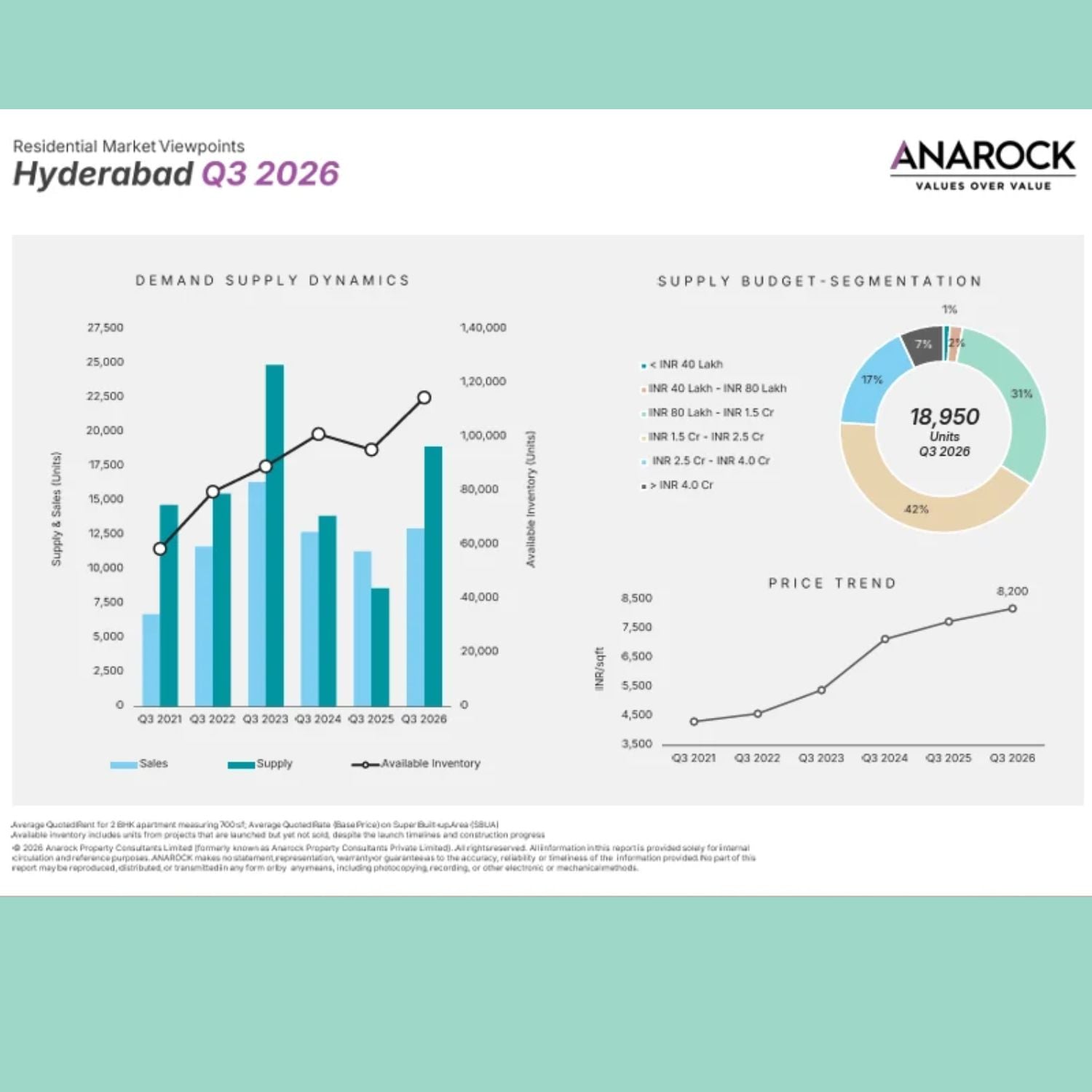
Now, here’s the ticket-size shock: Data from the Confederation of Real Estate Developers’ Associations of India (CREDAI) Hyderabad–CRE Matrix shows that around half of Hyderabad’s unsold inventory is priced above Rs 1.5 crore, while another 30 per cent sits in the Rs 1–1.5 crore bracket. Nearly 80 per cent of available stock consists of sprawling 3BHK and 4BHK apartments averaging over 2,050 sq ft.
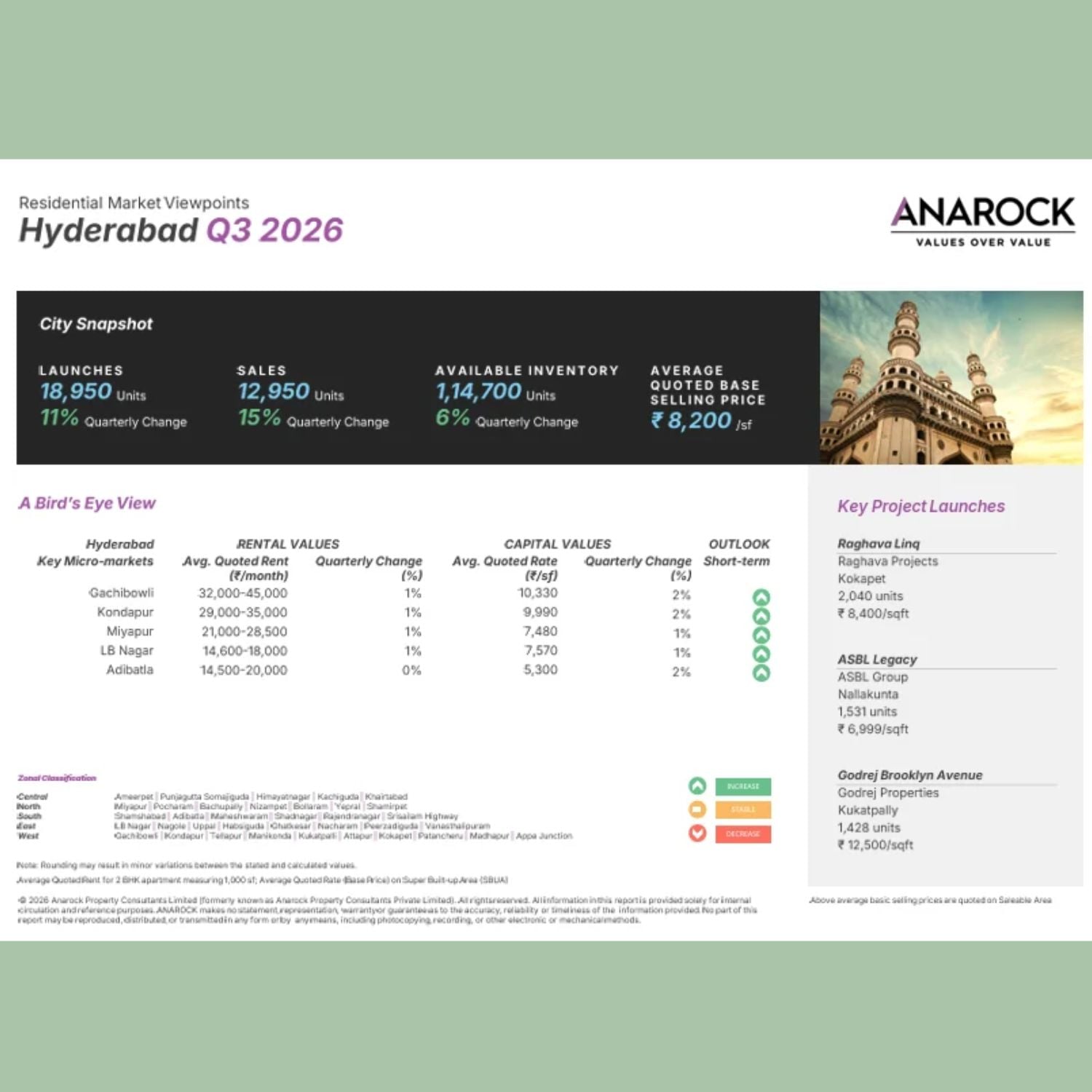
Anarock’s Q3 2026 Pan-India Residential Report also points to this luxury skew: Nearly 66 per cent of all new housing launches in Hyderabad during the July–September 2026 quarter were in the luxury segment. Even more starkly, nearly 97 per cent of Q3 launches were priced above Rs 80 lakh, leaving virtually nothing for first-time salaried buyers.
Shekhar Reddy, Chairman, India Green Building Council and former National President, CREDAI, acknowledged the oversupply and overpricing, saying, “After nearly 15 years, Hyderabad is changing from being a seller’s market to a buyer’s market now. There is certainly scope for price correction. It is a paradoxical situation where there is both an increase in inventory and the cost of homes.”
In Hyderabad, strong demand and limited housing supply had allowed builders to hike prices rapidly and dictate payment terms, leaving buyers with little choice but to make rushed decisions. But now, with a large inventory of unsold homes coupled with new premium launches and slower sales, buyers have more choices, stronger negotiating power, and better access to discounts or flexible payment plans without feeling pressured to buy immediately.
Instances of supply outpacing demand were flagged by many mid-sized developers, who noticed that first-timers and the middle-class segment were moving eastward to invest. Vertex Homes and NSL Infratech, both in the mid-sized residential segment, said the bigger builders kept launching even as absorption slowed.
As Falcon Research Desk pointed out in its Q3 review, Hyderabad launched 1.46 homes for every single home sold.
In the July–September 2026 quarter, developers launched roughly 18,950 new units—a 120 per cent year-on-year surge—against 12,970 units sold. “During the 2021–2023 frenzy, everyone assumed IT salaries would keep rising 25 per cent every year, and that private investor money would absorb anything launched west of Gachibowli,” said a senior commercial banker in Banjara Hills, who tracks developer debt, requesting anonymity.
“Now, the investors have exited, and the salaried end-user cannot stretch to Rs 85 lakhs to 1.2 crore, the banker said.
Builders vs buyers playbook
On the ground, the excess capacity has transformed the psychology of the home-buying experience.
Consider Rohit Dasoju, a 36-year-old product manager at a Gachibowli GCC. In late 2023, when he first looked at flats in Narsingi, a sales executive gave him an ultimatum: pay a Rs 5 lakh token by Sunday evening, or the base rate would jump by Rs 300 per sq ft — from Rs 8,200 sq ft to Rs 8,500 sq ft on Monday morning. Exhausted by the pressure, Rohit walked away and stayed in a rented flat in Kondapur.
When he resumed house-hunting in September 2026, the power dynamic had flipped entirely. Across three gated communities in Puppalaguda and Tellapur, sales teams greeted him with complimentary lunch, waived floor-rise and east-facing premiums, offered modular kitchens and club memberships at zero cost, and pitched a “10:80:10” subvention scheme, where he pays no equated monthly instalments (EMIs) until possession.
Developers such as Ira Realty’s Narsi Reddy explained to ThePrint that high land prices, elevated construction costs, and expensive debt not only made slashing headline per-square-foot prices financially ruinous, but also triggered angry demands for refunds from earlier buyers.
“This is why developers are offering invisible discounts. Tier-1 builders, with strong balance sheets, are holding base prices firm while absorbing GST, registration charges, or two years of maintenance. Meanwhile, smaller and mid-sized builders in peripheral pockets like Bachupally, Mallampet, and Kollur are quietly offering cash discounts of 8–12per cent to keep construction cash flows moving,” Reddy said, explaining the builders’ new playbook.
On the flip side, today’s buyers are hard-nosed end-users armed with spreadsheets. They are scrutinising carpet-to-super-built-up ratios, demanding Occupancy Certificates before signing cheques, and refusing to pay “Financial District prices” for projects located 30 minutes away from the city centre in Kollur or Ameenpur, decisions made by Rohit Dasoju and scores of other home-buyers suggest.
Also, speculative investors—who once accounted for up to 35 per cent of pre-launch bookings, flipping allotment letters for quick 25–30 per cent gains before a single pillar rose—have vanished, Narsi Reddy explained. Simply put, short-term property buyers — who purchase homes early just to resell them for quick profits — have stopped engaging in this game since there is an excess supply in the market already.
The twin regulatory chill: HYDRAA and Section 22-A
If oversupply cooled the market, two aggressive regulatory interventions rattled buyer confidence on the ground: HYDRAA and Section 22-A.
In July 2024, came HYDRAA—the Hyderabad Disaster Response and Asset Protection Agency. Empowered by Chief Minister Revanth Reddy’s government to reclaim encroached lakes, nalas (stormwater drains), Full Tank Levels (FTL), and buffer zones, HYDRAA’s bulldozers demolished dozens of illegal commercial and residential structures across the city.
While environmentalists cheered the protection of Hyderabad’s vanishing water bodies, the demolitions sent shockwaves through middle-class homebuyers. Suddenly, buyers realised that even projects with past municipal clearances could face scrutiny if a wing or compound wall encroached upon a lake buffer zone. While Maheshwar Ponduru, HYDRAA’s panel advocate, maintains that no occupied residences or housing projects with valid permissions were demolished, a 2025 report in The Times of India indicated HYDRAA had nearly 700 cases against it in the Telangana High Court by alleged encroachers within 15 months of its operation.
Occupancy Certificates slowed down — facing delays as long as six months — as civic, irrigation, and revenue officials conducted joint inspections. CREDAI Telangana President Indrasena Reddy has acknowledged severe bottlenecks in the approval pipeline, citing file movements across dozens of desks and other regulatory hurdles.
HYDRAA Commissioner IPS A.V. Ranganath publicly pushed back against developers blaming his agency for the slowdown, arguing that unaffordable Rs 10,000–15,000/sq ft pricing and AI-linked job caution—not lake protection—had dampened sales. On the ground, however, families began hiring independent land surveyors with satellite FTL maps before purchasing property because standard government approvals and basic title checks no longer guarantee that a house is safe from demolition or registration freezes.
Even more disruptive for ordinary buyers was Section 22-A of the Registration Act, which was introduced in August 2026.
Section 22-A empowers the state to bar the registration of “prohibited properties”—land classified as government, assigned, Waqf, endowment, or Urban Land Ceiling (ULC) surplus. During Telangana’s rocky transition from the K Chandrashekar Rao government’s Dharani land portal to the new Bhu Bharati revenue system in April 2025, widespread data-migration glitches and survey-number mismatches swept thousands of legitimately-purchased private plots and apartments onto the Section 22-A prohibited list.
Overnight, homeowners in established localities—from Kondapur, Miyapur, and Madhapur to Banjara Hills and Uppal—discovered they could neither sell their homes nor pledge them for bank loans. Although the state government issued remedial orders in September 2026, allowing registrations for certain pre-approved layouts and buildings, homeowners and brokers claim registration officers in Hyderabad are refusing to register resale flats and plots unless they first complete lengthy approval processes, including the TM-15 grievance filings to get their property removed from the Section 22 prohibited list.
Two cities at the registration counter
While the Telangana Revenue Minister Ponguleti Srinivas Reddy said that his government is working on removing wrongly-included properties in the prohibited list in response to the Telangana High Court rebuke, Section 22-A has troubled more than just wealthy property developers.
Among scores of other homeowners who rushed to the land registrar’s office, in Uppal (eastern Hyderabad), a 78-year-old retired schoolteacher Venkateswara Rao sat on a plastic chair outside a Sub-Registrar’s office, clutching a faded cloth folder thick with 30-year-old sale deeds, municipal tax receipts, and a clean Encumbrance Certificate (EC).
He had found a buyer for his 200-square-yard house in Uppal to help fund his granddaughter’s postgraduate medical seat—only for the clerk’s monitor to flash a single red warning: Transaction Blocked — Survey Number Listed Under Section 22-A.
“I have been living in my house with my family for the last 30-plus years. And now, the government asks me to prove it is mine despite possessing all the documents,” he told ThePrint. The classification of his property under Section 22-A prevents him from selling his property. He now has to prove to the government that this land was ‘patta’ land and was indeed bought legally either from the government or any other buyer. He has to then re-register it for the process to move further.
“For the first time in two decades, builders, brokers, and homebuyers across the city’s sprawling corridors are all feeling the pinch of ad hoc government policies, unplanned expansion, and the postponement of a lifelong dream to own a house,” said Harshavardhan Reddy, Founder and CEO, Housing Requirements Customised Solutions, an advisory that helps home buyers across the country invest wisely.
That Hyderabad is undergoing a painful, protracted tug-of-war between developers sitting on mountains of high-cost luxury stock and end-users who don’t yet hold all the cards is a reality that is undeniable.
Venkateswara Rao is now caught in a waiting game he never budgeted for. At 78, he has not considered knocking the judiciary’s doors yet. With his life savings frozen in digital red tape, the retired teacher is now preparing to file a TM-15 grievance—and, if the revenue machinery stalls, he may be forced to take his 30-year-old deed to the Telangana High Court—just to win back the right to sell his own home.
(Edited by: Aakriti Handa)
This is the fourth instalment of ThePrint’s series, Urban Housing Squeeze, which explores why India’s growing cities are putting homeownership beyond the reach of the middle class. Read all the stories here.