



Mumbai: By the time Payal reaches the salon near Kemp’s Corner, where she works as a nail technician, the journey from Vikhroli has left her sweaty. She changes into her work clothes and reaches for a bottle of Bella Vita perfume.
“By the time I reach the salon, I’m sweaty. We change there, and then I spray something so that I smell nice for the rest of the day. For everyday, I use Bella Vita that costs under Rs 500,” the 36-year-old said.
The perfume Payal really wants is Tommy Hilfiger’s Tommy Girl, which she hopes to buy for herself this Diwali.
Between those two bottles is the new Indian perfume market. Bella Vita, Renee and Studiowest have made perfume an everyday purchase for customers who might previously have bought deodorant. Other Indian brands are asking the same customer to spend Rs 2,000, Rs 5,000 or even Rs 10,000. The harder question is what makes a customer make that jump—and what makes an Indian perfume feel worth paying for.
India’s fragrance market reached Rs 6,640 crore in retail sales in 2025, growing approximately 15 per cent by value, according to Euromonitor. Redseer estimates that online fragrance is growing by 30-35 per cent annually and has overtaken deodorant in online sales.
How perfume stopped being an occasion-only purchase
For years, everyday fragrance came in a deodorant can. Axe advertisements promised female attention. Fogg’s “Kya chal raha hai?” campaign sold the number of sprays in each bottle. Nike’s brightly coloured variants gave girls their own shelf of choices.
Fogg launched in 2011 and made Rs 100 crore in sales the following year. By 2014, it had overtaken Axe and Engage to lead an Indian deodorant market worth Rs 2,300 crore, according to Nielsen data reported at the time.
Perfume largely belonged elsewhere: the foreign bottle brought home from a trip, received as a gift and saved for an occasion.
“When I was a child, my mother had this glittery perfume bottle. It was very pretty and the scent was also very nice. Somebody had probably given it to her. I don’t remember the name now,” Payal said.
There were inexpensive perfumes too, but the brand was not always the point. Madhu, a 42-year-old homemaker, remembers wearing Charlie from Archies when she was younger. A shop called Occasions near her home in Malad sold similar bottles, which her father sometimes bought when she did well in her exams.
“In those days, we didn’t know the names of these things. It would just be a present. The bottle would look nice, you would keep it, use it and finish it,” she said.
Bella Vita gave this customer recognisable branding, several variants and 100 ml bottles priced between Rs 449 and Rs 549. Payal was first gifted a set and has since repurchased her favourite several times.
The international bottle still occupies a different place in her imagination. She learnt about Tommy Girl through her sister-in-law, who bought it in Dubai. She recognises Carolina Herrera’s Good Girl without knowing its name: it is the perfume in the heel-shaped bottle she has seen while visiting clients’ homes.
The Rs 500 customer is learning to spend more
Manya’s first perfume was also Bella Vita, received among her college-graduation gifts. The 24-year-old engineering graduate had not previously cared much about fragrance.
“Sometimes, in the middle of the day, I would move my hair and suddenly smell the perfume on myself again. It felt really nice. I would think, wow, I’m smelling so nice,” she said.
The pandemic helped turn that private pleasure into a buying habit. People stuck at home were spending less on commutes, meals out and other parts of ordinary life. For some consumers, small purchases that offered pleasure became a way of replacing experiences they could no longer have outside the home.
“Access to delight fundamentally became shopping,” investor Harnidh Kaur said. “It was the first time in my life I saw myself and other people buying fragrances online. It wasn’t just fragrances that you were repurchasing.”
The shift was not only about buying more perfume. It also changed how people learnt about it. Buying perfume without smelling it also produced an education around it. On Reddit groups such as DesiFragranceAddicts, buyers compared originals and dupes, recommended discovery sets and decants, and discussed notes, projection and sillage—the trail a fragrance leaves behind.
“People were using words like sillage,” Kaur said. “That created an atmosphere of education.”
It became easier to try several small bottles instead of committing to one. Perfume could be chosen according to the day, occasion or mood.
Manya began looking beyond the Bella Vita set. She already shopped at Westside, where Studiowest perfumes cost approximately Rs 1,000.
“The bottles look nicer and feel heavier—the kind I want to keep on my dressing table. Bella Vita is common now. With Studiowest, people ask me what I’m wearing,” she said.
Studiowest costs Manya roughly twice as much as Bella Vita. She is willing to pay the difference for a nicer bottle, an unfamiliar scent and the pleasure of being asked what she is wearing.
That is the first step up the price ladder. The next is much larger. Typsy’s double-sided perfume costs Rs 2,299, SKINN by Titan’s 100 ml bottles range from Rs 2,795 to Rs 4,995, and 33North charges Rs 3,500 for 50 ml.
Isha, 16, is already looking past all three. Madhu was shopping with her daughter for the teenager’s birthday present, a designer perfume. Isha uses Bella Vita and Renee every day, and identifies the bottles in her Bella Vita set by colour rather than name.
“I know the colours and what they smell like. I choose between them depending on my mood—if I’m going to a wedding, meeting my friends or watching a movie,” Isha said.
For her birthday, she wanted Miss Dior or Burberry Goddess. Unlike Bella Vita, the designer bottle would be reserved for occasions.
“When I spray it when I’m older, I want to remember all these moments,” Isha said.
Both cost more than Madhu wanted to spend. A 100 ml bottle of Burberry Goddess cost approximately Rs 10,800, while Miss Dior was priced higher.
“She liked Miss Dior, but a 16th birthday doesn’t mean we can spend Rs 16,000,” Madhu said.
They planned to look for an online discount or ask someone travelling abroad to bring it back.
The jump from Rs 500 to Rs 10,000 is not simply a question of concentration or bottle size. The customer is being asked to buy a story: a familiar fashion house, a recognisable name, a particular country of origin, or an idea of luxury.
Middle Eastern brands found another route into this market through dupes—perfumes made to resemble famous, far more expensive ones.
“We thought of perfumery as foreign, but specifically as a white people brand. ‘This perfume was made in France’ was the calling card. Middle Eastern perfumes really broke that for us,” Kaur said. “You were getting something like YSL Opium for Rs 800. But that duping capacity made trust happen.”
Kairavi Bharat Ram, founder of colour-cosmetics brand Typsy, saw that appetite after a social-media video about Baccarat Rouge dupes received 500,000 to 600,000 views. Viewers began asking when Typsy would launch perfume.
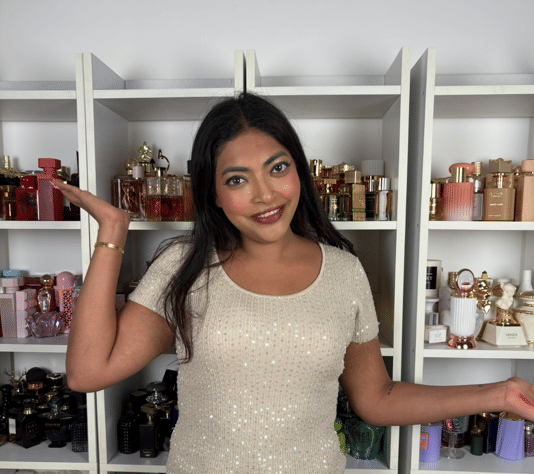
But Bella Vita had already fixed a low entry price, while Middle Eastern houses had built trust through familiar smells. Typsy’s bottle contained two perfumes that could be worn separately or layered. The company saw two fragrances for the price of one; a customer ordering online could see two unfamiliar scents she might dislike.
“What we were asking them to pay more for was something that we had to educate them about and then convince them that they needed,” Bharat Ram said.
Thirteen centuries before the Indian perfume startup
There is an irony in this new market: India does not lack a perfume history. It has one that predates most of the luxury houses now associated with fragrance.
More than 1,300 years before Typsy had to explain why an Indian perfume should cost Rs 2,299, Kannauj was selling fragrance to royalty.
Anirban Mukherjee, author of The Ittar Industry of Kannauj: A Saga of Commodification of Olfactory Aesthetics, found references to its perfume trade in Bāṇabhaṭṭa’s seventh-century Harshacharita. Mughal records later placed Kannauj attar in the imperial court, where Jahangir appointed a Khushbu Daroga to monitor its quality.
Attar is made by distilling flowers, herbs, spices, wood or baked earth into an oil base, traditionally sandalwood. But the industry carrying that history shrank. Mukherjee counted 375 perfume-making units in Kannauj in 2008 and 250 in 2012. He estimates that approximately 130 remain.
Many distillers began supplying paan masala, tobacco or companies that sold the finished product under another name. Younger customers, meanwhile, came to associate attar with an overpowering smell in a tiny bottle, with little distinction between traditional attar and cheap synthetic oil.
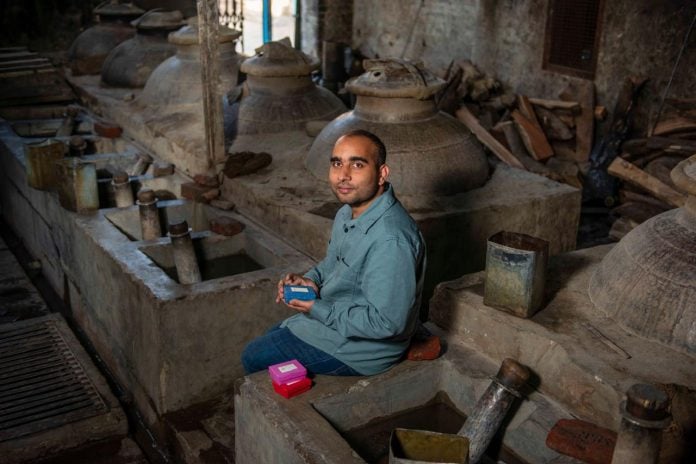
Vikram Singh, 37, learnt attar-making on the job. In one distillation, he used 80 kg of flowers to produce approximately 5 kg of attar.
“After I light the fire under the deg, it heats slowly and begins producing steam. The vapour travels through the pipe into the bhapka, which is kept in cold water. That is where the fragrance settles,” he said.
When siblings Varun and Krati Tandon started Boond during the pandemic, attar seemed to people their age “very, very old school, not in a good way”. They changed the packaging, explained the process and introduced lighter fragrances. Their first batch of 72 bottles sold out in two days.
An Indian name, a European perfumer
Much of the perfume business happens away from the brand whose name appears on the bottle. A brand takes a brief to a fragrance house, whose perfumers develop samples, revise the formula and may manufacture the perfume. The consumer brand approves it, names it and sells it.
International Flavors & Fragrances (IFF) is one such specialist. Its perfumers have created fragrances for Lancôme, Yves Saint Laurent and other international brands.
“If you’re developing a fragrance from scratch, you need to work with a perfume house and a perfumer. It can take a year, two years, 30 or 40 iterations. It’s very, very expensive,” Bharat Ram said.
Indian brands have entered this system in different ways. SKINN says its perfumes are “crafted in France”. All Good Scents foregrounds founder Rajiv Sheth’s experience in Paris and Grasse. Nykaa Moi uses French names such as Joie de Vivre and Raison d’Être.
Suryansh Parihar found European perfumers through LinkedIn when he began developing 33North in 2023. Its first four perfumes took approximately a year and a half and between 60 and 80 iterations. Their names and stories are Indian; the formulations came from Europe.
Typsy also works through international fragrance houses, including IFF. Bharat Ram said the Indian houses it approached could not produce the sweet, gourmand scents the brand wanted.
Europe can provide a particular perfumer, technical expertise or manufacturing capability. But for a consumer, “France” on a perfume bottle also carries a history of luxury and expertise that an Indian brand has to build for itself.
India has companies capable of developing fragrance. Keva, the fragrance business of S H Kelkar and Company, has perfumers, laboratories and factories. Its fragrance division reported revenue of Rs 2,052 crore in 2025-26. Its identified clients include Hindustan Unilever, Godrej Consumer Products, Marico and Wipro Consumer Care, although it does not disclose how much of its work involves fine perfume rather than scents for other consumer products. Typsy and 33North ultimately developed their perfumes abroad.
India also supplies raw material to European perfume houses. Jasmine Concrete Exports in Tamil Nadu processes flowers for perfumers. Guerlain perfumer Thierry Wasser told AFP that he sources jasmine extract from the company; its director said it has supplied Bulgari, Dior and Lush. Jean-Paul Guerlain used Madurai jasmine to create Samsara in 1989.
So the gap is not simply about whether India can make perfume. It is also about whether an Indian perfume house can turn that manufacturing ability, raw materials and history into a brand that consumers recognise as desirable.
Can Indian perfume turn history into luxury?
Chanel No. 5 was launched in 1921. Miss Dior followed in 1947. Both arrive with Paris, fashion archives and decades of advertising attached. Kannauj’s perfume history is considerably older, but it has not travelled with the modern bottle in the same way.
Shiv Kothari, 25, buys most of his perfumes while travelling because duty-free prices are lower. He tried a sample set from Indian brand Bla Bli Blu after finding it on Instagram, but did not like any fragrance enough to buy a full bottle.
He would pay the same amount for an Indian perfume as for a French or Italian one, but on one condition.
“It should have that heritage. I don’t think any Indian colognes have that heritage, or at least they don’t market it that well,” Kothari said.
For brands trying to move beyond the Rs 500 customer, this is the difficult part. A low price can get someone to try a perfume. A distinctive bottle can get it noticed. Dupes can build familiarity. But at the higher end, the customer is also paying for a reputation built over years.
Building that trust will require more than launching another label. Kaur expects many of the new brands to disappear, but predicts “the rise of at least a couple of Indian perfume houses, versus just brands”.
The distinction matters at the expensive end of the market. Chanel and Dior sell perfume with the authority of fashion houses. A niche perfume house is built around fragrance itself—its perfumer, compositions and ingredients. Maison Francis Kurkdjian, for instance, carries the name of perfumer Francis Kurkdjian. Its Baccarat Rouge 540 became an international reference point despite not arriving with a century of couture behind it.
That is the market Dimple Fouzdar wants Maison de Fouzdar to compete in. She trained in fragrance blending in Grasse before launching the brand in 2021, and manufactures its perfumes in India using ingredients sourced internationally.
The prices demand the comparison too. Santal Safran costs Rs 9,800 for 50 ml and Rs 13,999 for 100 ml. Fouzdar initially believed customers would have to smell the perfumes before spending that much, but online sales have since overtaken offline sales. She said 46 per cent of the brand’s customers return.
“I’m not competing with the Guccis and Chanels,” Fouzdar said. “I’m competing with the international niche brands.”
(Edited By Raunaq Lekhi)