



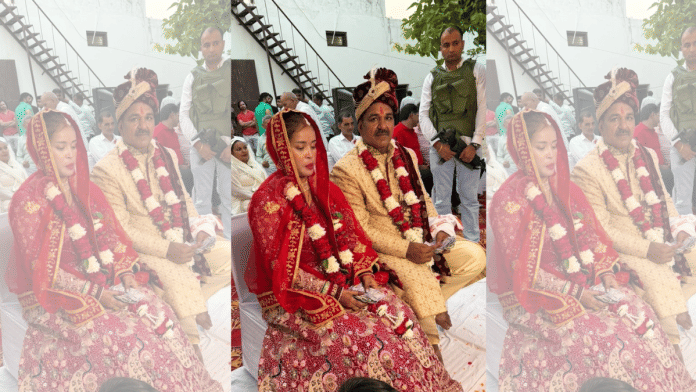
New Delhi: The priest was racing through the pheras, throwing “swaha, swaha” into the fire as Meta Chan tried to keep one of her three crying children quiet with a phone playing YouTube. Smoke stung her eyes. She kept looking towards her children, then back at the fire.
A large piece of cloth covered gangster Mainpal Dhilla’s hands, presumably to keep his handcuffs out of sight. But the metal kept peeking through. Someone would notice, and the cloth would be pulled back over it.
Around the mandap, heavily armed policemen stood watching. Nearby, women relatives and police constables chatted and inspected the bride’s lehenga.
“The bride’s lehenga doesn’t fit her,” one female constable remarked. “I heard it cost Rs 6,000,” another replied.
It was an unusual, hurried wedding. Dhilla had somewhere else to be—back in jail.
The 50-year-old Haryanvi gangster had been given just 12 hours of custody parole, from 8 am to 8 pm Thursday, to marry Meta, his 37-year-old Cambodian partner. She had travelled to Jhajjar with three of their children, but without any other family members.
Dhilla, a tractor mechanic from Badli village, entered the list of most-wanted criminals in 2000 after a dispute over water drainage in the village led to the killing of his uncle, Hemchandra. He later murdered his maternal uncle, Omprakash, and soon became a known criminal in the area. Over the years, he murdered two more people and now faces around 22 criminal cases. He is serving life sentences in murder and other criminal cases, including attempt to murder, robbery, dacoity, criminal conspiracy and illegal weapons cases.
Relatives and villagers from Dhilla’s native Badli village gathered around the mandap as about 15 heavily armed police personnel kept watch. For the policemen, it was a wedding that came with a very specific deadline: Dhilla had to be back in custody by 8 pm.
The mandap was a makeshift cubicle covered with fake flowers. Chairs had been lined up on one side for the men, while the women sat on the ground nearby. Inside the small enclosure, there was room only for Dhilla, Meta, their children and the pandit. Around them stood the policemen, with four officers in safety jackets and carrying guns, watching over the ceremony.
A wedding under police watch
Around 50 cars were parked outside the farmhouse on the Gurgaon-Jhajjar Road, including SUVs, Scorpios and Thars, but there was little else to suggest that a wedding was taking place inside. There were no decorations outside. Instead, policemen stood and sat around the entrance, watching those arriving.
At the entrance, police personnel checked bags, frisked those entering, and asked for their names, their fathers’ names and phone numbers. The media was not allowed inside.
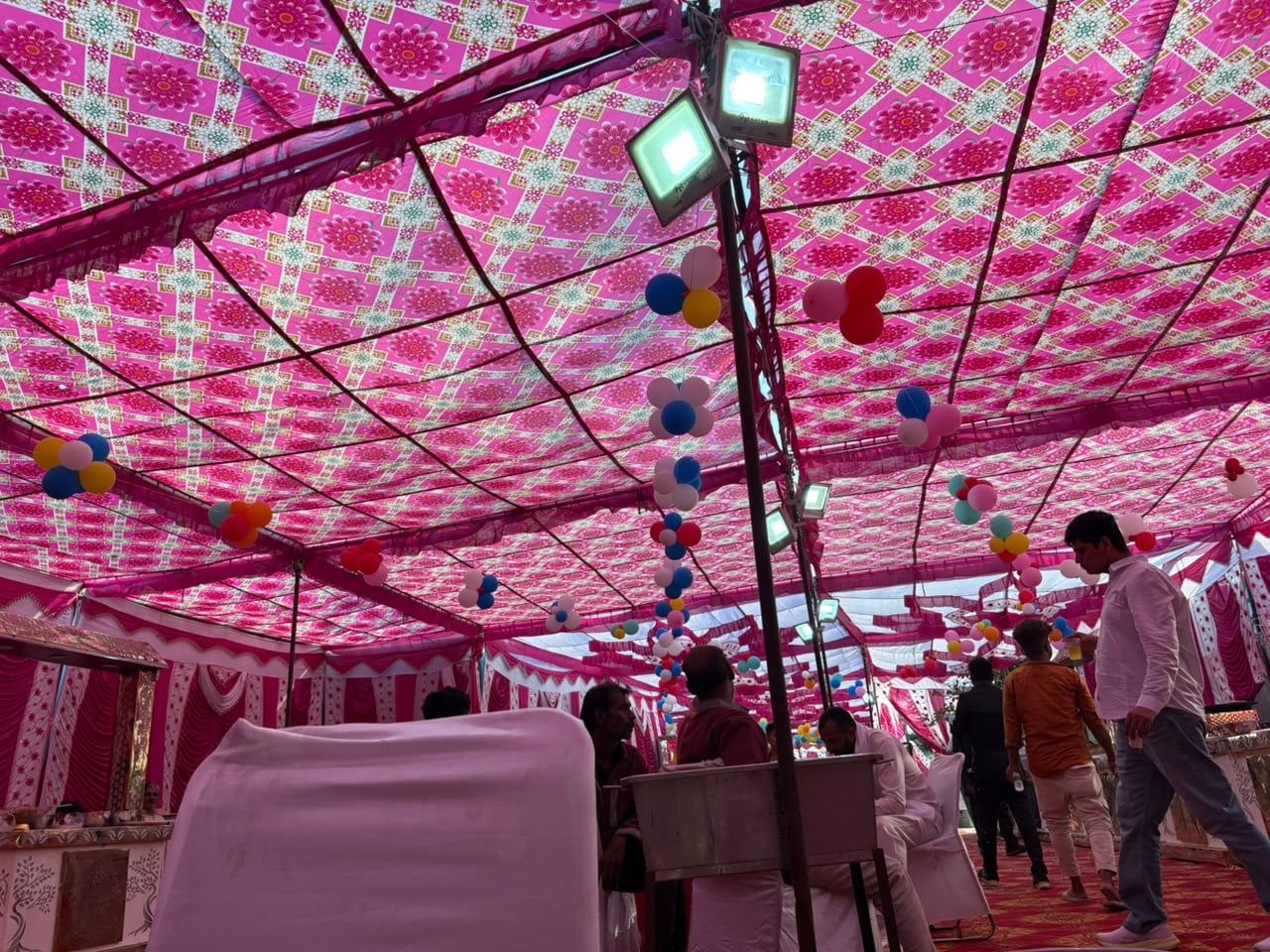
Inside, pink and white tents shaded the attendees. Men sat on chairs in the open area, eating and smoking bidis, while women moved between the rooms and the wedding arrangements.
The women, most of them dressed in suits, sat together inside the farmhouse, chatting among themselves and with the female police constables. There were no Bollywood songs playing and, unusually for a Haryana wedding, the women did not sing traditional wedding geets either.
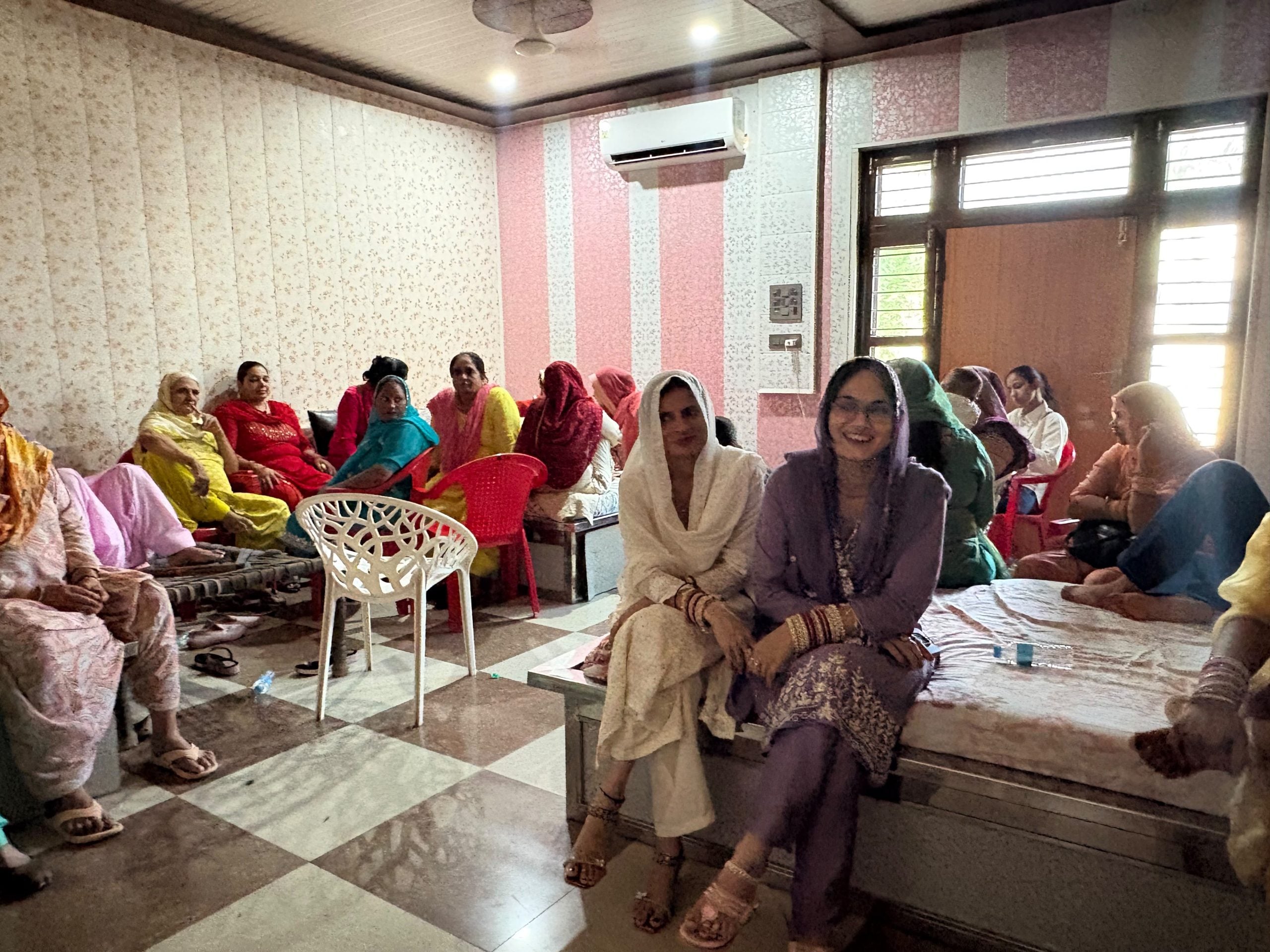
A woman looked at the female constables’ uniforms and said, “Women constables used to wear suits earlier, but now they have started wearing shirts and trousers.”
Another asked whether they still covered their faces with a ghunghat when someone from a village came to the police station.
“We have to wear the uniform. If someone from a village comes to the police station, I don’t cover my face. Work is work,” the constable replied.
“Meta will stay in the village for about a month and then go back to Cambodia. She may later apply for Indian citizenship,” said Dhilla’s lawyer, who did not want to be named.
The wedding took place at the farmhouse owned by Dhilla’s cousin.
The farmhouse had around four to five rooms and a kitchen, with a large open area around the building. There was no swimming pool or other obvious luxury feature. The place did not appear to be regularly lived in. Its owner, Dhilla’s cousin, lives in a village in Rohtak.
Some women tried to take pictures, but police personnel stopped them and told them to follow orders. Close relatives moved around the farmhouse, arranging things, handling children and helping prepare for Dhilla’s wedding.
This is not the first time a jailed Haryana gangster has been allowed out of custody to get married.
In March 2024, Sandeep alias Kala Jathedi, who was facing more than 30 criminal cases across Delhi, Haryana, Punjab and Rajasthan, was granted six hours of custody parole by a Delhi court to marry Anuradha Chaudhary, a history-sheeter also known as “Revolver Rani” and “Madam Minz”. They married at a venue in Dwarka, with more than 250 police personnel deployed around the wedding.
The same month, another Haryana gangster was granted custody parole for his wedding. Yogesh Dahiya alias Tunda, a Sonipat native and an alleged associate of the Gogi gang, was granted six hours by the Delhi High Court in March 2024 to marry at an Arya Samaj temple in Vikaspuri. Dahiya was lodged in Tihar Jail at the time.
A year later, in July 2025, Amit alias Dabang, described by police as a close aide of slain gangster Tillu Tajpuriya, was granted five hours of parole to attend his wedding in Narela, Delhi. He was taken to the venue under police escort and returned to jail after the ceremony.
Also Read: How India’s pre-wedding shoots have become content factories. Lights, camera, marriage
The fugitive who built a family in Cambodia
Eight years ago, Dhilla walked out of Hisar Central Jail on a six-week parole. He was supposed to return on 29 August 2018. Instead, he fled and remained on the run.
He then moved from Haryana to Kolkata, then Bangkok and eventually Siem Reap in Cambodia. In 2019, police said he obtained an Indian passport using forged documents and the name “Sonu Kumar” before leaving the country. He settled in Siem Reap, where he started a business and ran a nightclub.
It was there that he met Meta Chan.
The fugitive and the Cambodian woman began living together and raised a family. By the time Dhilla was arrested, the life he had built there was a long way from the prison in Haryana that he had left behind.
“There, he started his business. He ran a nightclub and built a life with Meta Chan,” said Preeti, a 30-year-old relative of Dhilla. “The plan is that Meta will stay here, and Dhilla will be out of jail by next year. Once he is released, the entire family will live together in the village,” she said.
After the CBI obtained an Interpol Red Notice against him on 6 November 2024, Cambodian authorities arrested him on 24 July 2025. A Haryana STF team brought him back to India on 2 September 2025, and he has remained in custody since.
Nearly a year later, Meta arrived in India with three of their children. Her seven-month-old girl couldn’t come. None of her own family members were at the wedding.
And there was another striking detail: Dhilla’s family had not known that he had children in Cambodia while he was away. They learnt about them only after he returned to India.
His mother sat among the women at the wedding. One of them told her not to look towards the mandap. In traditional Haryanvi weddings, they said, the groom’s mother is not supposed to watch the pheras.
Dhilla’s mother, who is in her 80s, did not speak even to the relatives at the wedding. A woman at the event said the mother had little choice but to accept the situation.
“She had to accept it. What other choice does she have?” the woman said.
A bride among strangers
Meta was getting dressed in a room full of people she was meeting for the first time—Dhilla’s relatives and women police constables. Three or four women from his family moved around her, adjusting her clothes and helping with her make-up. Five or six women constables sat nearby, chatting with the relatives.
There was hardly a moment when she could be alone.
Meta was more than the foreigner marrying the village’s gangster; she was also a mother trying to keep her children calm. She tried communicating in broken English, the only language she thought might be understood.
When she misplaced one of her bags and asked for her black one, the older Haryanvi women looked at her blankly. It was the younger bahus who stepped in.
“Your black bag? Where? Tumne kidhar rakha?” they asked, trying to piece together what she needed.
Then someone’s child started crying.
Meta unlocked her phone, opened YouTube and handed it to her daughter. The child fell quiet, staring at the screen. For a few minutes, Meta could turn back to getting dressed.
Then the child’s face scrunched up again.
She was also a restless bride who just needed two quiet breaths alone but couldn’t.
Preeti came over to her. Meta looked at her, and her eyes began to well up.
This moment went unnoticed amid the noise of a room crowded with women.
“Meta, come here… main pehnaati hoon tumhe lehenga (I’ll put your lehenga on for you),” Preeti said, taking hold of the outfit.
Another 22-year-old woman came over to help. Together, they fixed the lehenga, checked Meta’s make-up and tried to settle the children.
“She doesn’t understand Hindi yet, and we don’t know English. She’ll learn slowly,” the young woman said.
They watched Meta as she got ready, observing her clothes, makeup and appearance.
“Meta has maintained herself very well. Even after four children, she is so fit,” one woman said.
“Yes, she takes very good care of herself. She puts on makeup as soon as she wakes up, and she also goes to the gym in Cambodia,” another added.
The room carried the familiar bustle of a wedding—women fixing clothes, checking make-up, giving instructions and tending to children.
When it was time to go to the mandap, there was no brother, parent or other member of Meta’s family to accompany her. Dhilla’s relatives and the women police constables walked with her instead.
At the mandap, Dhilla was waiting, his hands cuffed beneath the cloth covering them. He was smiling. Their children sat beside them.
Meta had come to Jhajjar on 12 September with three of her children. The rest of her family had stayed behind in Cambodia.
Meta and Dhilla had known each other for years in Cambodia, where, according to his relatives, they lived together and raised their children.
“The couple had already had a religious marriage there, but the family wanted them to marry in India according to Hindu customs,” Preeti said.
Also Read: Return of the matchmaker. Why young Indians are reviving arranged marriage
Racing through the pheras
The priest raced through the pheras, chanting “swaha, swaha” into the fire at almost double speed.
There was no long celebration to follow. The clock was part of the ceremony.
Dhilla had arrived at the farmhouse on parole and had until 8 pm to marry Meta, spend a few hours with his children, and then return to jail.
By evening, the unusual wedding would end where Dhilla’s life in India had resumed, with him being taken back into custody.
Now live a good life
Dhilla’s release came under Haryana’s framework for temporary release of convicted prisoners, but his was not an ordinary parole.
The Haryana Good Conduct Prisoners (Temporary Release) Act, 2022 defines custody parole as the temporary movement of a prisoner under armed police escort for a specific purpose. The law allows a “hardcore convicted prisoner” to be taken out under custody parole to attend the marriage of his children or siblings. Such custody parole shall not exceed six hours for one event, excluding travel time.
Dhilla, however, was given 12 hours by the Punjab and Haryana High Court.
For his family, the wedding was a gathering of relatives and friends who had watched his life unfold over decades–from his arrest in 2000 to his escape from parole in 2018 and his return to Haryana.
Deepak, 37, Dhilla’s cousin, said Dhilla was likely to spend about another year in custody, after which he could seek bail in the remaining cases. He said some cases against him had already been resolved, while others were pending before the High Court and Supreme Court.
“There is about a year of custody left,” Deepak said, referring to the pending cases. He claimed Dhilla had already spent 12-13 years in custody in one of the cases carrying a life sentence.
He said the children–aged about five, four, two-and-a-half and seven months–could also be enrolled in school in India after Meta settled in Haryana, where they could learn Hindi as well as the local language.
Inside the farmhouse, a group of elderly men from Dhilla’s extended family, dressed in white kurtas and dhotis, sat together on chairs, talking about the wedding and his return to the village.
“He is a good person, but he made a mistake in the beginning, and after that, one thing led to another. When a person gets into something like this, it doesn’t always happen by choice,” Deepak said.
The older men spoke of his marriage and children as a chance to start afresh.
“Now that he is married and has children, he should just live a good life and leave everything else behind,” one of the elderly attendees said.
Before the wedding began, an orange mini-tour bus appeared from the other lane, making its way towards the farmhouse. Two men walked and danced in front of it, playing dholaks as they stopped.
Behind them, at least 15 babas associated with the Mastnath tradition travelled in the bus, dressed in orange dhotis. The group eventually arrived at the farmhouse. The family welcomed them.
An 18th-century Hindu saint from Rohtak, Mastnath Baba is revered in Haryana. People at the wedding said Dhilla was a follower of Mastnath Baba and had sought the babas’ blessings before his marriage.
For a man who had spent years away from Haryana, built a family in Cambodia and returned to India in handcuffs, the wedding was an attempt to imagine a life that looked very different from the one that had led him to prison.
But for Dhilla, that new life had to wait. His custody parole still came with an expiry time: 8 pm.
(Edited by Raunaq Lekhi)