



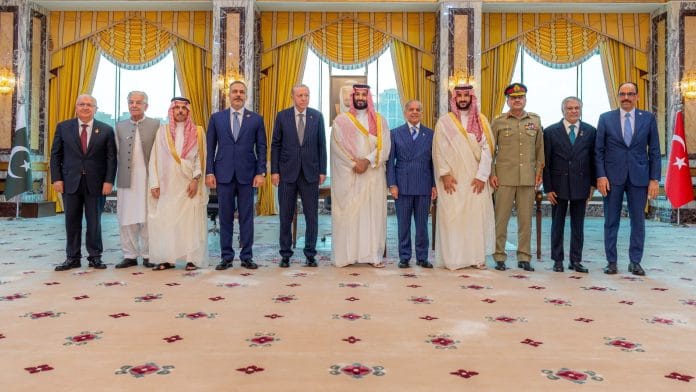
New Delhi: Pakistan, in an emergency meeting convened under the Mecca Joint Defence Agreement, announced on Monday that it would ‘deploy’ troops in Yemen against the Houthi offensive as part of a collective deterrence between Saudi Arabia, Pakistan and Turkey.
The development dominated Pakistani headlines as experts and analysts forewarned the consequences of such a move. Critics outnumbered those who were in support of the move. While across news and podcasts, most offered an analysis of what the deployment would mean, on social media, the anger was palpable.
“Pakistan has officially joined the Yemen war on the side of Israel,” Pakistani journalist Waqas wrote on X.
Pakistani author Muneeb Qadir added: “Pakistan getting dragged into the Middle East’s forever wars is a bigger disaster in the making than Zia’s intervention in Afghanistan in the 1980s. With a hostile Afghanistan & hostile India sandwiching us, we could now be incurring the wrath of a hostile Iran; A FORMIDABLE FOE”
Pakistani anthropologist Arsalan Khan warned that deploying Pakistani troops to Saudi Arabia could place them directly in the line of fire and potentially draw Pakistan into a conflict with Iran, threatening to destabilise the region. “This war can only be ended by pressuring the US to permanently cease its assault on Iran,” he wrote on X.
But beyond the brickbats, analysts also chose to focus on the implications. In a detailed piece for The Friday Times, journalist Ejaz Haider broke down the nuances of a military deployment as he labels it ‘an egregious folly’.
Riyadh entered the Stockholm International Peace Research Institute’s (SIPRI) list of the world’s 15 largest defence spenders in 2013, when a 14 per cent surge in spending pushed its military budget to $67 billion. For 2025, Saudi defence spending was estimated at $83.2 billion, placing the kingdom eighth globally.
Pakistan’s defence spending is much smaller. The official defence budget is approximately $10.8 billion for the 2026-27 fiscal year, an increase of nearly 16 per cent from the previous year’s revised allocation.
SIPRI calculates Pakistan’s spending differently. Its estimate includes military pensions, which cost 822 billion Pakistani rupees and are handled through a separate government ledger, as well as paramilitary forces and strategic procurement contracts. By that calculation, Pakistan’s total defense-related spending reaches approximately $11.9 billion, or about 2.91 per cent of GDP.
Using the SIPRI figure and rounding it to $12 billion, the difference between Saudi Arabia’s and Pakistan’s defense spending is approximately $71.2 billion.
Haider pointed out that this disparity raises an obvious question: “A country spending $71.2 billion less on defence is sending military equipment to a country that is globally the eighth largest spender on defence. But wait. We are missing out on another fact. Riyadh entered this exclusive club in 2013 (quite another thing that it spent $56.5 billion in 2012). We are in 2026. That’s 13 years of high spending. And it still needs us to fight or help it fight Ansar Allah?!”
He then highlighted how the geography itself would favour the defenders. Northern Yemen is characterised by rugged volcanic peaks and deep ravines that favour defensive operations and allow defenders to wear down attacking forces.
Then there is the logistics problem. Soldiers require food, water and ammunition. Tanks, armoured personnel carriers and infantry fighting vehicles require fuel, spare parts, ammunition and recovery support.
Maintaining and sustaining such a force across fragmented and hostile terrain would place enormous demands on the logistical tail, including fuel trucks, ammunition carriers and recovery vehicles.
He argued that both airpower and naval force too would not be able to counter a probable attack, even if there is a deployment.
Also read: How Pakistan marked its ‘Queen of Melody’ Noor Jehan’s 100th birthday—by forgetting her
The history
In 2015, when Saudi Arabia asked Pakistan to provide troops, warplanes and warships for its war in Yemen, Pakistan’s Parliament debated the request for days before unanimously voting to remain neutral, amid broad public opposition, DropSite noted.
It added that since 2015, power in Pakistan has shifted sharply to the military. To this, Arsalan Khan added: “Pakistan’s slow-motion military coup has been continuously moving forward since the early teens, triggered by the passing of the 18th amendment in 2010.”
Policy analyst Syed Ali Abbas Zaidi wrote that reports on how Pakistan had committed itself to Yemen were troubling because the conflict was a protracted war involving more stakeholders than solutions.
The confrontation between Ansar Allah and Saudi Arabia, he said, “has absolutely nothing to do with Pakistan,” adding that there should be no deployment without debate in Parliament or a public forum.
Others chose sarcasm. Another commentator, Shuja, wrote sarcastically that now that Pakistan was apparently prepared to fight the Houthis for Saudi Arabia, Zaid Hamid would surely be the first Pakistani to die for “Pak-Saudi friendship.” Hamid is an infamous Pakistani Islamist political commentator and conspiracy theorist.
Among the four big English newspapers in circulation—Dawn, Express Tribune, The Nation, News International—only The Nation had an editorial on the same.
“Pakistan should ensure that, both organisationally and regionally, the MDA chooses restraint, diplomacy and negotiation rather than allowing itself to be dragged deeper into Yemen’s civil war. Supporting Saudi security is one thing; becoming absorbed into an open-ended conflict inside Yemen is another
“Pakistan must push for engagement with Yemen’s warring parties and renewed political negotiations. Otherwise, the alliance risks turning its first major challenge into its first quagmire,” it added.
(Edited by Ratan Priya)