





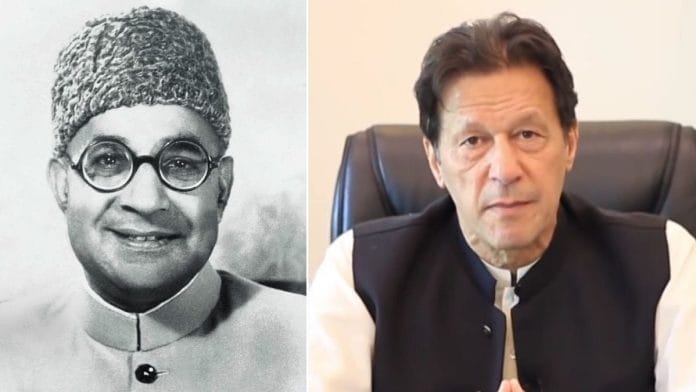

New Delhi: How does Pakistan treat its Oxford graduates? Mostly by jailing or killing them. Imran Khan is the latest proof. That is the argument being made by Sara Taseer, the daughter of Salman Taseer, Punjab’s former governor who was assassinated in 2011.
In a post on X, she drew attention to what she described as a striking pattern in Pakistan’s political history.
“Pakistan has had six Oxford-educated Prime Ministers… Not one allowed an ordinary political fate,” Taseer wrote. “Perhaps Pakistan’s problem was never a shortage of educated leaders. It was what was done to them.”
A history of cold farewells
The six prime ministers Taseer identified do share an unusual distinction: each attended Oxford, and each ultimately saw his or her political career end in circumstances far removed from an orderly transfer of power.
Liaquat Ali Khan, one of the principal leaders of the Pakistan movement and the country’s first prime minister, served from August 1947 to October 1951. He was shot by an assassin on 16 October 1951 while addressing a public gathering in Rawalpindi. He died shortly afterward.
Huseyn Shaheed Suhrawardy served as Pakistan’s prime minister from September 1956 to October 1957, during a period of intense political instability in the country’s early years. His government struggled amid disputes within the political system and tensions between civilian institutions and the country’s increasingly powerful establishment. He eventually resigned after losing political support, and spent his final years largely outside Pakistan’s political centre.
Taseer summarised his fate as being “forced out”, placing him in a broader history of prime ministers who were unable to complete normal political careers.
Feroz Khan Noon was prime minister from December 1957 to October 1958, when Pakistan’s political system was abruptly transformed by a military takeover. President Iskander Mirza abrogated the Constitution and imposed martial law in October 1958, removing Noon’s government. Gen Ayub Khan, who had been appointed chief martial-law administrator, soon forced Mirza from office and assumed power himself.
Then there was Zulfikar Ali Bhutto, who served as Pakistan’s prime minister from August 1973 to July 1977. His government was overthrown in a military coup led by Gen Muhammad Zia-ul-Haq, after which Bhutto was arrested, tried, and convicted in a murder case. He was executed by hanging on 4 April 1979, despite international appeals for clemency.
It was after Gen Zia’s accidental death in 1988 that elections were held again, and Benazir Bhutto—Zulfikar Ali Bhutto’s daughter—became Pakistan’s first woman prime minister. She served two non-consecutive terms: December 1988 to August 1990 and October 1993 to November 1996.
Both governments were dismissed before she could complete a full parliamentary term. Her political career was also marked by periods of exile and repeated confrontations with Pakistan’s military and political establishment.
On 27 December 2007, while campaigning for another return to power, Benazir Bhutto was assassinated in Rawalpindi after addressing a political rally. She was shot and then killed in a suicide bombing, according to Pakistani authorities.
The most recent entry in the list is currently the most popular leader in the country, Imran Khan. Khan served as Pakistan’s prime minister from August 2018 to April 2022, when he became the first Pakistani prime minister to be removed through a parliamentary no-confidence vote.
A former international cricket star, Khan had studied at Oxford before entering politics and founding the Pakistan Tehreek-e-Insaf (PTI) party. He has now been in jail for close to 3 years and various former cricketers, politicians, and heads of state worldwide have periodically called for his release.
Then there was the personal link to Taseer. She mentioned her father, Salman Taseer. While Salman was not a prime minister, he was an Oxford-educated political figure who became governor of Punjab. He was assassinated in Islamabad in January 2011 by one of his own security guards after publicly criticising Pakistan’s blasphemy laws.
Also read: Bilawal Bhutto denies Austrian princess wedding rumours, calls them ‘social media tamasha’
‘Why governance keeps collapsing’
In response to Taseer’s post on X, Pakistanis labelled her ‘dimagi naxal’, borrowing from Prime Minister Narendra Modi’s Independence Day coinage.
“This is the real colonial mindset of the cult elites: an endless desire to define value of Pakistani through affiliation with British institutions. ‘Dimaaghi naxal’ kahin kay, to quote PTI’s favorite leader Narendra Modi,” X user Umayr wrote.
However, the post was part of Taseer’s broader argument about the paradox of political leadership in Pakistan. She wrote that in Britain, Oxford and Cambridge produce prime ministers, while in Pakistan, even an Oxford-educated political mind such as Imran Khan or Salman Taseer is expected to withstand “political thuggery, prison and even assassination”.
“That contradiction is why governance keeps collapsing,” she added.
(Edited by Prasanna Bachchhav)