





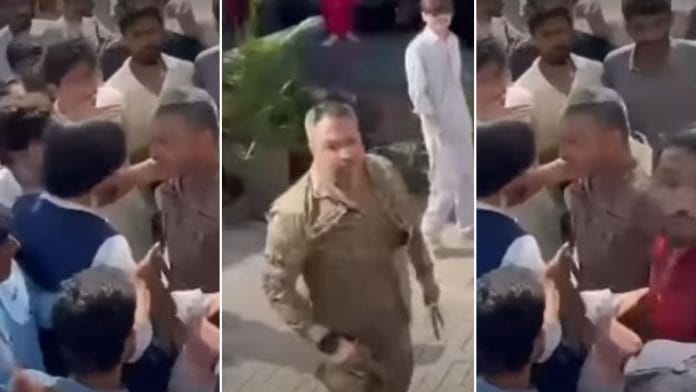

New Delhi: A Pakistan Army officer walked around in an Islamabad college campus brandishing his gun at protesting students. Pakistanis are calling it Army overreach, and demanding that the officer face strict action.
The incident took place at Sarhad University Monday amid student demonstrations over higher fees, departmental leadership, and a lack of regularly scheduled classes. According to accounts circulating online, Dr Aina, the university’s head of student affairs, who is married to Lt Col Asfandyar Wali, became involved in an argument with several protesters. She reportedly called her husband after what was described as misbehaviour by students.
Lt Col Wali allegedly arrived on campus in uniform carrying a firearm. The videos circulating on social media show him striking a student with a stick and hitting another. Students then appear to surround and slap him. The officer is subsequently seen opening fire, with reports saying that shots were fired into the air.
The episode has prompted sharply divided reactions in Pakistan, with most people questioning why an armed military officer was present at a university protest and whether he had any legal authority to use force against civilians. Others have portrayed him as a ‘Superman’ who intervened to protect his wife.
“The military has fired at us and, on top of that, they’ve filed a case against our HoD,” a student can be heard saying in a video. “We won’t let this military personnel leave the university until a senior military officer arrives here.”
Several analysts and journalists commented on the incident.
“When an institution starts acting above its stature, then its members too begin crawling everywhere like insects,” Pakistani analyst Ayesha Siddiqa wrote on X.
The officer, meanwhile, has been placed in custody and an inquiry has been ordered, with the military indicating that disciplinary action would follow if he was found to have violated military rules.
Prominent Pakistani journalist Hamid Mir described the episode as an “unpleasant incident” at an Islamabad university.
Journalist Asad Ali Toor raised questions about the officer’s presence on campus and his use of force.
“What (is) an armed forces officer in uniform doing at a university gathering and under what law/authority he can slap students? Can he carry his gun, point on students and fire gunshots?” he asked.
Journalist Syed Zeeshan Aziz had a similar question: “Is this how it is now that we have to fire at civilians?”
Also read: Who is new Pakistan Idol Hina Qaiser? The mother of three who had to take permission to sing
‘He fought valiantly’
Not everyone views the officer’s actions as an abuse of authority. Some cast him as a husband who had acted to defend his wife’s honour.
“Lt Col Asfandyar Wali is greater than Superman. What Superman does in films, he does in real life. Every person should protect their family just as he does,” X user Zardan Sangzi wrote.
According to X user Aziz Khan, arresting the officer was the wrong response. He wrote that “arresting a courageous officer who fought valiantly against Fitna ul Khwaraj ul Hindustan alone sets a poor precedent” and said the officer should instead be honoured with a Tamgha-e-Shujaat (Medal of Bravery). ‘Fitna Al Hindustan’ is a term used by the Pakistan military for insurgents in Balochistan. Islamabad alleges that these groups operate under Indian direction.
The controversy has also raised a broader question about accountability for powerful figures in Pakistan’s military establishment.
UK-based activist Maaz Malik wrote that the more important question was not simply what sentence the officer might receive, but what would happen after that sentence. Pakistan, he argued, has previously seen cases in which powerful military figures escaped or ultimately avoided the full consequences of punishment faced by ordinary citizens.
He cited the case of Gen Pervez Musharraf, who was convicted of high treason and sentenced to death but never served the sentence. He also cited Lt Gen Javed Iqbal, who was sentenced by a military court to 14 years but whose sentence was later reduced by seven years, allowing him to be released after serving the reduced term.
“The question is not simply whether an officer is arrested or sentenced,” Malik wrote. “Will there be genuine, consistent accountability until the very end regardless of rank, influence or institutional connections?”
(Edited by Prasanna Bachchhav)