



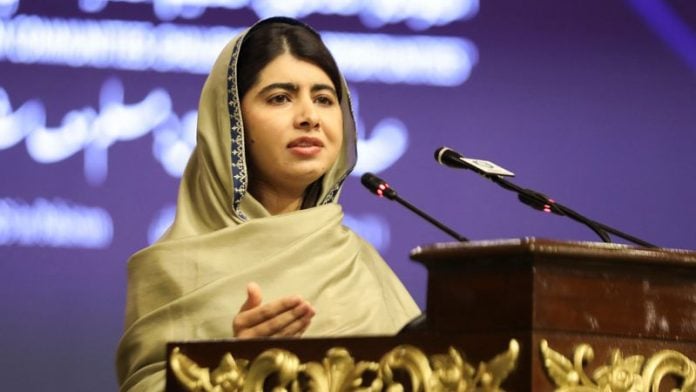
New Delhi: Nobel Prize winner Malala Yousafzai is now being labelled a ‘charity grifter’ on X. An Afghan investigative journalist decided to look into how many schools the Malala Fund had sponsored in Afghanistan, and the numbers did not look good, with the journalist claiming there were none.
Ironically, even as the two countries remain locked in conflict along their border, Pakistanis and Afghans on X found common ground in their anger over whether Malala was a ‘fraudster’.
The allegations were raised by Zarlashta Daisy Watanmal, an Afghan-German investigative journalist and academic, and influencer Nancy Sidley.
Both questioned the organisation’s public financial disclosures, particularly its ‘Afghanistan Initiative’, the allocation of educational grants, executive compensation, and the relationship between its revenue and expenditure.
Watanmal, in an X post on Tuesday, questioned the Malala Fund’s Afghanistan Initiative, alleging that publicly available financial information did not clearly establish how much funding had been transferred directly to organisations operating inside Afghanistan.
“My initial finding about @MalalaFund: It’s reported that over 10 million $ were awarded by Malala Fund to 57 organisations, majority going to its Afghanistan Initiative. A massive red flag & FRAUD. She spent zero on any Afghanistan-based org nor has she ever been to Afghanistan,” she wrote on X.
Watanmal subsequently said she intended to investigate the matter further. In another post, she wrote:
“We won’t let you walk away @Malala with the millions you raised in the name of Afghan women and girls. We will hold you accountable and I will investigate this fully. I can see zero spending in Afghanistan. Where are your ghost schools and organisations you funded in [Afghanistan]?”
She also claimed to have received hundreds of messages from Afghan women and girls in the country following the emergence of the allegations.
“I’m receiving hundreds of messages since yesterday from Afghan women & girls in Afghanistan. They’re all shocked that @Malala & her father @ZiauddinY made millions under their name while they have no clue nor received a penny. Shame they made millions in our Afghan women’s name,” Watanmal added.
The allegations have intensified debate over whether international organisations supporting education in politically restricted environments should be expected to maintain a direct physical presence in the countries they serve, or whether funding through regional and international partners can constitute meaningful assistance.
Defenders of international nonprofit organisations point out that restrictions imposed by the Taliban authorities in Afghanistan can complicate the delivery of grants and educational services. Under such circumstances, organisations may work through partners operating from neighbouring countries or through external institutions supporting activities inside Afghanistan.
The absence of a directly registered or physically based recipient organisation does not, by itself, establish that no educational assistance has reached people in the country. Conversely, the existence of an international programme does not, on its own, establish that its intended beneficiaries have received the promised assistance.
Financial disclosures, executive pay under scrutiny
Sidley, an influencer who said she had reviewed the Malala Fund’s 2024-2025 financial reports, drew attention to a reported difference between the organisation’s annual revenue and expenditure.
According to figures cited by her, the fund recorded approximately $16.48 million in revenue and $23.34 million in total expenses during the reporting period. Its reported net assets stood at approximately $42.97 million, commonly rounded to $43 million.
The difference between reported revenue and expenses was approximately $6.86 million, indicating that the organisation spent more during the year than it received in revenue.
The financial discussion has also focused on the allocation of expenditure across three broad categories: programme services and grants, administration, and fundraising. The reported breakdown puts approximately 82 per cent towards programme services and grants, 10 per cent towards administration, and 8 per cent towards fundraising.
Under this breakdown, the overwhelming majority of spending is classified as supporting the organisation’s programmes and educational initiatives, while administrative and fundraising expenses together account for approximately 18 per cent.
The discussion has also centred on compensation paid to senior personnel and the costs associated with executive travel.
Figures circulated by Sidley and other social media users put the chief executive’s compensation at nearly $372,000, that of a chief adviser at approximately $320,000, and that of the chief operating officer at nearly $241,000.
Amid the heated social media debate, other users pointed to references to first-class or private travel for officers in the financial reporting. They argued that such expenses warranted scrutiny when an organisation raises money in the name of girls who face severe barriers to education.
The Malala Fund is registered in the United States as a public charity based in Washington, DC. The American entity holds the organisation’s principal financial assets and governs its global operations.
The organisation also operates through international affiliates and regional structures, including Malala Fund UK, which is registered with the UK Charity Commission, and a registered international nongovernmental organisation (INGO) branch in Pakistan.
Malala’s public role draws political criticism
The controversy has expanded beyond accounting questions into wider disputes over Malala Yousafzai’s public role, the politics of international advocacy, and the use of humanitarian causes in geopolitical messaging.
Ahmad F Samin, a former academic adviser to the World Bank, accused the activist of profiting from the suffering of Afghans.
“While she can’t find Afghanistan on a world map, she has received millions of dollars in the name of the innocent people of Afghanistan. She is not alone; the majority of conflict profiteers have turned the pain and suffering of victims of war into a lucrative business,” he wrote.
Other Afghans also joined the debate. Afghan taekwondo player and women’s rights activist Marzieh Hamidi wrote on X:
“The struggle for Afghanistani women’s rights is much bigger than any one individual. Afghanistani women themselves, alongside countless activists and organizations, have been fighting this battle for decades. Their voices, sacrifices, and achievements must not be overshadowed. Anyone claiming to represent their cause must be held to the highest standards of transparency, accountability, and integrity!”
A Pakistani account, FrameTheGlobe, made a separate political allegation about the origins and purpose of Malala’s public profile.
“Malala’s genuine life-changing event was turned into a Hillary Clinton sponsored influence campaign. A common practice to exercise American soft power in the region,” the account alleged.
Pakistani academic Fareeha Zaheer described Malala as a “native informant”, arguing that her public narrative had helped her gain prominence in the West.
“I knew Malala was a ‘Native Informant’, a girl using her marginalized position to gain fame/ position/status in Global North. Her narrative of oppression perfectly suited the global capitalist Postcolonial Narrative,” Zaheer wrote on X.
French journalist, political analyst and commentator Catherine Perez-Shakdam responded to Watanmal’s allegations by questioning their implications and calling for accountability if they were substantiated.
“My goodness! Did she actually? Can someone enlighten me on this because it is criminal. Women and girls in Afghanistan deserve a lot better than crooks interested in making a few $$$ on their back. If this is true @Malala is condemning millions of innocent women and girls!” she wrote.
The debate also spawned memes. One Pakistani X user shared an image from Mughal-e-Azam with the caption: “Utho Anarkali, goron ko Malala Fund ka fraud pata chal gaya hai (Wake up, Anarkali, the white people have found out about the Malala Fund fraud).”
(Edited by Prashant Dixit)
Also Read: What is Pakistani defence minister saying about Marilyn Monroe in his post?