





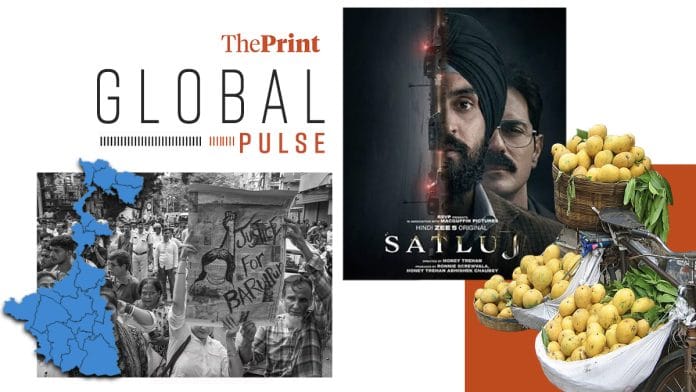


New Delhi: Japan has banned imports of fresh Indian mangoes, putting the world’s largest mango producer under scrutiny over food safety and health concerns. The Economist explores how poor-quality exports are costing India financially and damaging its global reputation.
“India flunks a lot of such (pest-control) tests. Its spices, seafood and rice all face restrictions, bans and extra inspections in America, Europe and Asia. The EU has issued 365 alerts against various Indian food products in the past two years,” the column notes.
Japan banned Indian mangoes after they failed its pest control checks.
“The problem begins on farms, where runaway pesticide use and banned chemicals are common and good pest control is not. Corruption and lax monitoring mean that pesticides, drug residues and microbial bugs like salmonella then travel smoothly up the supply chain.”
This, the column notes, is not only bad for business, but also hurts India’s reputation. A single cargo container of spices can easily cost $100,000, and a rejection personally costs the producer, The Economist says.
However, Indian consumers are probably bearing the brunt of graft and government laxity.
“Almost one in five samples that the Food Safety and Standards Authority of India tested in 2024-25 failed. One recent raid in Gujarat unearthed a stockpile of worm-eaten and fungus-infected mangoes destined for juice. Artificial ripening—a banned but common chemical trick—can cause organ failure. Other things can kill over decades: the bigger the amount of certain pesticides you consume, the greater the risk of cancer,” it notes.
The BBC reports on the rape and murder of an 11-year-old girl in West Bengal, a case that has shaken the newly elected BJP government in the state.
“The incident in Surjyapur village in Baruipur, on the outskirts of Kolkata, has triggered days of violent protests, a mob lynching of an innocent man and the police killing of one of the suspects. Three other men who have been arrested remain in custody,” notes the report.
The Opposition is accusing the BJP of “failing” to protect women in the state. The report cites analysts as saying that protection of women was a major electoral plank for the BJP in this year’s assembly elections.
“Family members of the girl said they last saw her on Saturday afternoon when she went out to buy a birthday gift for a friend. When she didn’t return home, they went to the police station at around 20:30 to seek help in finding her. The family and villagers alleged that the police did not take their pleas seriously and said they would look into it the next day,” the report says.
When family members checked the CCTV footage themselves at nearby shops, they “spotted her walking with Prakash Mondal”, a local who has since been killed in a police encounter.
“In a statement on Wednesday morning, Baruipur police said Mondal had been taken to the pond to recreate the crime scene as part of the investigation, but he attempted to snatch the weapon from a policeman and opened fire at them.”
The police retaliated and fired back, the report adds.
“The recovery of the body saw anger pour out onto the streets, with a mob vandalising roads, shops and a local railway station. A young man was beaten to death by the crowd—Chief Minister Suvendu Adhikari has since said he was innocent,” it notes.
“The unrest poses a huge challenge for the BJP, which swept to power in West Bengal for the first time ever in May, campaigning heavily on the issue of making the state safe for women,” it adds.
The New York Times reports on growing censorship of films in India, and how it is affecting filmmakers.
The report cites the case of Satluj, a film that has been awaiting clearance from India’s censor board for the past four years.
“Starring Diljit Dosanjh in the lead role, “Satluj” focuses on police abuses in the 1980s and ’90s, one of the most violent periods of independent India when an insurgency was roiling Punjab State. As the country’s Central Board of Film Certification presented an ever-growing list of demands for cuts and changes, the makers went to court. When that proved futile, they gave up on a theatrical release and put the film online last Friday, which does not require the board’s approval,” it says.
The film focuses on the life of rights activist Jaswant Singh Khalra, who documented police abuses in Punjab in the 1990s under the Congress government, and who was abducted and killed by police officers.
Within 48 hours, the streaming platform Zee5 took it down with a vague message that said that “in light of current developments”, the film would not be available to be viewed in India.
“The government has not released an official statement, but officials told local news agencies that they had ordered the film be taken down on security grounds and because it could be used by what they called ‘anti-India forces’,” the report notes.
“Since the film’s takedown on Sunday, it has taken on a life of its own. Bootleg copies are circulating online, and villages and temples in Punjab have hosted public screenings.”
The NYT report adds that this is only the latest example of what filmmakers say is a deeply entrenched state of censorship under Prime Minister Narendra Modi, “where making art that strays from official narratives has become extremely taxing”.
According to the report, the BJP has rewarded “art that promotes its ideology”.
“Films like “The Kashmir Files” have selectively drawn on painful episodes of Indian history, leading some critics to label them propaganda for the Hindu nationalist government. They were cleared by censors and endorsed by officials—including receiving public support from Mr Modi and tax breaks by many states run by his ruling party.”
“In recent years, that type of film has dominated mainstream Indian cinema: high-pitched, gory violence that often combines nationalistic fervor and religious chauvinism,” says the report.
(Edited by Nida Fatima Siddiqui)