





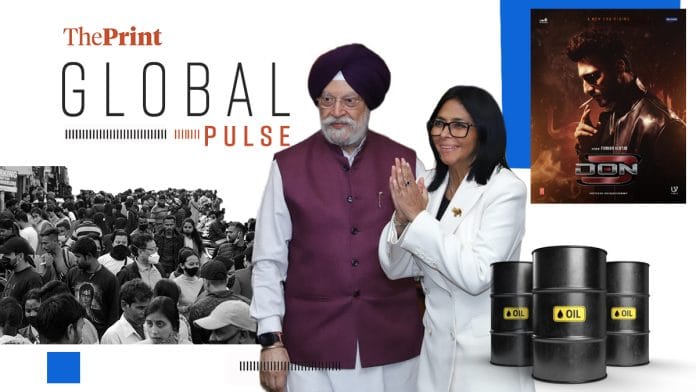


New Delhi: Venezuelan acting president Delcy Rodríguez’s visit to India comes at a pivotal moment, prompting speculation in global media about whether it could signal a revival of oil ties between the two countries.
“India, the world’s third-largest importer of oil, has sharply increased purchases of Venezuelan crude in recent months, turning the South American producer into an increasingly useful supplier just as the Iran war has choked energy flows from the Gulf,” Soutik Biswas reports for the BBC.
India, as the report points out, relies on imports for nearly 90 percent of its oil needs, with around half of its crude supplies transiting through the Strait of Hormuz, the strategic Gulf passage that has been disrupted amid the West Asia conflict. This has pushed India to look elsewhere, and Venezuela looks to be a viable alternative.
“Venezuela was India’s fifth-largest source of crude oil imports in May, supplying about 2,66,000 barrels a day, or roughly 5.3 percent of India’s total crude imports, according to maritime analytics firm Kpler. Only Russia, the UAE, Saudi Arabia and Brazil supplied more,” Biswas reports.
After enduring Trump’s sanctions against buyers of Venezuelan crude, Indian refiners resumed imports in February following a sanctions-easing agreement between Washington and Caracas, the report adds.
Following this, India, according to Kpler data cited by Biswas, brought in close to 2,80,000 barrels a day of Venezuelan crude in April and May, the first cargo after a nine-month hiatus; June arrivals are expected to rise to above 3,00,000 barrels a day.
“Relatively cheaper to buy but challenging to refine, Venezuelan crude is a heavy, sulphur-rich oil. India’s sophisticated refineries are among the few that can process it efficiently into fuels such as diesel and jet fuel. The renewed interest marks a partial return to an earlier relationship.”
Before US sanctions brought imports to a halt in 2019, Venezuela was among India’s top oil suppliers, delivering nearly 16 million tonnes of crude annually and driving bilateral trade to about 6.4 billion dollars, largely through oil exports, the report highlights.
The Economist writes that “India’s population will soon be falling—probably quite fast.” Dropping fertility rates are quickly becoming a topic of concern in the most populous country in the world.
“In 1950, India’s population was 360 m. The average woman had six children—roughly the same as an American woman a century earlier. But its total fertility rate (TFR), the number of births a typical woman has over her lifetime, has fallen to 1.9, below the level needed to keep the population stable in the long run.”
The rich world and many middle-income countries have been worrying about declining fertility, shrinking workforces and impending or intensifying fall in population. Now India, once associated with the phenomenon of a “population explosion” may be joining the same club.
“New school textbooks, to be published this summer, will warn of the perils of too few, rather than too many, children. In May, Chandrababu Naidu, the chief minister of Andhra Pradesh, a southern state of about 55 m, announced a 30,000 rupee ($315) payout for couples who have a third child,” the column adds.
In both Tamil Nadu, a state of roughly 77 million, and West Bengal (100 million), the fertility rate stands at 1.3, the same as in Finland. The average for urban India is 1.5.
“Some might see a shrinking population as a blessing. After all, India’s infrastructure often seems inadequate: Think of commuters cramming themselves into Mumbai’s local trains, for instance. Yet the prospect of an India with fewer children is not an entirely comforting one, either. It would get old before it gets rich, making for a difficult demographic transition. The effects would ripple through its society, its economy and its politics.”
Indian film union has dropped boycott calls against Ranveer Singh over exit from ‘Don 3’. Nikita Yadav of the BBC reports.
The Federation of Western India Cine Employees (FWICE) issued an informal ban last month after producers of Don 3 complained that Singh had quit the film just weeks before filming was to begin.
“The boycott withdrawal comes after Singh reportedly sent a legal notice to the federation. On Wednesday, FWICE president B. N. Tiwari backed Singh, saying the industry stood behind him and that the federation’s legal team would respond to the notice,” Yadav reports.
The dispute had begun after ‘Don 3’s producer Farhan Akhtar complained that Singh had quit ‘Don 3’ just weeks before overseas shooting was due to begin, after producers had already spent about Rs 450 million on pre-production, the report says.
Following the complaint, the union on 25 May asked its members not to work with Singh until he explained his position.
Taran Dugal of The New Yorker writes about the life and works of Raghu Rai, India’s veteran photojournalist who died last month.
One of Rai’s most consequential works was his coverage of the aftermath of the Bhopal gas tragedy. “Amid the chaos, Rai found a father burying his infant child, no more than a year or two old, in the shallow dirt. Rai approached with his camera, bent down, and snapped a closeup shot of the corpse, half covered in soil. The child’s eyes were swollen and milky, their mouth agape in a silent moan. At the top of the frame is the father’s veiny hand, tenderly brushing rubble away from the infant’s forehead.” The picture was titled ‘Burial of an Unknown Child’.
Rai journeyed through different publications while his photographs marked the most defining moments in his career. He began his career with Hindustan Times, and a few publications later, joined India Today. “Rai worked at India Today for about ten years, shooting luminaries such as Mother Teresa, director Satyajit Ray, and the Dalai Lama, who remained a friend for decades,” Dugal writes.
“Eventually, he set out as a freelancer, embarking on trips from the snowy Himalayan territory of Ladakh, on India’s northern border, to Kanyakumari, the coastal town at the southern tip of the subcontinent. As India took its place on the world stage, developing nuclear capabilities and harnessing its exploding population, as it lost one Prime Minister to a heart attack and the next to assassination, as it suffered bout after bout of sectarian violence, Rai was there.”
As he writes, Rai’s lens shaped how a maturing nation came to view itself.
(Edited by Viny Mishra)