





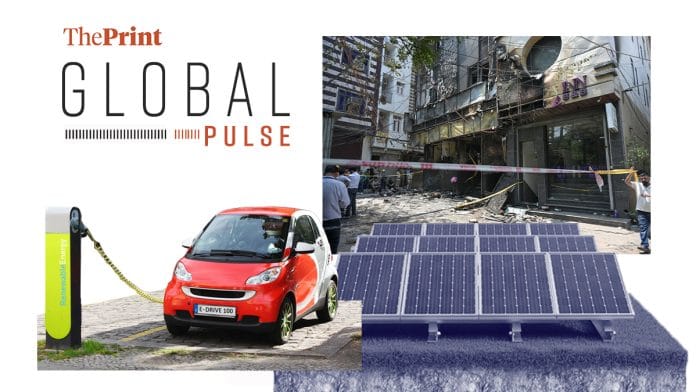


Rescue and relief personnel said that 26 people were rescued and survivors were sent to nearby hospitals while the fire was extinguished. “Speaking at a news conference, a doctor treating the injured said that eight had been put on ventilators. As of Wednesday evening, the cause of the fire was unknown; the city police and local government have opened investigations.”
The B&B generally provided affordable stays to the families of patients in the nearby private hospitals. “There are several private hospitals on major streets around the tightly packed neighborhood, and many of their patients come from other countries. Afghans, other Central Asians and Africans sometimes travel to India for affordable treatments unavailable at home,” the report says.
As Travelli and Kumar write, the Flourish Stay B&B is in Hauz Rani, historically a Muslim village, that is surrounded by Delhi’s urban sprawl. Its narrow lanes are overhung with electrical and internet wires, and packed with pharmacies and other businesses.
Such incidents are becoming more frequent. “A series of accidents earlier this year called attention to unsafe housing conditions in India’s capital. On May 30, a building collapsed less than a mile away from Wednesday’s fire, killing six people. Two other fires last month killed nine people in eastern Delhi and destroyed much of a furniture market in a northeastern part of the city,” the report highlights.
Simon Mundy of Financial Times reports on the renewable energy and the battery sector development, and how it could alter India’s coal power landscape.
“Near the edge of a sun-baked salt marsh in northern Gujarat, a vast new battery array highlights a tantalising opportunity for India and the global climate: to slow, or even reverse, the country’s rising demand for coal-fired power,” Mundy writes.
Adani Green Energy, a part of the Adani Group, is driving this boom. The company is developing a giant solar and wind park that already has more than nine gigawatts of installed capacity, the report says.
“By 2029, the company says, that will rise to 30GW—roughly two-thirds of Great Britain’s peak power demand—making this by far the biggest renewable facility in the world.”
However, as the report points out, despite making big leaps in the renewable energy sector, coal-powered energy remains the “backbone” of India. It is even projected to expand further in the years to come, the report notes.
“Last week, an Adani Green Energy announcement underscored that India now has a different path available to it. The company said it had brought into operation a battery system at the Gujarat plant with a capacity of 3.37 gigawatt-hours—enough to power the state of Goa for a whole day, and bigger than any such installation outside China, it claimed.”
This capacity, the report says, is far higher than the current battery storage India has been able to achieve: 1.1 gigawatt-hours, according to the research group Mercom.
The investment, the report argues, reflects a technology shift with important implications for the global energy transition. “Over the past two years, dramatic declines in battery prices have meant that renewable power plants, paired with storage systems, can now provide round-the-clock ‘baseload’ power at a cost competitive with fossil-fuelled plants.”
Batteries are gaining prominence for multiple reasons, and the BBC points to another one: electric vehicles (EVs). While the adoption of EVs has been slow in the Indian market, Nikhil Inamdar says it is picking up.
“Are electric vehicles finally going mainstream in India? A slew of indicators suggests the transition may finally be gathering momentum,” he writes.
The market for electric cars has expanded by 25 percent in the year ending March 2026. EVs crossed the important 5 percent threshold in India’s passenger vehicle market earlier this year—a figure often seen as a tipping point for mass-market adoption, the report says.
“Adoption is accelerating particularly in larger cars priced above one million rupees ($10,481; £7,777), where one in every 10 vehicles sold is now electric. Electric three-wheelers and motorbikes already account for more than 30% and 15% of sales in their respective categories.”
Electric vehicles have also received a renewed boost since the Iran war which drove up the costs of petrol and diesel in India.
“But beyond these immediate triggers, several longer-term factors are also driving buyer interest, most notably upcoming regulatory norms, known as CAFE-3, which are scheduled to come into force from April next year and run until March 2032,” Inamdar notes.
The draft rules seek to reduce carbon emissions in cars from 113 to 76g/km by 2032—a 33 percent drop, he highlights.
“Individual city-states like Delhi—one of the country’s most polluted hotspots—have also recently released ambitious draft policies that propose to phase out conventional internal combustion engines and halt registrations of new ICE two and three wheelers by 2027,” he writes.
(Edited by Tony Rai)
Also Read: A ‘new chapter’ in India-Myanmar ties & the ‘structural constraints’ to India’s sovereign AI push