



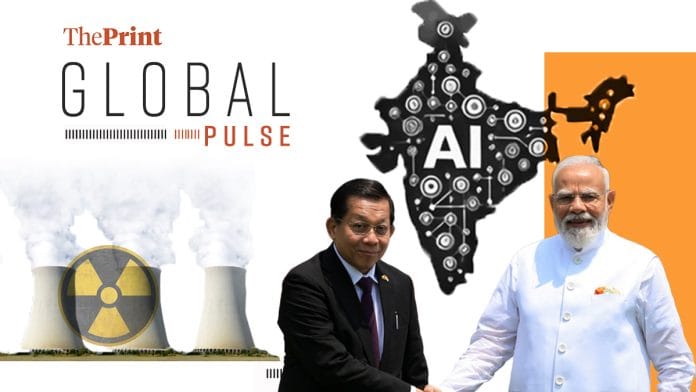

New Delhi: Myanmar President Min Aung Hlaing concludes his five-day trip to India Wednesday, first state visit since taking office in April this year. He also held talks with Prime Minister Narendra Modi this week. The visit is significant for India-Myanmar ties, especially in the context of the military coup that Hlaing led five years ago as then junta chief, overthrowing Aung San Suu Kyi’s elected government in 2021.
“Myanmar and India share a 1,643 km (1,021-mile) border and developments on one side often have consequences for the other, particularly in India’s north-eastern region, where security, migration and cross-border trade is closely intertwined with events in the neighbouring country,” writes.Abhishek Dey in a BBC report.
The talks this week broadly focused on areas of trade, connectivity, border security and defence. The coup is in the past, and “ensuring peace” is India’s message and hope for Myanmar, the report says.
Indian Foreign Secretary Vikram Misri said that New Delhi supports enduring peace and inclusive process involving “all stakeholders in Myanmar”, arguing that sustained dialogue over disengagement offered the best chance of progress.
Experts tell BBC that Myanmar’s relative isolation following the coup makes the visit all the more important. “For India, the visit reflects a long-standing view that strategic interests in Myanmar outweigh concerns about the nature of the government in Nay Pyi Taw,” Dey writes.
Myanmar also plays a key role in India’s regional strategy as it is the only member of the ASEAN group that shares a land border with India, the report adds. “Analysts also pointed to Myanmar’s importance in the wider strategic competition between India and China. The country provides China with a route to the Bay of Bengal, reducing Beijing’s dependence on the Strait of Malacca for some trade and energy supplies.”
An editorial in The Global New Light of Myanmar, the country’s state-run newspaper, also commented on Hlaing’s visit.
Citing India’s economic importance for Myanmar, it highlights how India is Myanmar’s fourth-largest export destination and its sixth-largest import source. At present, India has 39 investment projects in Myanmar, with a total investment of 782.385 million dollars, making it the 11th-largest investor in the country.
“The shared religious and historical ties, along with mutual respect and trust, constitute a strong foundation for the cultural and economic cooperation between the two countries. Furthermore, diplomatic relations between the two countries have already crossed the diamond jubilee milestone and are now in their 78th year,” it reads.
As the column further notes, investors from India are engaged in Myanmar’s industrial, oil and natural gas, transport and communications, services, agriculture, livestock, and fisheries sectors. “India is a global leader in pharmaceutical manufacturing and supplies around 60 percent of Myanmar’s pharmaceutical needs through imports. MSME enterprises are a driving force of Myanmar’s economy, and Myanmar also highly recognises India’s vocational skills and technological advancements.”
Looking at Myanmar’s evolving role with respect to India-China ties, it says that Myanmar is a “kind of land bridge” connecting India’s growth prospects with ASEAN and China.
“Both countries must work together to achieve a long-term win-win outcome that benefits both sides. By effectively combining India’s advanced technology and capital with Myanmar’s rich natural resources, strategic location, central positioning, and young labour force, efforts should be made to encourage investment in value-added production and service sectors within Myanmar,” it adds.
Meanwhile, a Bloomberg report asserts that despite the mega investment push, India’s sovereign AI ambitions are faced with multiple challenges.
“India’s ambition to build and export a sovereign AI template across the world is colliding with structural constraints: years of underinvestment in compute capacity, a late start in building the most advanced AI models, deep reliance on foreign cloud providers and a venture capital culture wary of the vast, risky bets that define the global AI race,” writes Saritha Rai, adding that technological prestige is at stake.
With US and China transforming AI into a form of “geopolitical power—controlling chips, cloud access and the models themselves”—countries like India run the risk of dependence on “systems they do not own and may not always be able to control”.
India is becoming, Rai further writes, a test-case if a middle-power country can build its own AI. “Its successes—or failures—could offer a blueprint for much of the Global South, where governments face similar trade-offs between technological independence and reliance on foreign platforms.”
While the US already has tech giants pouring in billions to develop and advance AI models, China has built a “state-influenced” AI ecosystem of chips, applications, and cloud. The latter is also rolling out and exporting these low-cost models as far as Africa, the report notes.
“India is attempting something more complex: carving out a third path, building an indigenous ecosystem spanning public computing infrastructure, homegrown multilingual models and applications,” it argues. “India may have the talent and the ambition, but does not yet have the ecosystem to finance them at scale.”
Away from the world of AI, Chris Kay and Krishn Kaushik of Financial Times report on India’s preparations to open up nuclear power to the private sector. Among the firms seeking approval to build nuclear power plants are Tata Power and the Adani Group.
While the country majorly depends on coal, it “wants to bolster its supply of uninterrupted low-carbon power, with an eye towards nuclear”.
The move comes at a time when the West Asia conflict has globally triggered energy crises, pushing countries to revive nuclear power push. However, India’s push predates the war.
“Last year, Parliament passed legislation paving the way for greater private participation in the sector. Although India’s first nuclear reactor became operational in 1956, the government had maintained a tight grip and monopoly on the industry,” the report notes.
Modi has set a long-term goal of reaching 100GW of capacity—up from 8.8GW now—by 2047, the centenary of India’s independence, FT highlights. “Despite Parliament approving the new nuclear power law, final rules are still being drafted, including potentially sensitive changes aimed at easing project development.”
(Edited by Mannat Chugh)
Also Read: Allegations of India flattering growth figures unfounded; and Gautam Adani, the escape artist