





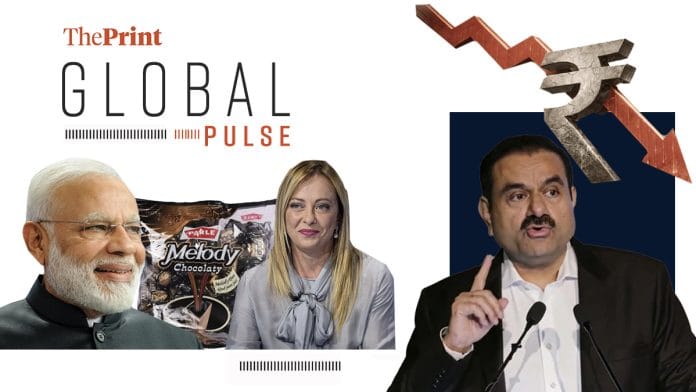


New Delhi: Prime Minister Narendra Modi is in Italy, and the internet is abuzz with memes since he gifted Melody chocolates to Italian PM Giorgia Meloni. However, it is also a diplomatic visit on the last leg of Modi’s five-nation tour, which started with the United Arab Emirates.
Modi’s visit to Italy has helped improve bilateral relations, writes Antonio Armellini, in Corriere della Sera, an Italian daily.
Armellini writes the marines’ affair, where Italian marines were accused of killing Indian fishermen off Kerala’s coast, found a difficult resolution, which “safeguarded the interests and dignity of both sides”. The Finmeccanica-Westland issue—a 2013 scandal where the Italian aerospace giant was accused of bribing Indian officials to secure a contract for AgustaWestland helicopters—was also resolved. Defence cooperation is now being vigorously resumed.
The author attributes the uneasy relations between the two countries during the UPA era to opposition political parties weaponising Sonia Gandhi’s “Italianness”. During the height of the scandals, any attempt by the ruling Congress to find a diplomatic compromise with Italy was immediately labelled as a corrupt “fix” engineered to favour her home country.
Circling back to the current times, Armellini emphasises the “similar” political trajectory of Modi and Meloni. He says that both come from far-right movements and have made a gradual shift to a more “moderate” ideological standpoint. Regardless of assessments of their individual political careers, the two leaders command heavy fanfare in their countries. “Meloni can interpret Modi’s thinking and priorities better than any of her European competitors, and Modi, for his part, can do the same with our Prime Minister,” the column adds.
While everything is “in place” to take Italy’s relationship with India to the “next level”, the column says challenges posed by India’s “bloated and inefficient bureaucracy and market fragmentation” remain.
Meanwhile, Subhadip Sircar and Malavika Kaur Makol of Bloomberg report on the plummeting rupee.
Rajeev De Mello, global macro portfolio manager at Gamma Asset, told Bloomberg that the rupee hitting the 100 mark was an “important psychological threshold that investors will increasingly focus on”. “The rupee was already under pressure before the Middle East conflict began, weighed down by widening external balances and foreign fund outflows. The oil shock has since compounded the pressures, stoking speculation over how far the currency could fall,” the report notes.
Bank economists are revising their forecasts as pressure on the rupee mounts. Kotak Mahindra Bank now sees the currency trading between 93 and 99 per dollar. Australia and New Zealand Banking Group now expects the rupee to weaken to 97.5 by year-end—a change from its earlier forecast of 93. HSBC Holdings Plc has lowered its target to 95.5 from 93.5.
“Investors are also watching how aggressively the Reserve Bank of India would respond if the currency nears 100. While the authority has said it seeks to smooth volatility rather than defend a specific level, some investors say a rapid slide could prompt heavier intervention.”
Meanwhile, Cherylann Mollan of the BBC reports on Gautam Adani’s criminal fraud charges.
“The US Department of Justice dropped criminal fraud charges against Indian billionaire Gautam Adani and some officials of his firm, days after he agreed to settle a separate civil case,” according to the report.
This comes after “the US Securities and Exchange Commission moved to drop fraud charges against Adani and his nephew Sagar in a separate civil case after they agreed to pay a combined settlement of $18 million”. The civil case was reportedly resolved last week.
Adani Enterprises also agreed to pay the US Treasury $275 million to settle another investigation into alleged Iran sanctions violations.
Sources told the BBC that all three cases against Adani and his associates have now been resolved.
(Edited by Madhurita Goswami)