





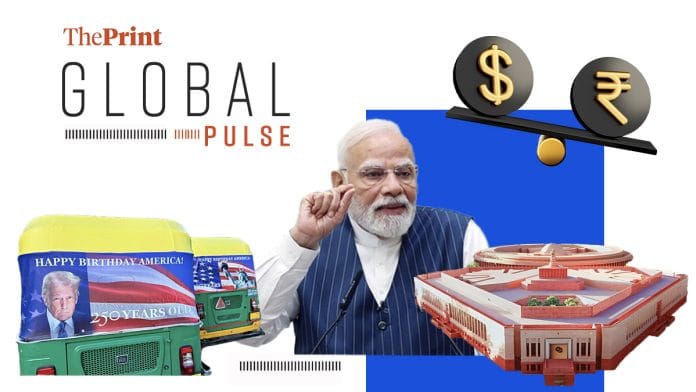

New Delhi: Prime Minister Narendra Modi’s appeal for austerity, urging Indians to cut back on foreign travel, gold purchases and fuel consumption, has continued to draw the attention of global media.
Writing in the Financial Times, Veena Venugopal says that Modi’s appeal for austerity amidst the West Asia war has disappointed his core voter base: the middle class. The PM’s framing of the economic strain as a “Covid-type” crisis has landed badly—particularly because, Venugopal notes, “he waited until the elections were safely won before announcing this stream of appeals”.
Speaking in Amsterdam Saturday, Modi warned that the decade risks becoming “one of the disasters for the world” and would push a large section of the global population into poverty. “There is very little doubt that Indians will form a significant part of that number,” Venugopal writes.
The rupee has been one of the worst-performing currencies, pushing up the costs of education abroad, foreign business travel and leisure trips—all concerns that weigh heavily on the salaried middle class.
Venugopal reports that from social media platforms to drawing-room conversations, there is now “considerable anxiety” and anger within this demographic—and that this is the first time such friction has surfaced in Modi’s political career.
A viral report claiming the government was planning a tax on foreign travel triggered much anger before Modi, through his own X account, stepped in to dismiss it as “totally false”.
But Venugopal is measured on the durability of this rupture.
“This is arguably the first time in Modi’s career that he is facing the prospect of sustained friction from this demographic. The question is how long it will last. Much depends on the Middle East. If the conflict ends quickly, and the economic anxieties are calmed, all of this will be forgotten by the time the next general elections come round in 2029. If not, all bets are off,” she writes.
A new report from Carnegie Endowment for International Peace takes a data-driven look at India’s delimitation question—and arrives at conclusions that complicate both the government’s position and the Opposition’s.
Written by Louise Tillin, Milan Vaishnav and Andy Robaina, the report opens with: “Since the most recent reapportionment of parliamentary seats between states in 1971, India’s population has surged by nearly 1 billion, yet its political map has remained unchanged.”
It goes on to refer to the special parliamentary session called in mid-April this year, when the government’s attempt to pass the delimitation bill was thwarted by the Opposition.
This defeat, the report says, “only sharpened, rather than settled, the debate”.
The report broadly validates the Opposition’s concern that a purely population-based exercise would tilt representation northward. “If seats were reallocated in proportion to states’ populations, under a strict ‘one person, one vote’ standard, faster-growing, poorer northern states would likely gain representation, while slower-growing, richer southern states would see their relative influence decline.”
But, it argues, southern states are already over-represented in Parliament.
“As India’s population has tripled and state fertility rates have diverged, some states have become increasingly overrepresented, while others have become underrepresented,” the report notes.
For instance, Bihar’s population has grown roughly 215 percent since 1971; Kerala’s by just 70 percent. “The result is that Lok Sabha members from fast-growing northern states represent more people than their southern counterparts, diluting the political voice of northern voters,” it reads.
It goes on to point out that despite lower population growth, southern states contribute disproportionately to the national economy. The authors describe this as a “dual asymmetry”, which has “long underpinned an informal federal equilibrium”.
A population-based delimitation, they warn, would dismantle one side of that balance without addressing the other.
In another oddity from Lutyens’ Delhi, Alex Travelli of The New York Times reports on the city’s characteristic green-and-yellow autorickshaws displaying an unlikely face: that of US President Donald Trump.
Travelli notes that Trump’s portrait—printed on red, white and blue American flags—has been appearing on the backs of “dozens of three-wheeled, motorized rickshaws buzzing all over the Indian capital”, most of them in the Lutyens zone. The sticker reads: “Happy Birthday America, 250 years old!”
The campaign was launched by Sergio Gor, the US ambassador to India, who arrived at his post in January and has since, in Travelli’s telling, “established a flair for spectacle”.
Rolling out the campaign on social media, the US Embassy declared: “Freedom is on the move … literally!” Dozens, possibly hundreds, of vehicles have been decorated—some with Trump’s face, and the rest the Statue of Liberty.
One auto driver told Travelli he was paid Rs 1,500 to carry the sticker. He added a question that, for Travelli, crystallised the report’s central irony: those same autorickshaw drivers are enduring rising fuel costs driven in large part by the US’s war on Iran. The driver told Travelli that he respects Americans, and then asked: “Now, when will you stop this war?”
(Edited by Prerna Madan)
Also Read: ‘Fair’ delimitation could give Indian cities a big boost, writes global media