





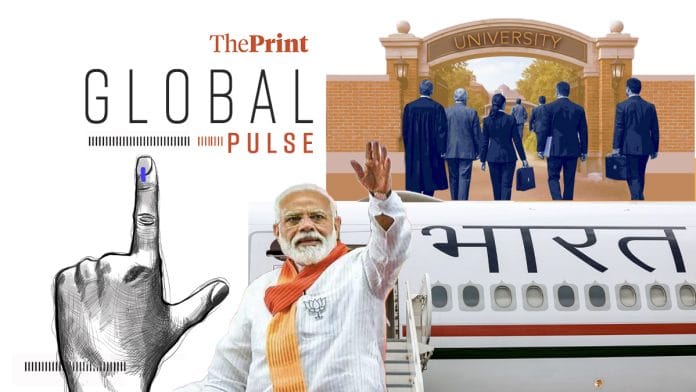


New Delhi: Prime Minister Narendra Modi has asked Indians not to buy gold for a year and to avoid foreign travel—a call that, writing in The New York Times, Alex Travelli said “landed like a thunderclap and underlined the severity of the economic crisis caused by the war in Iran”.
Speaking in Hyderabad Sunday, Modi also urged farmers to switch from diesel to solar-powered water pumps and asked white-collar workers to work from home, citing the need to conserve fuel supplies constrained by the blockade of the Strait of Hormuz.
Travelli noted that Modi’s tone represents a political pivot. Having secured two state election victories, the Prime Minister no longer faces the risk of rising fuel costs—and appears to have drawn on that latitude. “Instead of subsidising the losses and running huge budget deficits, India’s leader appears emboldened to ask its people to bear the burden,” the report noted.
But Modi was not the only leader to have asked citizens to make these “sacrifices”.
“The Philippines, Bangladesh and Sri Lanka, among others, have made similar requests and even demands of their citizens, since March. India, by contrast, has cushioned ordinary citizens from the full pain of the energy crunch by running higher deficits and piling losses onto the state-owned oil companies,” Travelli wrote.
The electoral potency of welfare spending, BBC’s Soutik Biswas wrote, is weakening even as the money keeps flowing.
Under a report headlined, ‘Why welfare isn’t winning elections in India like it used to’, Biswas examined the political logic behind the shift.
“Over the past decade, cash transfers, subsidised services and women-focused schemes have become the default grammar of state politics in India, with welfare increasingly used to soften the effects of a growth model that has struggled to generate enough jobs,” he wrote.
The shift, Biswas argued, has moved from welfare politics to competitive welfarism: “Parties now compete less over whether to offer welfare than over how much.”
Several incumbents known as “welfarist leaders” lost their seats in recent assembly elections, the report noted.
“Women have become central to this expanding welfare architecture–seen both as more reliable managers of household spending and as an increasingly decisive voting bloc whose turnout now often exceeds that of men,” the report read.
Biswas said it was a broader political coalition that parties build around welfare schemes that actually win them the elections.
But the fiscal exposure was considerable. State governments run over 2,000 cash transfer programmes, and spent nearly $18 billion on unconditional cash transfers in 2025-26, according to the Economic Survey.
“In some states, the transfers account for as much as half the monthly consumption expenditure of poorer rural households. For female casual labourers and self-employed women, they form a substantial share of income,” the report noted.
Biswas reported that there was a growing sentiment that valued infrastructure building over cash handouts.
“With salaries, pensions, subsidies and interest payments already consuming more than 60% of state revenues, every additional rupee spent on cash transfers risks crowding out capital investment–the kind economists associate with longer-term growth and employment,” he wrote.
India’s pricey private universities, a column in The Economist read, want to take on the Ivy League.
Referring to Ashoka, Ahmedabad, Shiv Nadar and OP Jindal universities, the column pointed to their aspirations to “put Indian higher education” on the map. The state of teaching and research were dire in the country, but the “posh private universities” were bent on changing that landscape. “They take inspiration from their famous American counterparts, including when it comes to costs: annual fees at some of them can rise above 1m rupees,” the column noted.
“Private universities offering liberal arts in India developed as a concept under Indian billionaires, who have come to see higher education as a cause worthy of their philanthropy,” it added.
Global trends were also working in their favour: “English-speaking countries that attract a lot of well-off Indian students have started narrowing the gates for foreigners.” Adding to it was US President Donald Trump’s crackdown on immigrants in American Universities, which was making it easier for Indian schools to attract and retain staff.
“Indian academics who are just completing their doctorates in America are becoming more open to moving home,” the column said.
But, it added, private universities in India remain under the government’s lens over “research and opinion”.
“In recent years academics who have fallen out with the government have been forced from posts in private universities, or prevented from taking them up. Young universities have much to lose from upsetting politicians. And irate officials are not beyond putting pressure on their rich founders, who have interests outside education to protect,” it said.
Also Read: IPL losing sheen? Global media looks at its ‘commercial run rate’ & seat-wise data from West Bengal
Not when the government fiddles with the education policy to suit their ideology!!