





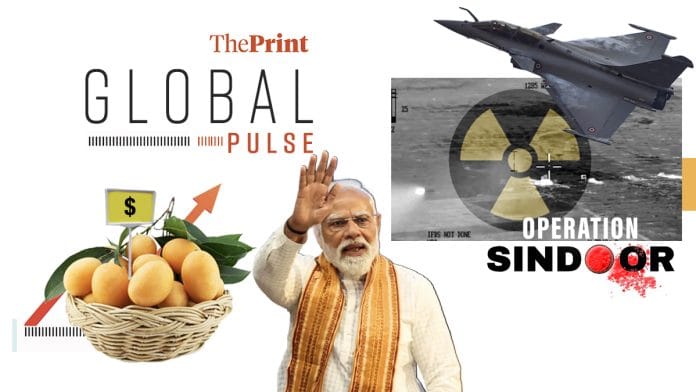


New Delhi: As Operation Sindoor marks one year, Elizabeth Threlkeld writes in Foreign Affairs that the next crisis between India and Pakistan would be “more dangerous, more destructive”, with risk of “inadvertent” nuclear use, if not deliberate.
She said that both sides have historically shown considerable caution in managing crises and avoiding uncontrolled escalation, but they climbed new rungs of the escalation ladder in the last conflict.
Following the ceasefire between the two countries, India and Pakistan spent the last year drawing lessons about how to inflict greater damage on each other in future conflicts, she writes.
“Both sides have concluded that the next major clash will turn on their ability to strike faster, farther, and in greater volume than they have in the past. They are putting those lessons into practice by acquiring new capabilities, expanding indigenous development programs, and enacting major structural reforms to improve the speed and coordination of their forces,” she adds.
If and when it comes, the next crisis between India and Pakistan is likely to prove more dangerous, more destructive, and more difficult for Washington to manage, she writes.
The column notes that soon after the conflict ended last May, Prime Minister Narendra Modi announced a “new normal” where India would “strike precisely and decisively” and “not tolerate any nuclear blackmail”.
“Yet despite their confidence and bluster, the continued risk of escalation in a region home to a quarter of the world’s population should not be underestimated,” she writes.
“Even if precision-strike warfare makes the deliberate use of nuclear weapons less likely than in a ground combat scenario, the introduction of novel systems, targets, and domains increases the risk of inadvertent nuclear use,” the column adds.
Also Read: West Bengal win a boost for ‘expansionist Hindu-first politics’ of Modi’s BJP, writes global media
‘One-leader country’
Alex Travelli, Hari Kumar, and Pragati K.B. of The New York Times write on the just-concluded state elections in four Indian states and a Union territory. The BJP retained Assam and Puducherry, and came to power in West Bengal for the first-time ever, ending the 15-year rule of Mamata Banerjee-led TMC.
“Where have Modi’s rivals gone?” the authors ask. “When Narendra Modi first campaigned to lead the country, more than a decade ago, he raised the slogan of a ‘Congress-free India,’ plotting the elimination of his only national opposition.”
Today, they write, the Congress and its allies govern only four of 28 states, while the BJP and its allies govern 22 states.
“Its decline left regional parties across India as the most important counterweight to Mr. Modi’s Bharatiya Janata Party and its Hindu nationalist agenda. Their leaders ranged against him in the north, south, east, and west.”
As the report notes, two of the most prominent regional leaders—Mamata Banerjee and MK Stalin—were defeated on their home turf on 4 May.
“Mr. Modi finds himself at the helm of an India in which his opponents hold virtually no political power.”
Today, more than ever before, Modi is making India look like a “one-leader country”. And contrary to Jawaharlal Nehru’s idea of “a political pluralism to match the vast country’s human diversity of religion, language and culture,” the BJP is pushing for its “100-year-old vision of an orthodox Hindu nation”.
“The B.J.P. has always prided itself on its members’ ideological commitment. Uniting Hindus, who belong to many different caste communities but form an evenly distributed 80 percent of the population across the country, has been the party’s strategy. In recent decades, it has picked up organizational discipline like no other national party, as well as a business-friendly reputation that made it the darling of the donor class.”
Meanwhile, Anvee Bhutani of the Wall Street Journal reports on the prize that is the Indian mango in American markets.
“Welcome to Indian mango season in America, when a devoted and slightly unhinged community descends into a collective frenzy over a delicacy that most of their neighbors have never tasted,” she writes.
“They track flight arrivals like anxious parents. They drive to warehouses and parking lots at odd hours. They flash IDs and walk away clutching crates like they’ve just collected treasure from a Swiss vault.”
She notes that Indian mangoes give lucrative business to importers for the summer season. “Mango sells itself,” an importer tells Anvee.
“Walk into any American grocery store and the mango on offer is almost certainly from Mexico. At around $10 a box, it’s affordable and available year-round. But Indian mango devotees swear it’s essentially a different fruit.”
A 10-12 mangoes costs anywhere between 50 and 60 US dollars. But the prices have recently increased due to “tariff uncertainty” and increased transport costs due to the Iran war.
In 2006, when US President George W. Bush visited India and tasted a mango, he was supposed to have said to then PM Manmohan Singh — “This is a hell of a fruit!”
The Economist writes about the relationship between trees, infrastructure, and government in India.
“Two years ago the authorities tore down a building on Hill Road, a busy street in an overpriced part of Mumbai, to widen it and ease the traffic. But they left in place a large-canopied rain tree that stood in front of the vanished structure. In theory, the road has been widened. In practice, however, the building’s footprint is now an informal car park.”
The author writes that such consequences are not uncommon in India, and the reason for this is the “noisy group even more feared by authorities than motorists, who are themselves no pushovers. That is the tree-huggers.”
The column admits that “Indian cities badly need more green cover.”
“Yet urban India needs to build more flyovers and high-rises, too. Some 40% of the country’s 1.45bn people live in its dysfunctional cities. One way to improve their lives—and their productivity—is by making it easier to get around.”
But the government has hurt its own case by clearing thousands of trees in the dead of the night. “It is hard to know whether promises to plant extra trees to make up for lost ones have been kept, since comprehensive data are rarely published.”
All of this often results in circular logic that is counter-productive. “When cities widen roads or plan new ones, well-meaning citizens argue that this will only encourage car ownership, and that investing in public transport would be wiser. True. But many metro lines, including in Kolkata and Bangalore, have been held up by litigation over protecting trees,” the column adds.
If one were to rely on buses, they would in turn need roads to ply on. “And so it goes, round and round, with infrastructure rollouts taking longer and costing more than they should while greenery is lost anyway.”
(Edited by Ajeet Tiwari)
Also Read: Battle for Bengal draws global media gaze & the ‘will India age before it grows wealthy’ question