





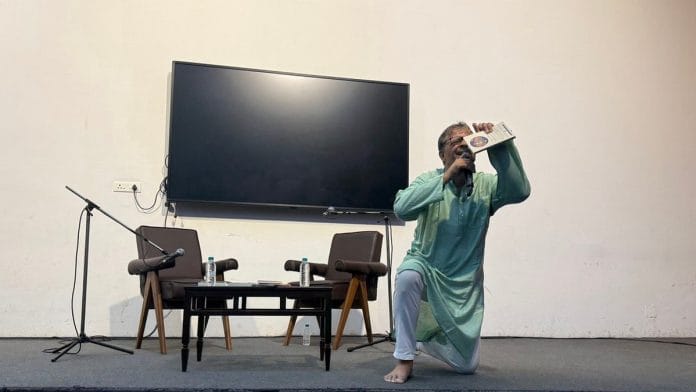


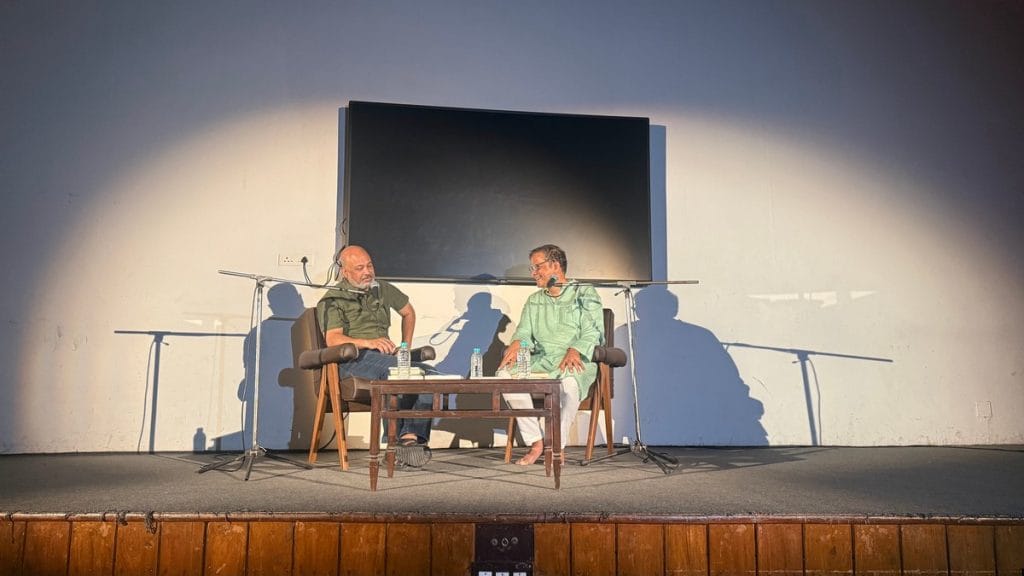
Chandigarh: At 6.30 pm on Sunday, the audience for author Jerry Pinto and publisher Ravi Singh’s event was still waiting outside the Government Museum and Art Gallery in Chandigarh. The electricity was out, and after a brief delay, the evening finally started around 7 pm.
The discussion was formally about Pinto’s book A Good Life: The Power of Palliative Care. But Singh’s questions and Pinto’s answers kept returning to one thing: how to look at another person without reducing them to illness, class, grief, or anecdote.
Once Pinto started speaking, the audience’s restlessness over the delay disappeared. He didn’t follow the template of a typical talk. He did voices and acted out exchanges he’d had over the years. The auditorium was not packed, but Chandigarh’s literary crowd was well-represented.
Pinto traced A Good Life to his friend, painter Mehlli Gobhai, whose will included money for an animal hospital “where he had seen a very happy buffalo once”, and also for children’s charities. The bequest led him to a children’s palliative care unit, where a doctor asked him to fund a librarian. The doctor told him that hospitals like big machines, but children also needed someone to take books and toys to their beds, to make them “happy” and “expectant”.
Pinto recalled being invited to a workshop on washing dead babies ahead of their last rites.
“I thought, ‘No, I don’t think I can do this,’” he said. Then he recognised the fear. “There’s a no that is a very clear no. That’s usually a no that is just a no of fear.”
He walked to the hospital, telling himself, “Jerry, it will be a doll.” It was not. When the baby was placed in his hands, he cried. So did the ayahs, ward boys, doctors, and nurses. An ayah, he said, later asked, “Kitne zulm kiye humne?”—how many sins have we committed? She admitted that she had once washed dead babies by putting water and Dettol in a bucket and shaking them. “Aisa nahi karna chahiye tha hamen (We shouldn’t have done that).”
For Pinto, palliative care extends beyond tending to someone in the final days of life. It means caring for the whole person, including their physical and mental pain. Modern medicine, he said, had become so intent on defeating disease that it forgot suffering.
“You can go through the whole of an MBBS and never hear anything about suffering,” he said.
One of Pinto’s most memorable stories came from Kerala. He spoke of Nagamma, who was caring for four grandsons with a neurological disorder. A family pushed so far that they voted on whether to live or die. Only one boy voted to live, and that vote saved them all. Later, when a doctor found the boys’ heads wounded from hitting a rough wall, the answer was not to move them to a home. It was to pad the wall.
“Sometimes palliative care is a mattress stuck on a wall,” Pinto said. “That’s all it takes: one gesture, one act of kindness that can alleviate years of suffering.”
Also Read: Euthanasia decision opens the conversation about palliative care at Nainital Lit Fest
A ‘khazana’ everywhere
From there, the conversation moved through Pinto’s novels Em and the Big Hoom and The Education of Yuri, his book on the actress Helen, as well as his translations, poetry, and Bombay, Meri Jaan: Writings on Mumbai.
Pinto’s Bombay was where class, language, friendship, embarrassment, and generosity collided at close quarters. It was also where he learnt storytelling’s first discipline: listen long enough and people will give you everything.
“Stories are low-hanging fruit,” he said. “All you have to do is sit down with a person and wait and listen attentively.”
Young people on trains, he said, now cut the world out with earphones, even though “right around you is a khazana, is a library, is an archive of human experience”.
That archive could also be extremely funny. Pinto recalled being in an upper-crust Bombay home, already feeling out of place, when he was offered tea and confronted with an unfamiliar ritual.
“Syrup or liquor?” the hostess said.
“I thought we were having tea,” Pinto replied.
Then came “cream”. Pinto said he did not like cream, so she put it away.
“That’s milk!” he protested.
“It is cream,” she replied.
On stage, he turned the exchange into class comedy without cruelty. “You say ‘cream’, I say ‘milk’. This isn’t going to work,” he said.
Years later, when she heard he had been making “gentle fun” of her, she only asked that he mention the Spode tea set.
At the end, the house lights came on for poetry because Pinto said he needed to see the audience. After an evening of performance, the room became still. He read a poem about trying to get used to one’s body and discovering that even that is not settled.
“I should be able to live in here now,” he read, before reaching the failure built into that hope: “My body in name only. My body that refuses to settle down. My body that will not acknowledge me.”
Pinto ended by asking the audience to be “even awesomer” and buy books. They obliged and crowded around the stage for signatures and photographs.
(Edited by Asavari Singh)