





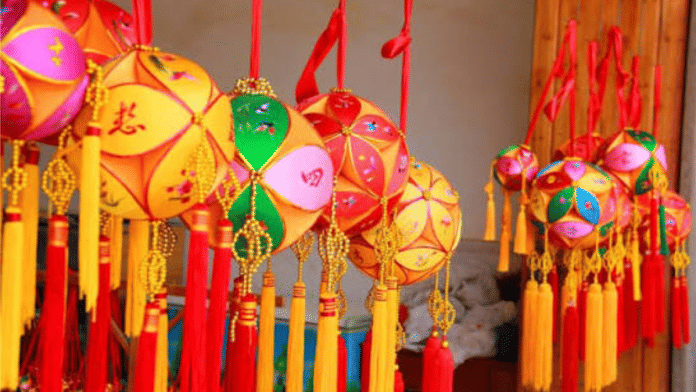


New Delhi: In Chinese period dramas and classic literature, a woman tossing an embroidered ball to choose her future husband may be seen as an established marriage custom. Common for its time, but odd in the modern world. However, this custom is still practised in southern China’s Guangxi Zhuang region.
One of the first widely known depictions of the tradition was in the 16th-century novel Journey to the West. In the Chinese classic, Xuanzang’s father is chosen through such a ball-throwing ritual.
The tradition again gained popularity with the 1998 television drama My Fair Princess, which features a wealthy family whose daughter’s embroidered ball lands with a poor young man, setting off a dispute over their marriage.
But the real tradition behind these stories was considerably less random.
What is the tradition?
The embroidered ball is known as a “xiuqiu”. This ball has long been associated with courtship among the Zhuang. Rather than being thrown indiscriminately from a balcony, the ball traditionally served as a carefully chosen expression of affection between men and women.
The Zhuang are the largest ethnic minority group in Guangxi and account for more than 30 per cent of the region’s population. Their culture has long been shaped by folk songs, festivals and embroidery, with the xiuqiu becoming one of the most recognisable symbols of Zhuang courtship.
The tradition is particularly associated with a festival celebrated on the third day of the third month of the lunar calendar.
The festivities include young men and women traditionally gathering at singing fairs, where they exchange improvised songs in a form of musical courtship.
If a girl develops a liking to a particular young man, she can throw an embroidered ball towards him. If he catches it, he could throw it back with a small gift attached. Acceptance of the gift signals that the woman was willing to pursue the relationship.
Understanding the xiuqiu
The ball itself is an intricate handicraft. Traditionally, it is made from 12 connected, stuffed petal-shaped sections, with colourful silk fabric embroidered with flowers, birds and other auspicious motifs. The dozen petals are sometimes said to represent the months of the year.
The balls were historically stuffed with seeds, grains or rice husks. Today, sawdust and other lighter, glittery materials are commonly used, while some are filled with fragrant herbs.
The origins of the tradition are believed to go back around 2,000 years, although the object did not begin as a romantic token. Historical accounts trace it to an ancient weapon known as “fei tuo”, or a flying weight. The early versions were made from heavier materials, including bronze, and were associated with hunting and warfare.
Over time, the object evolved. It was covered in colourful cloth, filled with grain and eventually transformed into a symbol of prosperity, good fortune and, later, romance.
(Edited by Insha Jalil Waziri)