



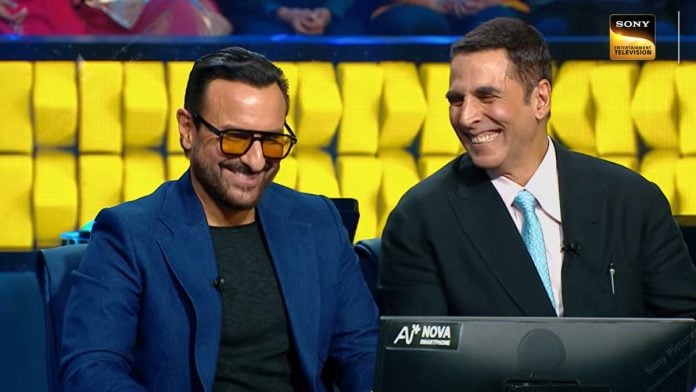
Gowardhan Ghee has transcended from being a kitchen staple to dinner table conversation, and the credit goes to actor Saif Ali Khan. What was just an ordinary product integration on Kaun Banega Crorepati has turned into a pop-culture moment, travelling from television to Netflix and, of course, the internet.
And in the middle of all this is Saif, whose association with the brand has become a case study in how a small moment can become a brand’s biggest marketing win.
It all started in September, when Saif and Akshay Kumar appeared on Kaun Banega Crorepati (KBC), hosted by Amitabh Bachchan, to promote their film Haiwaan. During the episode, Bachchan announced that answering the tenth question correctly had earned them a two-year supply of Gowardhan Ghee.
Saif’s reaction was priceless: “Wow, what?…This is it, this is why I came.” Akshay broke into laughter. Then memes followed, with users calling Saif a “Gen Z born in the wrong era”. The product integration had found its punchline, and Gowardhan had found itself at the centre of an internet joke. It was funny, relatable and, well, quite easy to recall.
Then came Saif’s Instagram debut. Fans flooded his comments with references to the promised ghee, joking that the prize was so exciting it had finally convinced him to join the platform. What began as a television moment was now following the actor into his personal social media space.
But the story still wasn’t finished.
The joke came up on Netflix’s The Great Indian Kapil Show, where Saif appeared with his wife, Kareena Kapoor Khan. Kapil Sharma read out a fan comment about his Instagram debut and the two-year ghee supply. Saif clarified, “I haven’t even received the ghee yet…even my cheque has not come.”
And, after all the chatter, the collaboration of the year finally happened. Saif Ali Khan and Gowardhan Ghee. In an Instagram video, Khan collaborated with the ghee brand urging fans to move past the ghee conversation.
For a brand, that kind of recall is a pretty sweet deal or, in this case, a very ghee-rich one.
Also read: Ethnix took its wedding-season ad out for a spin. Gurugram roads were the canvas
The accidental advertising jackpot
A brand can buy attention, but it cannot simply buy cultural relevance.
Advertising campaigns are typically built around control. Scripts are written, visuals are approved, media plans are mapped, and desired outcomes are carefully documented. The internet, unfortunately for anyone who enjoys a predictable spreadsheet, does not always cooperate.
Hence, in the last five years, very rarely an ad has stayed in public memory.
The marketing lesson here is not that brands should abandon strategy and just be hopeful that something funny happens. It is that the audience’s response can create value far beyond the original execution.
From an advertising perspective, this is a smart opportunity. Rather than inventing an entirely new conversation, the brand can build on an existing one. People who remember the original moment get the satisfaction of recognising the reference.
It can be called ‘remarketing’, except the asset being reactivated isn’t a product, it is a memory.
That said, there is a fine line between joining a joke and trying desperately to manufacture one. Brands that force themselves into every trending conversation risk coming across as an uncle using Gen Z slang at a family wedding.
The reference has to feel natural. The humour has to work. And the brand needs to understand why people remember the moment in the first place.
So, the next time someone says “ghee khatam”, it might be worth remembering that the real marketing win isn’t just about getting people to talk about the product. It is getting them to remember the brand while they do it.
(Edited by Aamaan Alam Khan)