



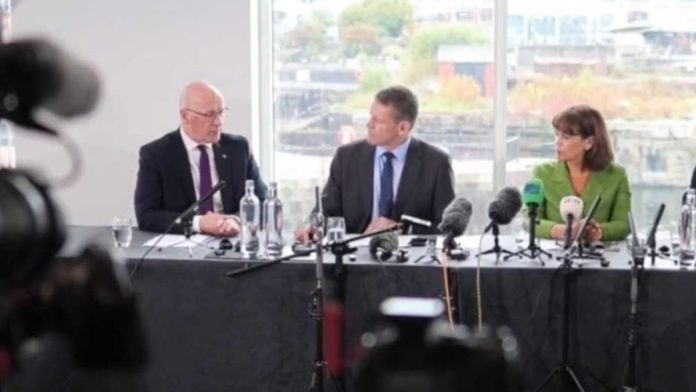

New Delhi: The United Kingdom’s union faces a new challenge after the leaders of Scotland, Wales, and Northern Ireland joined forces to demand the right to decide their own future. The three devolved nations signed a pact on Monday saying their future belongs in the European Union, which sparked a wider debate on social media about splitting the UK.
The memorandum, signed by John Swinney of the Scottish National Party, Rhun ap Iorwerth of Plaid Cymru, and Michelle O’Neill of Sinn Féin on Monday, calls on the British government to prepare for and support constitutional change in the three nations. It is the first time pro-independence parties have led all three devolved administrations simultaneously.
“For people watching across these islands – for people watching around the world – there could be no clearer sign that Westminster’s time is coming to an end,” the memorandum of understanding read.
The agreement does not mean Scotland, Wales or Northern Ireland has already left the UK. Nor does it set dates for independence referendums. Instead, it is a joint political demand that Westminster should not indefinitely delay the question of constitutional change.
The leaders also linked their argument to Europe. The memorandum states that the future of their nations lies in the European Union and calls for cooperation on the economy, energy, jobs, international relations, and self-determination.
“Our nations have the right to self-determination. No Westminster government has the right to block democracy or undermine the principle that our people will decide their own future,” the leaders said.
Also read: Europeans are losing purchasing power by keeping money in banks, says study
‘Westminster’s time is coming to an end’
The Cardiff agreement has been welcomed by nationalists as a historic moment. Supporters say it marks a new alliance among the UK’s smaller nations and gives their movements greater visibility beyond their individual borders.
On X, accounts posted lines from the memorandum, particularly “Westminster’s time is coming to an end” and “the future of our nations belongs in the European Union”. One widely shared trend described the agreement as a “Celtic alliance” and presented it as a route back toward Europe.
Others used humour to imagine the break-up of the UK, with memes depicting England and Westminster as being left with the ‘remaining pieces’ of the nation.
“Also lowkey Cornwall should get independence too. I think it’d be funny. Let’s split the British Isles again,” read one tweet.
Some users questioned whether the three nations could realistically pursue their goals together, given the differences between Scottish independence, Welsh independence, and Irish reunification. “Can those nations stand on their own, maybe probably Scotland. But Wales and Northern Ireland?” one user asked.
Others welcomed the prospect of the UK breaking apart, drawing comparisons with the collapse of the Soviet Union. “Perfect karma against British leaders; they dreamt of a Russian dislocation, working towards WW3. They will only get destruction of the United Kingdom, just like we got USSR dislocation. Hope England, Scotland, Wales and Northern Ireland will be right after that,” an X post read.
One tweet took the argument beyond the three nations, calling for a wider redrawing of the UK’s political map. “Division should be proper; UK muslims didn’t work their arse off to be clubbed with brits; North England should be a secular and most welcoming state; the rest can have their way, and it’s time to give up the UNSC seat,” it read.
(Edited by Aamaan Alam Khan)