





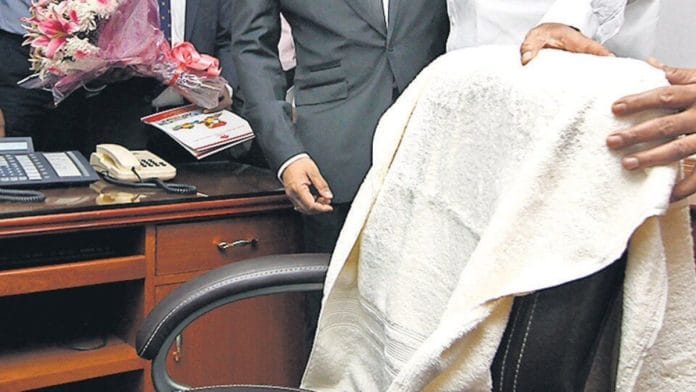


New Delhi: The internet is today baffled about the role of white towels in Indian government offices. The online discourse started with a tweet describing white towels as “ubiquitous symbols of power”.
A user named Ketan shared an anecdote of lawmakers in Uttar Pradesh who allegedly filed a complaint for not being offered chairs draped in white towels. They pointed out that officers were “sitting on tall, betowelled chairs.”
It was a reference to the 2024 emergency video conference called by UP Chief Secretary Manoj Kumar Singh to ensure that administrative protocols regarding towels were followed. According to the government order, MPs, MLAs, and MLCs should be given towel-adorned chairs “of the same height and decor” at meetings across the state.
The Uttar Pradesh secretariat in Lucknow replaces around 1,000 towels twice a week on Monday and Thursday, according to a Hindustan Times report.
And it triggered a wave of reactions with users weighing in on its symbolism and relevance. Even civil servants joined the conversation.
Also read: Erased from Kashmir’s grief—Muslims killed as ‘informers’ lie buried, forgotten for 3 decades
Legacy of the British era
Former civil servant Ashish Joshi termed placing a towel on chairs as “anachronistic” and indicative of a “feudalistic mindset.”
“It was a common practice in the pre-air-conditioned era, primarily to absorb sweat. With almost all government offices, especially those of civil servants, now equipped with air conditioning, this practice has become outdated,” Joshi wrote. “It is now more a reflection of a feudalistic mindset, particularly in states like Uttar Pradesh.”
Gurdeep Singh Sappal of Congress traced its historical origins. Sappal termed white towels as the “legacy of the British era” when roads were fewer, cars were fewer, and there was no air conditioning.
“Officers toured on horses, and towels were an integral part of hygiene routine. The British left, horses were sent away, but the towels stayed! It’s not just towels, the size of tables and colour of ink are also defined by hierarchy.”
Sappal also shared his own experience when he was working at the Joint Secretary level with the Vice President of India. “I had to fight a stiff battle of sorts to order a smaller table that would fit better in my office. The system would not approve of a smaller table.”
The politician also mentioned another anecdote. Sappal referred to a memoir by economist and former minister Arun Shourie on the colour of ink used for notings and signatures.
“In 1999, two officers in the Ministry of Steel made notes on files using red and green ink. This raised a furore as they were junior officers. The seniors were scandalised and an enquiry was initiated,” Sappal’s tweet read. “India’s bureaucracy spent 13 months debating which colour ink officers could use on files.”
In the next chapter of the towels saga, an orange towel has entered the fray. The Chief Minister of Uttar Pradesh, Yogi Adityanath’s chair is not adorned with a white but an orange towel. However, the shift is yet to trickle down to the bureaucratic ranks.
An ex-IPS officer, Yashovardhan Jha Azad, also commented on Sappal’s tweet, calling the practice a “towel legacy.”
“Towels white on chairs, in Ambassador cars, jeeps as if part of uniform. No ACs in the 80s and fans circulating hot air in summer — white towels were the saviour while travelling. Well, some carry the towels now too wrapped behind on the chair or the neck in scorching heat outside. But good old white towels were an integral part of one’s being till the mid-nineties,” his tweet read.
Sappal’s tweet ended by saying, “The white towel on the officer’s chair. The red telephone on the desk. The peon standing at the door. The green ink reserved for the senior sahib. These are not accidents of history. They are architecture, the physical grammar of a bureaucratic culture that worships hierarchy.”
(Edited by Ratan Priya)