



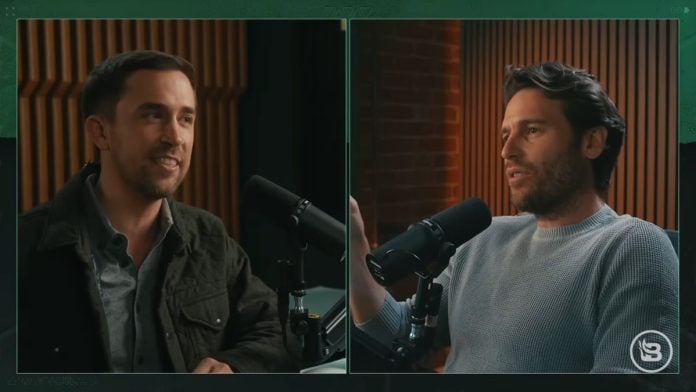
New Delhi: American conservative activist Christopher Rufo and conservative publisher Jonathan Keeperman analysed the “unique case” of Indian immigration to the US.
In the latest episode of Rufo and Lomez, released on 26 September, the two hosts sat down to analyse the cultural, political and demographic tensions surrounding Indian immigration in the US after a racist post on X by Texas Republican candidate Bo French.
The hour-long podcast, titled “The Indian Question”, discusses how Indian immigrants often excel within the existing system in America. The hosts pointed out that immigrants often have high education attainment, low crime, strong family structures and professional success in fields like medicine, tech and law.
“Indian-Americans are a very successful group. I think a group that has and will assimilate rapidly into a professional-managerial culture of the United States. But that’s exactly the rub, because there’s this feeling of–I think it’s in part resentment, in part frustration, in part confusion”, Keeperman said in the podcast.
‘Awful tweet’ and ‘rhetoric is bad’
The hour-long podcast began with Rufo discussing the tweet by French in September. The Republican nominee for Texas Railroad Commissioner posted a photograph of South Asian students celebrating a University of Texas football win over Ohio State on X.
“I heard UT graduation this year looked like this. I didn’t believe it. The problem is now obviously far worse than anyone imagined,” read the caption.
Users on X pointed out that most of the people visible in the video were Indians. His post triggered backlash on social media, with critics accusing him of targeting South Asian students.
Rufo and Lomez took the discussion further, with “anxiety” that is there among everyone and the role of H1B visa.
“I think there is a sense of anxiety. And if we are trying to explain why people are anxious about this, for a couple reasons. One is that there is a sense that the H-1B program is radically unfair because it is a way to bring in cheap technological labor and undercut native-born American wages,” said Keeperman.
He also discussed what he described as discrimination against white students at universities, which he said compounds the anxiety around Indian-Americans’s overrepresentation in elite American institutions. He linked this argument to employment opportunities.
“In the AI era, let’s say, where people are already feeling anxiety about what the future of white collar employment [is], there’s a sense that the number of slots available in elite America is getting smaller and it’s getting more competitive”, he said.
Discussing American culture
Rufo & Lomez is produced by the Blaze Podcast Network and releases several times a week. It is also available on Spotify and other podcast platforms. The hosts often discuss headlines, political developments and modern American culture.
While Keeperman repeatedly returned to what he described as this anxiety, Rufo argued that Indian immigrants represent a relatively recent addition to the US.
“Indians are a unique case. The Black population, for example, has been here for hundreds of years. It’s part of the American story. East Asians have been here for generations and are integrated into the American story. Indians are totally new,” Rufo said.
Rufo drew on his personal experience of travelling in India in his 20s to argue that Indian immigrants in the US are mostly from “upper-caste” backgrounds.
“Indians are especially the upper caste Indians where we’re predominantly kind of skimming from in our immigration system and are very capable of assimilation. And it seems to me like part of the illusion that people are not seeing is that you will see the picture of the Indians and the colorful costumes and native dress,” he said.
“And this is why I think the Indian question scrambles people’s categories because it’s a question of not just race, but actually race is in some ways secondary. It makes it visible but actually I think it is a question of class which hardens over time into cast. And that feeling is that we have you know upper caste Indians. Most Indians that you meet in the United States are upper cast and they’re slotting into an American upper class, right?” he questioned.
Also read: France studying Op Sindoor as it pushes for longer-range air-to-air missile to match China, Russia
Backlash on social media
Rufo opened the podcast by describing the subject as “delicate”, acknowledging the potential for backlash.
Soon after the release, the episode drew criticism on social media, with some users calling it “gross”.
Writer Jeremiah Johnson criticised what he described as the racial framing of the discussion.
“It’s honestly shocking how much of the conversation is just outright admitting it’s a pure racial story and driven by nothing but race. They abandon the idea of high-skill immigrants, they abandon assimilation, they abandon meritocracy, they abandon the idea that we should strive for achievements or growth, all to service the baseline of “I feel icky when I have to see lots of Indians”, he wrote.
US Congressman Raja Krishnamoorthi said the podcast is “fundamentally un-American”.
“Indian Americans are not an “Indian Question” to be solved. Treating any American community as a problem because of their ethnicity is racist, xenophobic, and fundamentally un-American”, he wrote.
Krishnamoorthi argued that America is a nation born of “ideals and not bloodlines”.
“No race, religion, or ancestry has a greater claim to America than another. Indian Americans are as American as anyone. This country belongs to all of us”, he wrote.