



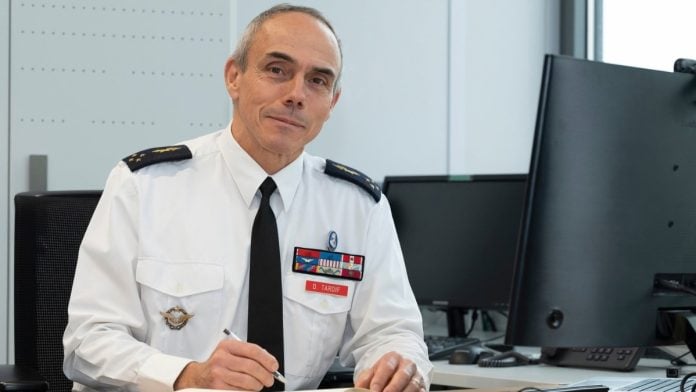
New Delhi: The French Air and Space Force is pushing for a longer-range air-to-air missile to match Chinese and Russian systems and is studying the Indian Air Force’s experience in Operation Sindoor, said the force’s Vice Chief, Lieutenant General Dominique Tardif.
Tardif, who is in India for the second edition of the IAF’s multinational air combat exercise Tarang Shakti in Jodhpur, made the remarks on Monday in response to queries from ThePrint during a briefing for select journalists. The French deployment includes Rafale fighters as part of Mission Pégase 2026, a long-range air-power projection mission.
Tardif also indicated an openness to discussions with India on the future of sixth-generation air combat systems, but stopped short of saying the two countries could collaborate on the Future Combat Air System (FCAS).
Also Read: C-130J-30 vs C-390: Lockheed lays out its case for India’s medium transport aircraft deal
MBDA to develop long-range missiles
Tardif said France was closely monitoring the development of long-range air-to-air missiles by other countries and was already working with leading European missile maker MBDA to increase the range and performance of its air-to-air weapons to match Chinese and Russian systems such as the PL-15 and R-37.
“We are observing the evolution of missiles in different nations. This is something we are closely following in France, and we are discussing it with MBDA,” Tardif said, adding, “MBDA is also working to develop the missile we need in terms of range. There is no question about that.”
The remarks are significant because the European Meteor, currently operated by the IAF, French Air and Space Force and other European air forces, is widely regarded as one of the most capable beyond-visual-range air-to-air missiles in service. However, its effective range is said to be around 150km, compared with more than 300km for some Chinese, Russian and US missiles.
Thanks to China’s exports, even Pakistan operates an air-to-air missile with a range exceeding that of the Meteor.
Tardif did not specify the intended range or timeline for the new weapon, saying France had put “very big pressure” on MBDA to develop and produce it rapidly. “I can’t answer, for the moment, your question [on range], but we have put very big pressure on the firm, MBDA, in order to design and produce that very rapidly,” he said.
He suggested the new weapon could build on existing technologies rather than require an entirely new missile architecture. “We have designs like the new-generation MICA. We can also combine these technologies to achieve a greater range. It’s not a major revolution in terms of future design. I have no worries about that,” Tardif said. The MICA is a French short-to-medium-range, all-weather, air-to-air missile manufactured by MBDA.
Sindoor lessons being studied
Tardif said France was studying India’s experience during Operation Sindoor, particularly because of the scale and complexity of the air operations involved.
“I think we haven’t seen something like this since, perhaps, World War II. So the Indian Air Force has something very interesting,” Tardif said, referring to the number of aircraft operating in the same battlespace during the operation.
He said the French Air and Space Force was discussing lessons from the operation with the IAF, although the extent of information that could be exchanged was naturally limited by operational sensitivities.
“We are also to analyse what has been done, and it’s a long way, because you need to have all the different records of the different systems, to analyse, to understand, because you can’t draw rapid lessons. It takes time to analyse,” he said.
“So, yes, we have had some discussion with the Indian Air Force in order to share what they can share, because there are some questions that are very sensitive. It’s a question for the Indian Air Force. But for sure, this is something very interesting for all the different air forces,” Tardif added.
India-France discussions on 6th-gen air combat system
Tardif also said India and France could discuss the future of sixth-generation air combat, describing it as a broader combat system rather than simply a new fighter aircraft.
“When we speak about the sixth generation, it’s not about a sixth-generation platform; it’s a sixth-generation air combat system,” he said.
He said such a system would combine manned fighter aircraft with unmanned platforms and other sensors, allowing them to operate as part of a highly connected combat architecture.
“A new platform, with a pilot on board. But not only that. We also need drones,” he said.
The challenge, he said, would be to enable fighter aircraft, drones, satellites and other sensors to share information and operate together even in heavily contested electromagnetic environments.
Tardif said India and France had similar approaches to the future of air warfare.
“I understand that the Indian Air Force is also taking a lot of (interest in) the future. And I am sure that we are two very dedicated air forces… So we have the same mindset when it comes to thinking about the future,” he said.
Asked whether this could translate into collaboration on a sixth-generation programme, Tardif said it was too early to discuss a specific project, but indicated that the two countries could continue discussions.
“It’s too early, but what I can say to you is that we have the same mindset when it comes to thinking about the future,” he said.
His comments come at a significant moment for Europe’s sixth-generation fighter programme. France and Germany abandoned their joint path on the Future Combat Air System (FCAS) in June this year after years of disagreements over industrial leadership and workshare.
India has separately indicated that it has initiated efforts to join the French-led FCAS effort. ThePrint was the first to report in February this year that India and France were in talks over possible collaboration on the FCAS project.
(Edited by Chingkheinganbi Mayengbam)